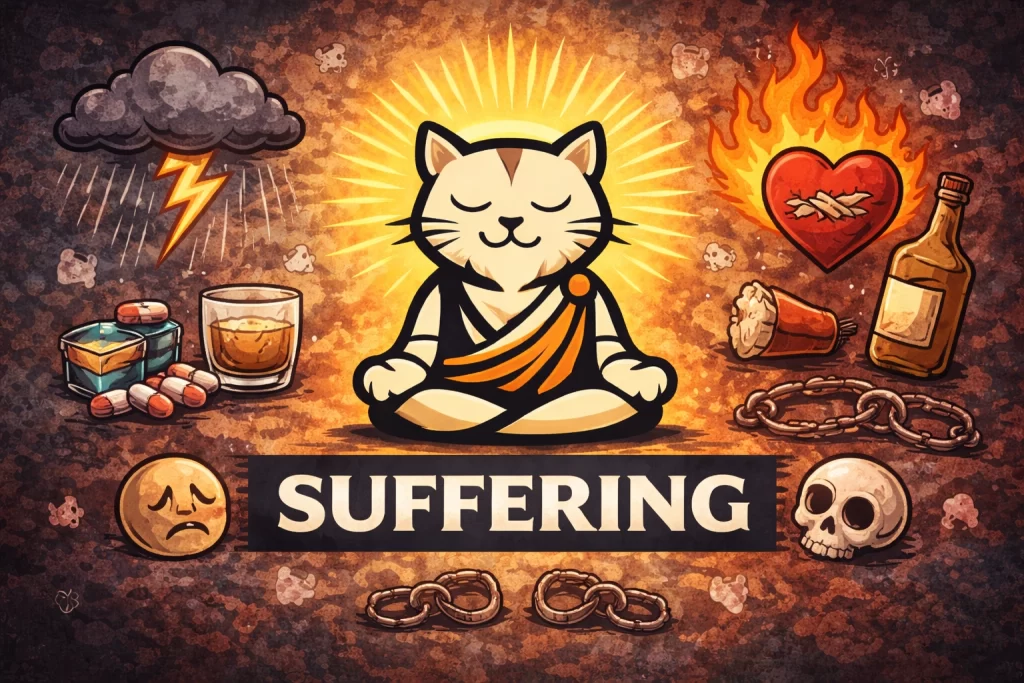
Suffering is one of the most inescapable dimensions of human existence. It appears in physical pain, emotional loss, disappointment, anxiety, injustice, and mortality itself. It interrupts plans, reshapes identities, and forces questions that comfort rarely provokes. To reflect on suffering is not merely to dwell on hardship, but to examine a force that has shaped individuals, cultures, religions, and philosophies throughout history.
At the most basic level, suffering arises from vulnerability. To have a body is to be susceptible to injury and illness, to have attachments is to risk loss, to have desires is to face frustration. Wherever there is dependence—on health, on relationships, on circumstances—there is the possibility of disruption. Suffering is not an anomaly in life; it is woven into its conditions. Change guarantees it. Impermanence ensures it.
Biologically, certain forms of suffering have purpose. Physical pain protects the organism, signaling danger and demanding care. Emotional distress can function similarly. Fear heightens alertness; guilt can encourage repair; loneliness drives reconnection. In these cases, suffering acts as information. It points toward imbalance or threat. Without such signals, survival and social cohesion would falter.
Yet much suffering exceeds simple utility. Chronic illness, grief that lingers for years, existential despair—these do not always resolve into lessons or advantages. They can feel senseless, disproportionate, or cruel. This excess is what makes suffering philosophically urgent. It challenges the belief that the world is neatly ordered for human well-being. It exposes the fragility of meaning and the limits of control.
At the same time, suffering often deepens perception. Those who endure hardship frequently report greater empathy, patience, or clarity about what matters. Struggle can strip away illusions, revealing priorities previously obscured by comfort. In this way, suffering can function as a kind of refinement. It tests convictions, exposes dependencies, and invites transformation. This does not romanticize pain; rather, it acknowledges that adversity sometimes expands inner life.
Religions and philosophical traditions have responded to suffering in varied ways. Some interpret it as a consequence of desire, attachment, or ignorance; others see it as a test, a punishment, or an inevitable feature of a finite world. Still others reject metaphysical explanations and focus instead on practical responses: reducing harm, cultivating resilience, fostering compassion. Across these perspectives runs a shared recognition that suffering is central to the human condition.
Importantly, suffering also binds people together. Shared hardship can dissolve superficial differences and awaken solidarity. Compassion arises from the recognition that others hurt as we do. Without suffering, empathy would lack depth. The awareness of vulnerability—our own and others’—grounds moral concern.
Ultimately, suffering resists simple answers. It is both destructive and revealing, isolating and unifying. It can embitter or mature, close the heart or open it. While we cannot eliminate suffering from life, we can shape our response to it. We can meet it with denial, resentment, and fear—or with courage, patience, and care.
To live is to encounter suffering. But within that encounter lies a choice: not whether it exists, but how we carry it, what we learn from it, and whether we allow it to narrow our humanity or deepen it.