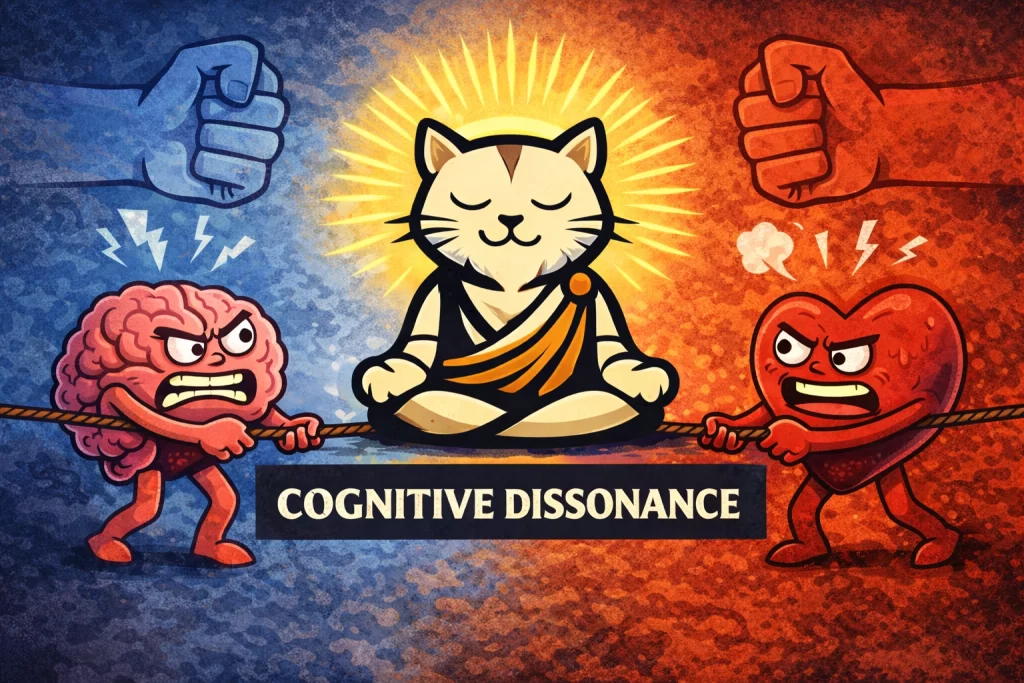
Cognitive dissonance is the uneasy tension that arises when our beliefs, values, or self-image conflict with our actions or new information. It is not merely a logical inconsistency; it is a psychological discomfort—sometimes subtle, sometimes intense—that demands resolution. The mind prefers coherence. When coherence fractures, we feel it.
The term was introduced by social psychologist Leon Festinger in 1957. He proposed that individuals are motivated to reduce internal inconsistency because inconsistency produces mental strain. If someone believes they value health but smokes cigarettes, or sees themselves as honest yet tells a lie, a gap opens between identity and behavior. That gap is dissonance.
What makes cognitive dissonance powerful is that people often resolve it not by changing their behavior, but by adjusting their beliefs. A smoker might downplay the health risks. A person who cheats might redefine the act as justified. Rather than admit “I acted against my values,” the mind quietly shifts the values to protect the self. In this way, cognitive dissonance reveals how deeply invested we are in maintaining a stable self-concept.
Dissonance also explains why contradictory evidence can strengthen, rather than weaken, existing beliefs. When confronted with information that challenges a worldview—political, religious, or personal—people may dismiss the source, reinterpret the data, or double down on their original stance. Accepting the contradiction would require revising identity, community ties, or long-held assumptions. The psychological cost can feel too high.
Yet cognitive dissonance is not merely a flaw; it can also be a catalyst for growth. When the discomfort is acknowledged rather than denied, it prompts reflection. A person who notices the tension between stated values and lived behavior might change course. Someone confronted with compelling new evidence may revise beliefs in light of it. In this constructive form, dissonance becomes a force for integrity—pushing individuals toward alignment between what they think, say, and do.
Modern life intensifies cognitive dissonance. Social media exposes us to competing narratives, moral contradictions, and curated identities. We may present ourselves one way online while feeling differently offline. We may endorse principles publicly yet compromise them privately. The gap between ideal and reality widens, and with it, the potential for internal strain.
At its core, cognitive dissonance reflects the human need for consistency and meaning. We want our story about ourselves to make sense. When it does not, discomfort arises. The question is how we respond: by distorting reality to preserve comfort, or by reshaping ourselves to restore coherence.
In this sense, cognitive dissonance is a mirror. It reveals where we are divided. It shows where our actions fall short of our aspirations or where our beliefs resist evidence. Though uncomfortable, it signals an opportunity—to become more honest, more integrated, and perhaps more free.