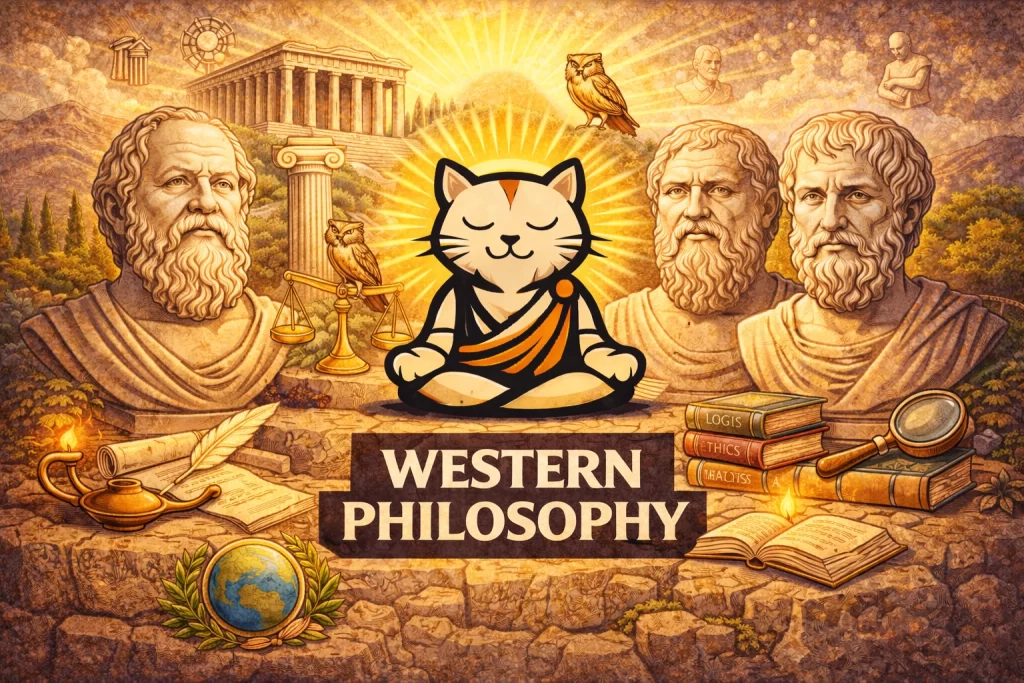
Western philosophy begins in ancient Greece in the sixth century BCE, where thinkers first attempted to explain the world through reason rather than myth. Early figures such as Thales of Miletus and Heraclitus asked what the fundamental substance of reality might be. Their inquiries marked a decisive shift from poetic cosmology to rational investigation.
The classical period brought philosophy to maturity through the work of Socrates, Plato, and Aristotle. Socrates redirected philosophy toward ethical examination and intellectual humility. Plato articulated sweeping metaphysical and political theories in works such as The Republic, while Aristotle systematized logic, biology, metaphysics, and ethics, establishing frameworks that shaped inquiry for centuries.
As Greek thought spread through the Roman world, philosophical schools such as Stoicism and Epicureanism offered practical guidance for living. Later, early Christian thinkers incorporated classical philosophy into theology. Augustine of Hippo adapted Platonic ideas to Christian doctrine, and Thomas Aquinas synthesized Aristotelian philosophy with medieval theology. The medieval era preserved ancient knowledge while transforming it within religious contexts.
The Rise of Modern Thought
The Renaissance and early modern period marked a profound shift. Scientific discoveries unsettled traditional authorities, prompting philosophers to seek new foundations for knowledge. René Descartes began with radical doubt, searching for certainty in self-awareness. John Locke and David Hume emphasized experience as the source of knowledge. In response, Immanuel Kant argued that the mind actively structures experience, reshaping metaphysics and ethics.
The Enlightenment extended philosophical inquiry into politics and rights. Thinkers such as Jean-Jacques Rousseau and Montesquieu influenced democratic theory and constitutional design. Philosophy increasingly engaged with emerging sciences, economics, and social reform.
Nineteenth-Century Transformations
The nineteenth century witnessed dramatic expansion and critique within Western philosophy. Georg Wilhelm Friedrich Hegel proposed that history unfolds through dialectical processes of conflict and synthesis. Karl Marx transformed Hegel’s dialectic into a materialist analysis of class struggle and economic structures. Philosophy became inseparable from political revolution and social critique.
Meanwhile, Søren Kierkegaard emphasized individual faith and subjective experience, laying foundations for existentialism. Friedrich Nietzsche launched a radical critique of morality, religion, and truth itself, challenging Western assumptions about objectivity and value. These thinkers shifted philosophy’s focus toward history, power, individuality, and the psychological dimensions of belief.
Twentieth-Century Diversification
In the twentieth century, Western philosophy fragmented into diverse movements. Analytic philosophy, influenced by developments in logic and language, sought clarity and precision. Figures such as Bertrand Russell and Ludwig Wittgenstein examined the structure of language and its limits.
At the same time, continental philosophy explored existence, consciousness, and culture. Martin Heidegger investigated the meaning of being, while Jean-Paul Sartre and Simone de Beauvoir developed existentialist and feminist perspectives. Critical theorists analyzed power, ideology, and modern society, extending philosophy into cultural critique.
Philosophy also engaged deeply with science. Debates over the philosophy of mind, artificial intelligence, and the nature of scientific explanation became central topics, reflecting rapid technological advancement.
Core Themes and Continuing Influence
Despite its variety, Western philosophy remains unified by enduring questions: What is real? How can we know it? What is right? What is justice? Across centuries, thinkers have disagreed sharply, yet they share a commitment to rational argument and critical reflection.
Western philosophy has profoundly shaped legal systems, political institutions, scientific methodology, and ethical discourse. Concepts such as human rights, democracy, and individual liberty are rooted in philosophical development. At the same time, contemporary philosophy increasingly engages in dialogue with non-Western traditions, recognizing the importance of global perspectives.
Ultimately, Western philosophy is not a fixed doctrine but an evolving conversation. It stretches from ancient Athens to modern universities, from metaphysical speculation to social activism. Its enduring power lies in its insistence that human beings can question, reason, and refine their understanding of the world—and in doing so, shape both thought and society.