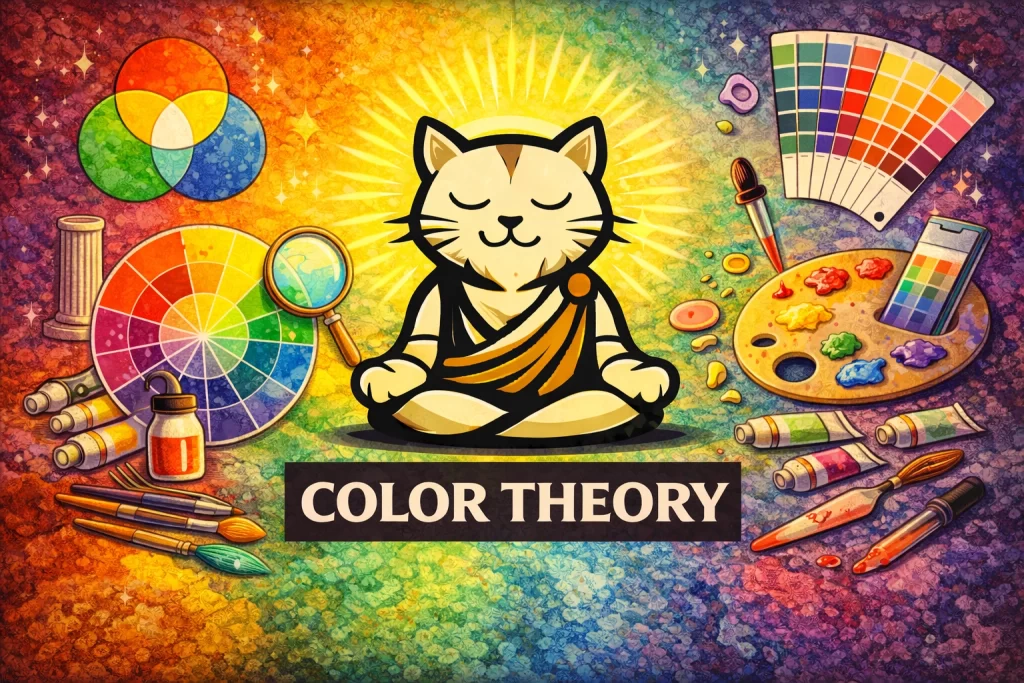
Color theory is the study of how colors interact, combine, and influence perception. It bridges science and art, uniting physics, psychology, biology, and design into a framework that helps explain why certain color combinations feel harmonious while others create tension. From painting and branding to film, architecture, and digital interfaces, color theory shapes how we interpret and emotionally respond to the visual world.
At its foundation, color theory rests on two pillars: the physics of light and the biology of perception. Light consists of electromagnetic waves of varying wavelengths. When light strikes an object, certain wavelengths are absorbed and others are reflected. The reflected wavelengths are interpreted by the human eye as color. The brain then processes these signals, constructing what we experience as a coherent visual reality.
The Color Wheel and Harmony
One of the most influential tools in color theory is the color wheel, first systematically developed by Isaac Newton in the seventeenth century. By passing white light through a prism, Newton demonstrated that it separates into a spectrum. He arranged these hues in a circular diagram to illustrate their relationships.
In traditional subtractive color theory (used in painting), the primary colors are red, blue, and yellow. Mixing these produces secondary colors: orange, green, and purple. Tertiary colors arise from mixing primary and secondary hues. Artists use these relationships to create harmony and contrast.
Complementary colors—located opposite each other on the wheel—generate strong visual contrast (such as blue and orange). Analogous colors—adjacent on the wheel—produce smoother, more cohesive compositions. Triadic schemes, built from three evenly spaced colors, offer balance and vibrancy.
In digital media, the additive RGB model (red, green, blue) governs screens, while the CMYK model (cyan, magenta, yellow, black) is used in print. Understanding these systems ensures accurate color reproduction across platforms.
The Psychology of Color
Color does not merely describe the world; it influences how we feel within it. Warm hues such as red and orange often evoke energy, urgency, or passion, while cooler tones like blue and green suggest calmness or reliability. However, these associations are influenced by both biology and culture.
Psychological research provides measurable evidence of color’s influence. A well-known study by Andrew Elliot and colleagues found that exposure to the color red before an exam negatively affected performance, possibly because red is subconsciously associated with danger or failure. Another experiment published in Science (2009) demonstrated that athletes wearing red uniforms were statistically more likely to win in certain competitive sports, suggesting color may subtly influence perception of dominance.
In marketing research, studies have shown that color significantly impacts purchasing decisions. Some analyses suggest that up to 85% of consumers cite color as a primary reason for buying a product. Blue is frequently used in financial branding to signal trust, while red is often used in clearance sales to stimulate urgency.
Yet color perception is not universal. Cultural context shapes meaning. In many Western cultures, white symbolizes purity; in parts of East Asia, it is associated with mourning. Effective design must account for these contextual differences.
Color Perception and Vision Science
Human color perception depends on specialized cells in the retina known as cones. Most people possess three types of cones, sensitive to red, green, and blue wavelengths. This trichromatic system allows the brain to construct millions of color variations.
Scientific research has explored how context influences color perception. A famous example is “The Dress” phenomenon (2015), in which viewers disagreed over whether a photographed dress was blue and black or white and gold. The debate highlighted how assumptions about lighting conditions can dramatically alter color interpretation.
Color constancy—the brain’s ability to perceive colors consistently under changing light—is another crucial concept. Studies in vision science show that the brain automatically adjusts for lighting shifts, maintaining stable perception. This explains why a red apple appears red in both sunlight and indoor lighting, even though the wavelengths reflected differ.
Color blindness (more accurately, color vision deficiency) provides additional insight into perception. Individuals with red-green color blindness experience difficulty distinguishing certain hues, reminding designers of the importance of contrast and accessibility.
Color in Art, Film, and Modern Design
Throughout history, artists have used color to evoke emotion and symbolic meaning. Renaissance painters manipulated light and shadow to create depth. Impressionists used complementary contrasts to capture fleeting light. In the twentieth century, artists such as Wassily Kandinsky treated color as an independent expressive force, believing hues could convey spiritual resonance without representational form.
In film, directors use color grading to reinforce narrative tone. Cool blue palettes often signal isolation or dystopia, while warm amber tones suggest nostalgia or intimacy. In contemporary interface design, color guides user attention, communicates hierarchy, and enhances usability.
Accessibility research has also shaped modern color application. The Web Content Accessibility Guidelines (WCAG) recommend specific contrast ratios to ensure readability for users with visual impairments. This demonstrates that color theory is not merely aesthetic but functional.
Emotional and Cognitive Impact
Recent neuroscience research indicates that color influences not only mood but also cognitive processing. Studies suggest that blue environments may enhance creative thinking, while red environments may improve attention to detail. Such findings have implications for educational spaces, workplace design, and digital environments.
Hospitals often use soft greens and blues to create calming atmospheres, reducing patient stress. In urban planning, color can influence perceived safety and community identity. Even dietary research shows that plate color can affect perceived taste and portion size.
These examples underscore a central insight: color shapes behavior subtly yet consistently. It affects attention, memory, appetite, and emotional state, often without conscious awareness.
Conclusion
Color theory is far more than a painter’s tool—it is a multidisciplinary framework connecting physics, biology, psychology, and design. It explains how wavelengths become sensations, how combinations create harmony, and how visual cues shape emotion and decision-making.
By studying color theory, artists and designers gain control over visual communication. By studying color science, researchers gain insight into perception itself. Ultimately, color theory reveals that what we see is not simply light reflected from objects—it is a collaboration between the external world and the human mind.