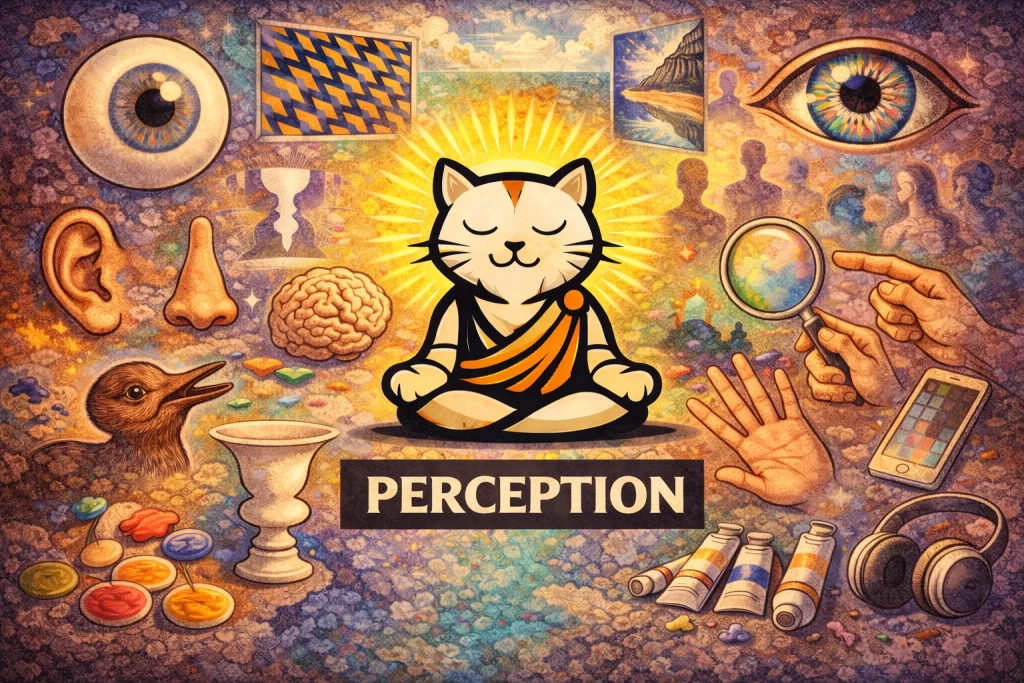
Perception is the process through which the brain organizes and interprets sensory information to produce a meaningful experience of the world. It is not a passive recording device but an active system of interpretation. What we see, hear, taste, and feel is filtered through neural mechanisms, shaped by prior experience, and guided by expectation. In this sense, perception is less like a camera and more like a constantly updating model of reality.
From a biological standpoint, perception begins with sensation. Light stimulates photoreceptors in the retina, sound waves activate hair cells in the inner ear, and chemical molecules bind to receptors in the nose and tongue. These signals travel to the brain, where specialized regions process them. Yet perception does not end at sensation. The brain integrates fragments of information into coherent patterns, often adding assumptions and predictions along the way.
The Brain as a Predictive System
Modern neuroscience increasingly supports the idea that perception is predictive. Rather than waiting passively for data, the brain generates expectations about what it is likely to encounter. Incoming sensory input is then compared to these predictions. When discrepancies arise, the brain adjusts its model.
Research by neuroscientist Karl Friston has advanced the “predictive coding” framework, suggesting that the brain constantly minimizes prediction error. This explains why familiar environments feel stable and why surprises capture attention—they violate expectation.
Optical illusions provide powerful demonstrations of this principle. In the Müller-Lyer illusion, lines with outward or inward arrowheads appear different in length despite being equal. The brain interprets the angles as depth cues, altering perceived size. Another famous example is “The Dress” phenomenon (2015), in which viewers disagreed over whether a dress was blue and black or white and gold. A study published in Current Biology found that individual differences in assumptions about lighting conditions influenced perception. These examples reveal that perception depends as much on inference as on raw data.
Gestalt Principles and Pattern Recognition
In the early twentieth century, Gestalt psychologists such as Max Wertheimer proposed that perception is organized according to innate grouping principles. Rather than perceiving isolated elements, we perceive structured wholes. Principles such as proximity (objects near each other are grouped together), similarity (similar items are perceived as related), and closure (the mind fills in missing information) describe how we organize visual scenes.
A classic study demonstrated the phi phenomenon, in which two flashing lights placed side by side create the illusion of motion. The brain interprets sequential stimuli as continuous movement. This discovery laid groundwork for film and animation, where motion is created from rapidly presented still images.
These principles extend beyond vision. In auditory perception, the brain groups sounds into patterns, allowing us to distinguish a melody from background noise. This capacity is essential for speech recognition, especially in noisy environments.
Perception, Attention, and Cognitive Limits
Perception is limited by attention. We do not process every detail of our environment; instead, we selectively focus on what seems relevant. Psychologists Daniel Simons and Christopher Chabris demonstrated this in their famous “Invisible Gorilla” experiment. Participants watching a video of people passing basketballs were asked to count passes. Many failed to notice a person in a gorilla suit walking through the scene. This phenomenon, known as inattentional blindness, illustrates how focused attention can cause us to miss unexpected events.
Another limitation is change blindness—the failure to detect significant changes in a visual scene. Studies show that even large alterations can go unnoticed when attention is diverted. These findings challenge the assumption that perception offers a complete and accurate picture of reality.
Social and Cultural Dimensions of Perception
Perception is not purely sensory; it is shaped by culture, language, and belief. Social psychologists have shown that expectations influence what we see. In one study, participants who were primed with certain stereotypes were more likely to interpret ambiguous behavior in line with those expectations. This suggests that perception can be filtered through implicit bias.
Cross-cultural research also reveals differences in visual perception. Studies comparing Western and East Asian participants have found that Western observers tend to focus on central objects, while East Asian observers attend more to background context. Such findings suggest that cultural experience shapes attentional habits.
Philosophically, thinkers such as Immanuel Kant argued that the mind structures experience according to categories like space and time. We do not perceive the “thing-in-itself,” but rather the world as filtered through cognitive frameworks. Modern philosophy of mind continues to debate how subjective experience arises from neural processes.
Perception and Reality
Perception guides every decision we make—from crossing a street to interpreting a facial expression. Yet it is neither infallible nor objective. It is a dynamic interaction between external stimuli and internal interpretation. This does not mean that reality is purely subjective, but it does mean that our access to it is mediated.
Understanding perception fosters intellectual humility. It reminds us that what feels obvious may be constructed, that disagreements may arise from differing interpretations rather than differing facts, and that awareness is selective rather than total.
In the end, perception is the mind’s attempt to make sense of a complex world. It blends biology, prediction, attention, culture, and experience into a seamless narrative we call reality. By studying how perception works—and where it fails—we gain insight not only into the world around us, but into the hidden processes that shape our experience of it.