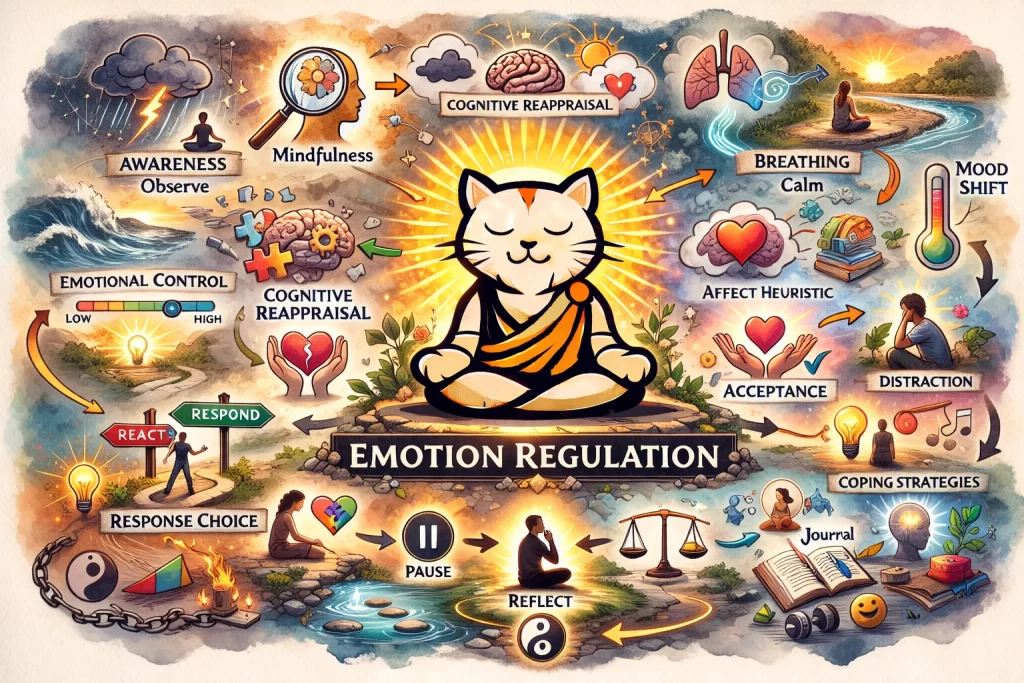
Emotion regulation refers to the processes by which individuals influence which emotions they experience, when they experience them, and how they express them. Rather than suppressing emotion entirely, regulation involves managing emotional responses in adaptive ways. It plays a crucial role in mental health, relationships, decision-making, and resilience.
Psychologists view emotion regulation as both conscious and unconscious. Sometimes we deliberately calm ourselves before a presentation; other times our minds automatically adjust emotional intensity without awareness. Research over the past several decades has identified distinct strategies and neural mechanisms underlying these processes.
The Process Model of Emotion Regulation
One of the most influential frameworks was developed by James Gross. His process model distinguishes between strategies used before an emotional response fully unfolds and those used after it has already emerged.
Antecedent-focused strategies include situation selection (avoiding a stressful event), situation modification (changing aspects of it), attentional deployment (distraction), and cognitive reappraisal (reinterpreting the meaning of a situation). Response-focused strategies, such as expressive suppression, occur after the emotion has been generated.
In laboratory studies, Gross demonstrated that participants instructed to use cognitive reappraisal while viewing distressing images reported reduced negative emotion and showed lower physiological arousal compared to those instructed to suppress their expressions. Suppression reduced outward signs of emotion but increased internal stress markers, suggesting it may be less adaptive over time.
Neural Mechanisms of Regulation
Neuroscience has revealed that emotion regulation involves interaction between the prefrontal cortex and limbic regions such as the amygdala. The amygdala rapidly detects emotionally salient stimuli, particularly threats, while the prefrontal cortex supports evaluation and control.
Functional MRI studies show that cognitive reappraisal increases activity in prefrontal regions associated with executive function and decreases activation in the amygdala. This suggests top-down regulation, where higher-order cognitive systems modulate emotional responses.
Research by Kevin Ochsner has demonstrated that individuals who are more effective at reappraisal show stronger connectivity between these regulatory networks. These findings highlight that emotion regulation is both psychological and biological.
Emotion Regulation and Mental Health
Difficulties in emotion regulation are linked to various mental health conditions, including anxiety disorders, depression, and borderline personality disorder. Studies show that individuals prone to rumination—repetitive negative thinking—experience prolonged emotional distress.
Dialectical Behavior Therapy (DBT), developed by Marsha Linehan, specifically targets emotion regulation skills. Clinical trials have shown that DBT reduces self-harm and improves emotional stability in individuals with severe emotional dysregulation.
Similarly, mindfulness-based interventions have been shown to enhance emotional awareness and reduce reactivity. Experimental research indicates that participants who undergo mindfulness training demonstrate improved attentional control and reduced amygdala activation in response to stress.
Social and Developmental Influences
Emotion regulation develops across childhood and adolescence. Early caregiver interactions play a crucial role. Studies show that children whose parents model adaptive coping strategies are more likely to develop effective regulation skills.
The famous “marshmallow test,” conducted by Walter Mischel, examined delayed gratification in children. Those who successfully delayed eating a marshmallow for a larger reward later tended to show better academic and life outcomes. Follow-up research suggested that the ability to regulate impulses is shaped by both environment and trust in caregivers.
Cultural norms also shape regulation strategies. Some cultures emphasize emotional restraint, while others encourage open expression. These norms influence how individuals manage anger, sadness, and joy.
Conclusion
Emotion regulation is not about eliminating feelings but guiding them constructively. Study examples—from James Gross’s reappraisal experiments to mindfulness research and the marshmallow test—demonstrate that regulation involves cognitive strategies, neural mechanisms, and social influences.
Effective regulation supports psychological well-being, improves relationships, and enhances resilience under stress. As research continues to integrate psychology and neuroscience, emotion regulation emerges as a central skill for navigating the complexities of human life.