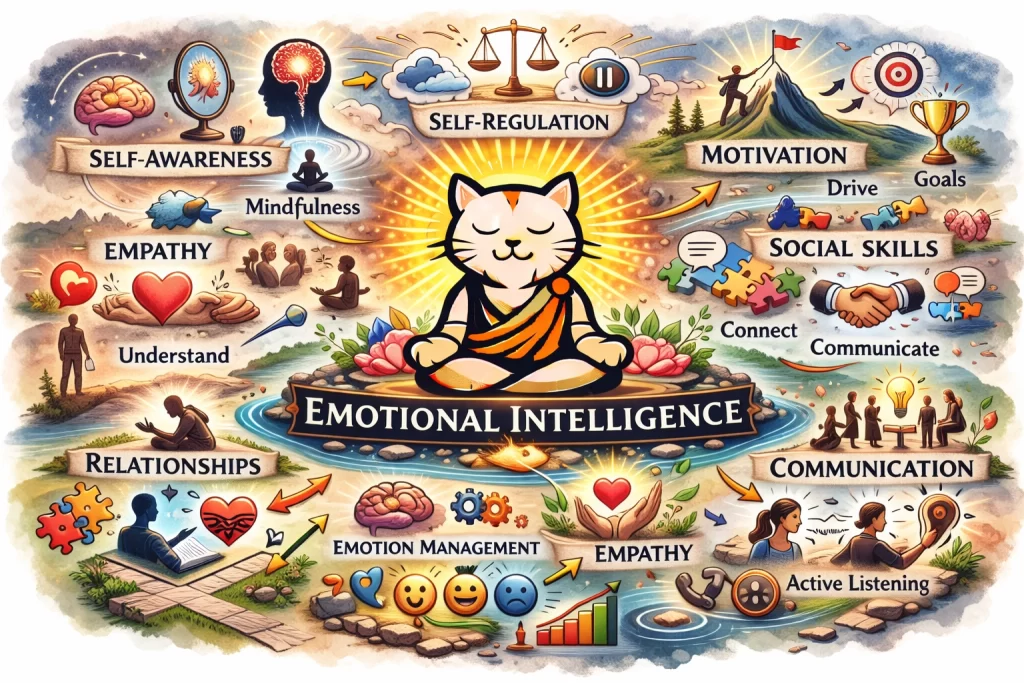
Emotional intelligence (EI) refers to the ability to perceive, understand, manage, and use emotions effectively in oneself and others. While traditional models of intelligence emphasize reasoning and problem-solving, emotional intelligence highlights the role of emotional awareness and regulation in personal and social success. It bridges cognition and emotion, suggesting that intelligence is not only about thinking clearly but also about feeling wisely.
Over the past few decades, emotional intelligence has become a major topic in psychology, education, and organizational research. Though definitions vary, most models converge on four core abilities: perceiving emotions, understanding emotions, regulating emotions, and using emotions to guide thinking and behavior.
Theoretical Foundations of Emotional Intelligence
The modern concept of emotional intelligence was formalized by Peter Salovey and John D. Mayer in the early 1990s. They proposed the “ability model” of EI, defining it as a set of measurable cognitive skills related to emotional processing.
Later, Daniel Goleman popularized the concept in his book Emotional Intelligence (1995), arguing that EI may predict life success more strongly than IQ. Goleman’s framework expanded EI to include motivation, empathy, and social skills.
Empirical research supports parts of these claims. Studies using the Mayer-Salovey-Caruso Emotional Intelligence Test (MSCEIT) measure how well individuals identify emotions in facial expressions and manage emotionally charged situations. Results often show correlations between higher EI scores and better interpersonal functioning.
Emotional Intelligence and Decision-Making
Emotions influence judgment and choice, and individuals with higher emotional intelligence tend to navigate these influences more effectively. Research by Antonio Damasio on patients with damage to emotion-processing areas revealed that impaired emotional signaling can disrupt decision-making, even when logical reasoning remains intact.
Experimental studies show that individuals high in EI are better at regulating mood before important tasks, which can enhance performance. For example, participants with higher emotional regulation skills demonstrate lower physiological stress responses during public speaking tasks.
In organizational settings, research suggests that leaders with strong emotional intelligence foster better teamwork and employee satisfaction. Studies in workplace psychology indicate that managers who accurately perceive employee emotions tend to resolve conflicts more effectively.
Emotional Intelligence and Social Relationships
Empathy—a key component of EI—facilitates understanding others’ feelings and perspectives. Studies show that individuals scoring higher on emotional perception tasks are more accurate in interpreting facial expressions and tone of voice.
Research on marital satisfaction has found that couples who effectively regulate emotions during conflict are more likely to maintain stable relationships. Emotionally intelligent individuals tend to use constructive communication strategies rather than escalating disputes.
Developmental research further indicates that children who demonstrate strong emotional regulation and empathy skills show better peer relationships and academic outcomes. Social-emotional learning (SEL) programs implemented in schools have been shown to improve classroom behavior and reduce aggression, highlighting the practical value of EI training.
Criticisms and Ongoing Research
Despite its popularity, emotional intelligence remains debated. Critics argue that some models overlap significantly with personality traits, such as agreeableness or conscientiousness. Others question whether EI is truly distinct from general intelligence.
Meta-analyses suggest that ability-based measures of EI show modest but consistent relationships with social functioning. Ongoing research seeks to clarify how emotional intelligence interacts with cognitive ability, personality, and cultural factors.
Neuroscientific studies are also exploring the biological basis of EI. Brain imaging research indicates that regions such as the prefrontal cortex and amygdala play roles in emotional awareness and regulation, supporting the idea that EI reflects measurable neural processes.
Conclusion
Emotional intelligence highlights the essential role of emotion in human functioning. Study examples—from Salovey and Mayer’s ability model to workplace research—demonstrate that perceiving and managing emotions can influence decision-making, relationships, and leadership.
While debates continue about measurement and scope, evidence suggests that emotional intelligence contributes meaningfully to social adaptation and well-being. In a world increasingly shaped by collaboration and communication, the capacity to understand and regulate emotion may be as important as traditional measures of intellect.