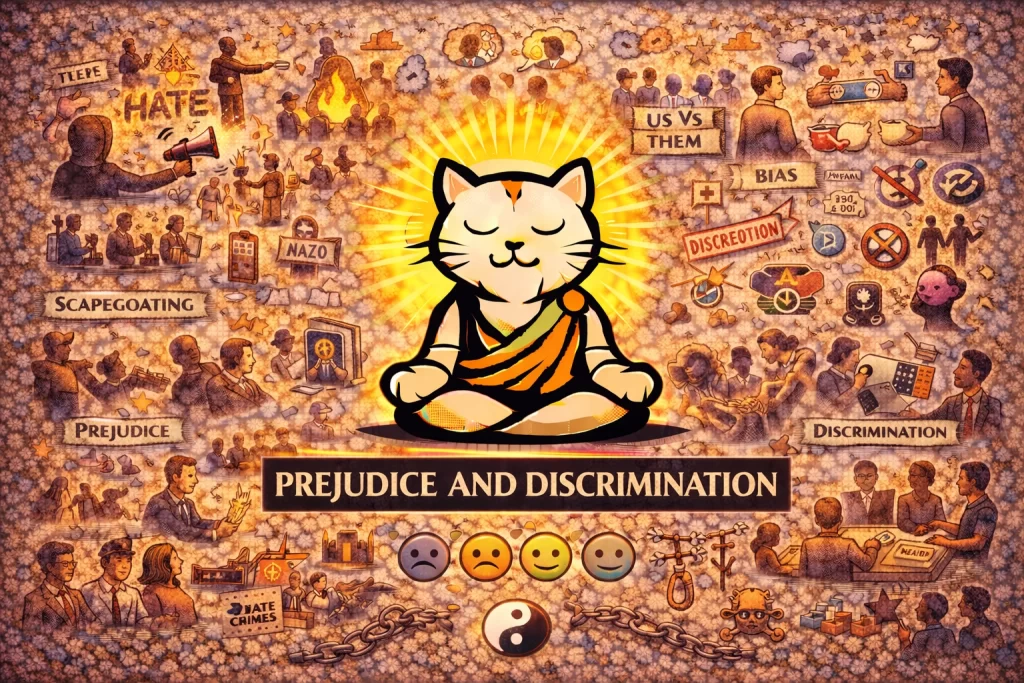
Prejudice and discrimination are social phenomena that shape how individuals perceive and treat others based on group membership. Prejudice refers to negative attitudes or beliefs about members of a group, while discrimination involves behaviors that disadvantage or exclude those individuals. Though often discussed together, they are distinct: one is attitudinal, the other behavioral.
Social psychology seeks to understand how prejudice forms, why discrimination persists, and how both can be reduced. Research shows that these processes arise from cognitive shortcuts, social identity, cultural norms, and structural systems—not simply from individual malice.
The Cognitive Roots of Prejudice
Human beings naturally categorize information to simplify a complex world. While categorization is efficient, it can lead to stereotyping—generalized beliefs about members of a group. Stereotypes can operate automatically, influencing perception without conscious awareness.
Research using the Implicit Association Test (IAT), developed by Anthony Greenwald and colleagues, demonstrated that individuals may hold unconscious associations linking certain groups with positive or negative traits. These implicit biases can influence split-second decisions, even among individuals who consciously reject prejudice.
Another foundational framework, social identity theory, developed by Henri Tajfel, showed that mere group membership can generate favoritism. In minimal group experiments, participants favored their assigned group—even when group divisions were arbitrary. This suggests that in-group bias is a basic social tendency.
Social and Structural Factors
Prejudice is not only cognitive but also shaped by social structures and competition. The Robbers Cave experiment, conducted by Muzafer Sherif, demonstrated that intergroup hostility can arise when groups compete for limited resources. Boys at a summer camp developed strong prejudice and aggression toward rival groups during competitive activities.
Sherif’s research supports realistic conflict theory, which argues that competition over resources fosters intergroup tension. However, the same study showed that cooperation toward shared goals reduced hostility, suggesting that prejudice is malleable.
Sociological research further shows that discrimination is often embedded in institutions, policies, and norms. Structural inequalities can perpetuate disparities even in the absence of overt prejudice. For example, audit studies in employment have shown that resumes with names associated with minority groups receive fewer callbacks than identical resumes with majority-associated names.
The Effects of Discrimination
Discrimination has measurable psychological and physiological consequences. Studies indicate that experiences of chronic discrimination are associated with increased stress, anxiety, and depressive symptoms. The concept of minority stress explains how ongoing exposure to bias can affect mental and physical health.
Research also shows that stereotype threat—the fear of confirming a negative stereotype—can impair performance. Psychologist Claude Steele demonstrated that when individuals are reminded of stereotypes about their group before a test, their performance declines. This effect illustrates how prejudice can influence outcomes even without explicit discrimination.
These findings highlight that prejudice is not merely attitudinal—it shapes opportunity, well-being, and achievement.
Reducing Prejudice and Promoting Inclusion
Despite its persistence, prejudice can be reduced. The contact hypothesis, proposed by Gordon Allport, suggests that positive interaction between groups reduces bias under certain conditions—particularly when groups share equal status and cooperative goals.
Subsequent research supports this theory. Intergroup contact programs in schools and workplaces have been shown to reduce stereotyping and improve attitudes. Perspective-taking exercises and empathy-building interventions also decrease bias in controlled studies.
Education, inclusive policies, and awareness of implicit bias contribute to long-term change. While prejudice may arise from cognitive shortcuts, deliberate reflection and structured interaction can counteract these tendencies.
Conclusion
Prejudice and discrimination are complex phenomena rooted in cognition, social identity, and structural systems. Study examples—from Tajfel’s minimal groups to Sherif’s Robbers Cave experiment and Steele’s stereotype threat research—demonstrate that bias is both learned and context-dependent.
Understanding these mechanisms is essential for promoting fairness and social cohesion. By recognizing the psychological processes underlying prejudice and the structural forces that sustain discrimination, societies can work toward greater equity and mutual understanding.