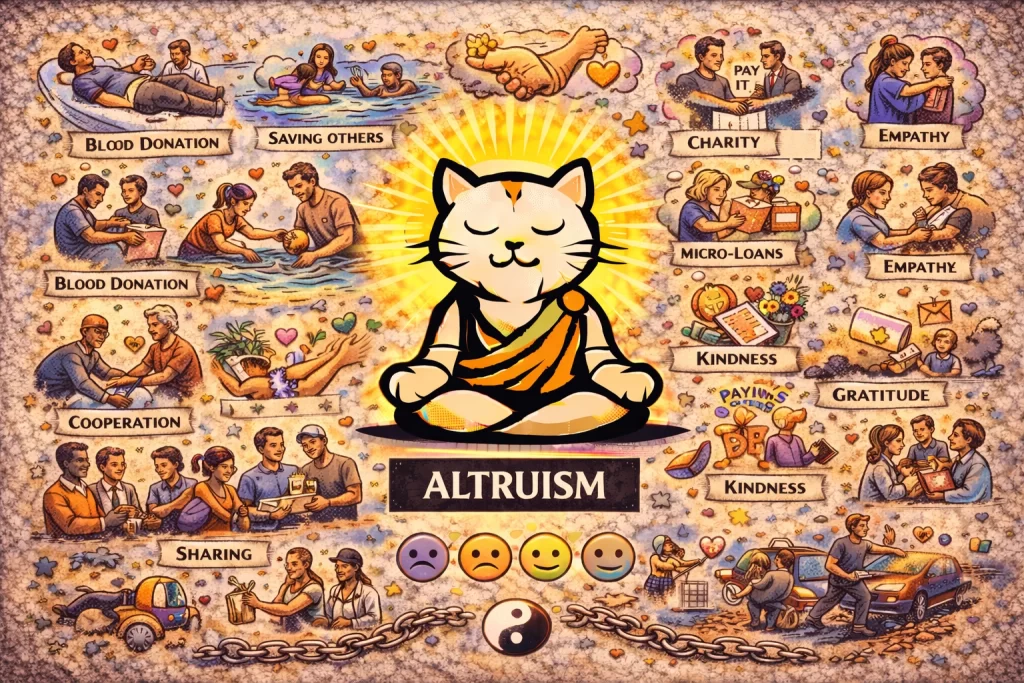
Altruism refers to behavior intended to benefit others without expectation of personal gain. From helping a stranger in distress to donating time or resources, altruistic acts appear to challenge the assumption that human behavior is driven purely by self-interest. Social psychology, evolutionary theory, and neuroscience have all sought to understand why people help—and under what conditions they fail to do so.
Research shows that altruism is shaped by empathy, social norms, situational factors, and even biological mechanisms. While helping behavior can be spontaneous and compassionate, it is also influenced by context in systematic ways.
The Bystander Effect and Situational Influence
One of the most famous findings in the study of altruism is the bystander effect. After the 1964 murder of Kitty Genovese, researchers John Darley and Bibb Latané conducted experiments to examine why people sometimes fail to help in emergencies.
In laboratory studies, participants believed they overheard someone having a seizure. When participants thought they were the only witness, most quickly offered help. However, when they believed others were present, helping rates dropped significantly. This phenomenon was explained by diffusion of responsibility—when responsibility is shared among many, individuals feel less personal obligation to act.
The bystander effect demonstrates that altruism is not solely a matter of character; situational factors can inhibit helping even in well-intentioned individuals.
Empathy and the Motivation to Help
Empathy—the ability to understand and share another person’s emotional state—is strongly linked to altruistic behavior. C. Daniel Batson developed the empathy-altruism hypothesis, proposing that empathic concern produces genuinely selfless helping motives.
In experimental studies, participants who felt high empathy for a person in need were more likely to help, even when escape from the situation was easy. These findings challenged purely self-interest explanations of helping behavior.
Neuroscientific research supports this connection. Brain imaging studies show that observing someone in pain activates neural regions associated with personal distress and empathy. These shared circuits may underlie the emotional motivation to assist others.
Evolutionary and Social Perspectives
Evolutionary theory offers additional explanations for altruism. Kin selection theory suggests individuals are more likely to help relatives because doing so increases shared genetic survival. Research shows that people are more willing to take risks for close family members than for strangers.
Reciprocal altruism proposes that helping others can promote long-term mutual benefit. Studies of cooperation in economic games demonstrate that individuals often cooperate when future interaction is expected, reinforcing social bonds.
Social norms also influence altruism. The norm of reciprocity encourages returning favors, while the social responsibility norm promotes helping those in need. Cultural research shows variation in helping behaviors, with collectivist societies often emphasizing communal responsibility.
Barriers and Promoting Altruism
While altruism can be powerful, it is not automatic. Time pressure reduces helping behavior, as demonstrated in the “Good Samaritan” study conducted by John Darley and C. Daniel Batson. Seminary students rushing to give a talk were less likely to help a person in distress compared to those with more time, regardless of the topic of their speech.
Research suggests that awareness of situational barriers can increase helping. When individuals recognize diffusion of responsibility, they are more likely to intervene.
Educational programs that cultivate empathy, perspective-taking, and moral reasoning have been shown to enhance prosocial behavior. Volunteering opportunities and community engagement also strengthen habits of helping.
Conclusion
Altruism reflects both compassion and context. Study examples—from the bystander effect to empathy experiments—demonstrate that helping behavior is shaped by emotional, social, and evolutionary forces.
While situational pressures can suppress altruism, empathy and social norms can promote it. Understanding the psychological foundations of altruism reveals that helping is neither purely instinctive nor purely rational—it is a dynamic interplay between human connection and social environment.