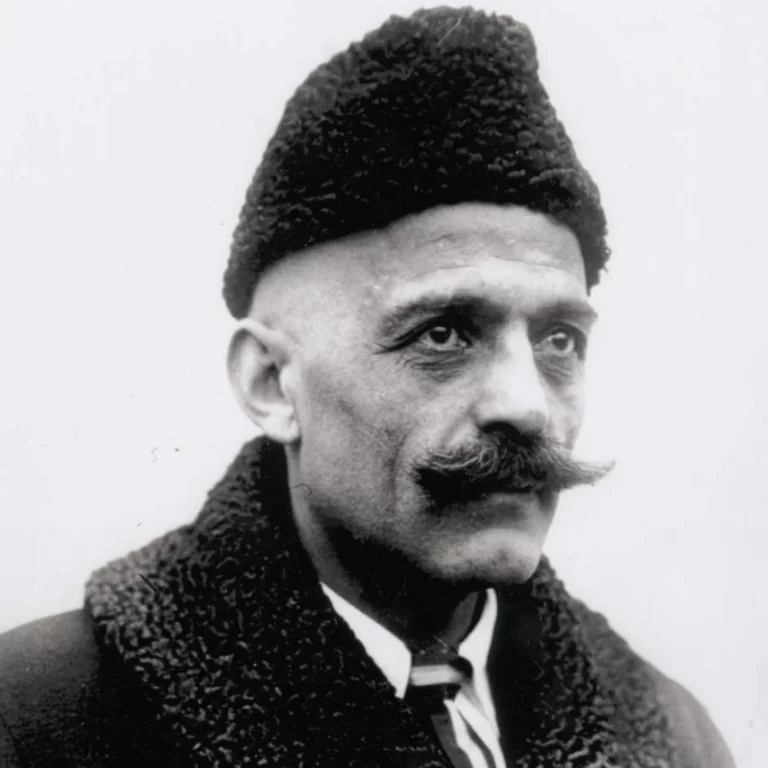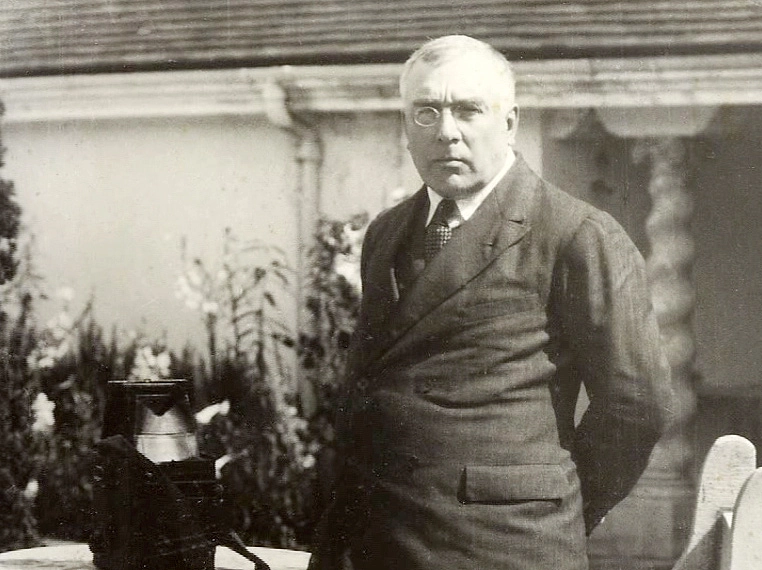
Pyotr Demianovich Ouspensky (1878–1947) was a Russian philosopher, journalist, and esoteric teacher best known for introducing the teachings of George Gurdjieff to the Western world. A prolific writer and deeply original thinker in his own right, Ouspensky sought to reconcile modern scientific thought with ancient spiritual traditions. His life represents a sustained effort to explore the limits of human perception and the possibility of conscious evolution.
Early Life and Intellectual Formation
Born in Moscow in 1878, Ouspensky showed early intellectual independence. Rather than pursuing a conventional academic path, he entered journalism and dedicated himself to wide-ranging self-study. Mathematics, psychology, philosophy, and Eastern mysticism all captured his attention. He was particularly fascinated by the idea that human perception might be incomplete—that reality could extend beyond the three-dimensional framework recognized by ordinary consciousness.
In 1909, he published The Fourth Dimension, exploring geometric and metaphysical implications of higher dimensions. His breakthrough work, Tertium Organum (1912), expanded on these ideas, proposing that human consciousness limits understanding of reality in the same way that two-dimensional beings would struggle to grasp three-dimensional space. The book gained international recognition and established Ouspensky as a serious philosophical voice within esoteric circles.
Meeting Gurdjieff and the Fourth Way
In 1915, Ouspensky met George Gurdjieff in Moscow—a turning point in his life. Gurdjieff claimed to teach an ancient system of self-development known as the “Fourth Way,” distinct from the traditional spiritual paths of asceticism or monastic withdrawal. This path emphasized conscious effort within ordinary life rather than retreat from it.
Ouspensky was deeply impressed by Gurdjieff’s psychological insight and practical methods. After the Russian Revolution, Ouspensky left Russia and eventually settled in London, where he began lecturing on Gurdjieff’s system. His intellectual precision and structured presentation helped translate Gurdjieff’s often cryptic teaching into a coherent philosophical framework.
However, in the early 1920s, Ouspensky broke from Gurdjieff, believing that the integrity of the teaching was being compromised. He continued independently, refining and organizing what he believed to be the essential principles of the system.
Major Works and Philosophical Themes
Ouspensky’s most influential work, In Search of the Miraculous (published posthumously in 1949), provides a detailed account of his years studying with Gurdjieff. It remains one of the clearest expositions of the Fourth Way philosophy.
Other notable works include A New Model of the Universe and The Psychology of Man’s Possible Evolution. Throughout his writings, several recurring themes stand out:
- Human beings live mechanically, in a state of “waking sleep.”
- True consciousness is rare and must be cultivated intentionally.
- Self-observation and “self-remembering” are essential practices.
- Time and recurrence play fundamental roles in understanding existence.
Ouspensky maintained that inner development required disciplined effort and psychological honesty. His style blended rigorous logic with mystical exploration, appealing to readers who sought spiritual depth without abandoning intellectual clarity.
The Concept of Eternal Recurrence
One of Ouspensky’s more provocative philosophical ideas concerned eternal recurrence—the possibility that human lives may repeat in cycles. Unlike purely symbolic interpretations, Ouspensky entertained the idea as a literal metaphysical hypothesis: that events might recur unless a person achieves a higher level of consciousness.
In his view, recurrence was not fatalistic but conditional. If individuals remain mechanical and unconscious, they may repeat patterns indefinitely. However, conscious effort could alter the cycle, introducing the possibility of genuine evolution. This interpretation differed from purely existential readings of recurrence and reflected his synthesis of metaphysics and psychology.
Teaching Style and Influence in the West
After settling in England and later teaching in the United States, particularly in New York, Ouspensky developed a structured lecture format. He often presented ideas in question-and-answer sessions, encouraging students to observe themselves rather than accept doctrine blindly. His teaching groups attracted writers, scientists, and intellectuals seeking a systematic approach to spiritual development.
Ouspensky avoided theatrical methods and emphasized disciplined inquiry. His analytical temperament appealed to Western audiences wary of mysticism that rejected reason. In this way, he functioned as a cultural translator—bridging Eastern esoteric traditions with Western philosophical discourse.
Later Years and Legacy
During World War II, Ouspensky relocated to the United States. Though his health declined, he continued lecturing and refining his ideas. Shortly before his death in 1947, he reportedly told students to “begin again,” suggesting that no system should become rigid or dogmatic.
Ouspensky’s legacy rests on his insistence that human beings possess unrealized capacities. He argued that consciousness is not static but developmental—that with effort, individuals can move beyond mechanical existence.
Today, his writings continue to influence students of mysticism, psychology, and philosophy. Whether viewed as a metaphysician, psychologist, or spiritual teacher, P. D. Ouspensky remains a pivotal figure in twentieth-century esoteric thought—a thinker who challenged modern individuals to awaken from what he called the sleep of ordinary life.