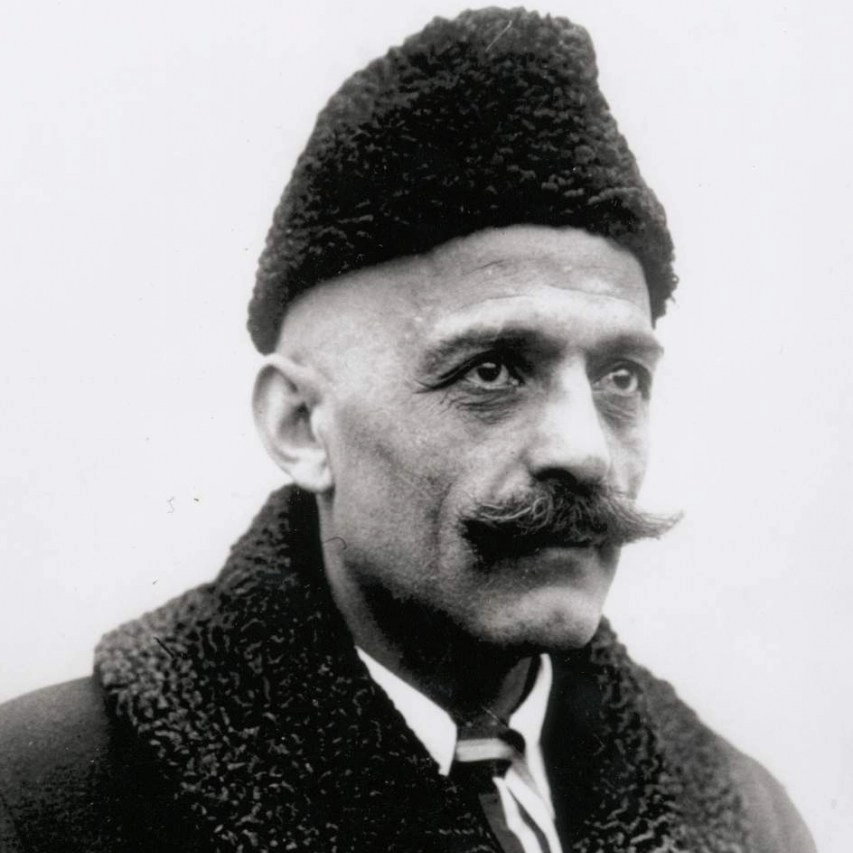
George Ivanovich Gurdjieff (c. 1866–1949) was a mystic, philosopher, composer, and spiritual teacher whose ideas profoundly influenced twentieth-century esoteric thought. Best known as the originator of the “Fourth Way,” Gurdjieff developed a system of inner development designed to awaken human consciousness from what he described as a state of psychological sleep. His life combined mystery, travel, teaching, and controversy, leaving behind a legacy that continues to attract students around the world.
Early Life and Travels
Gurdjieff was born in the Caucasus region of the Russian Empire, likely in Alexandropol (modern-day Gyumri, Armenia). His father, of Greek origin, was a bard and storyteller, and from him Gurdjieff absorbed a fascination with myth, oral tradition, and ancient wisdom.
As a young man, Gurdjieff became obsessed with understanding the deeper laws governing human existence. Dissatisfied with conventional religion and science, he embarked on extensive travels across Central Asia, the Middle East, North Africa, and possibly Tibet and India. According to his own accounts, he sought out hidden brotherhoods and ancient schools preserving knowledge of forgotten spiritual sciences. While some details of these journeys remain debated, they formed the mythic foundation of his later teaching.
The Fourth Way
Gurdjieff’s central teaching became known as the Fourth Way. Unlike traditional spiritual paths—the way of the fakir (physical discipline), the monk (faith and devotion), or the yogi (mental development)—the Fourth Way aimed at balanced development of body, emotion, and mind while living an ordinary life.
He taught that most human beings function mechanically, driven by habits, reactions, and unconscious impulses. True consciousness, he argued, requires deliberate effort and “self-remembering”—a state in which one becomes aware of oneself in the present moment. Without such effort, people remain in a condition he described as “waking sleep.”
Gurdjieff’s teaching methods were often unconventional. He used paradox, shock, humor, and structured exercises to disrupt habitual patterns of thought. He believed transformation required not comfort but friction—intentional struggle against one’s mechanical tendencies.
Teaching in Russia and the West
In the years before the Russian Revolution, Gurdjieff gathered students in Moscow and St. Petersburg. Among them was P. D. Ouspensky, who would later document and systematize many of Gurdjieff’s ideas.
After the upheaval of World War I and the Bolshevik Revolution, Gurdjieff left Russia and eventually established the Institute for the Harmonious Development of Man at the Château du Prieuré in Fontainebleau, France, in 1922. There, students engaged in intense psychological work, manual labor, sacred dances known as “Movements,” and group exercises designed to cultivate awareness.
In 1924, a serious automobile accident nearly ended his life. Following his recovery, Gurdjieff shifted focus toward writing and smaller teaching groups. He later traveled to the United States, especially New York, where he attracted a circle of devoted students.
Writings and Musical Work
Gurdjieff’s literary masterpiece, Beelzebub’s Tales to His Grandson, is the first volume of his trilogy All and Everything. Written in a deliberately complex style, the book presents his cosmology and critique of modern civilization through allegorical narrative.
His other major works include Meetings with Remarkable Men and Life Is Real Only Then, When “I Am.” In addition to writing, Gurdjieff composed numerous pieces of music in collaboration with pianist Thomas de Hartmann. These compositions, often inspired by sacred and folk traditions, were intended to evoke inner states and support meditative work.
Personality and Controversy
Gurdjieff was a charismatic yet enigmatic figure. Some students viewed him as a spiritual genius; others found him manipulative or severe. His methods—sometimes intentionally shocking or confrontational—sparked debate about the ethics of his teaching style.
He rejected blind belief and insisted that students verify ideas through personal experience. This insistence on inner testing contributed to both his enduring influence and the controversy surrounding his character.
Final Years and Legacy
During World War II, Gurdjieff remained in Paris, continuing to teach small groups despite the dangers of occupation. In his later years, he emphasized practical application of the work in daily life rather than institutional expansion.
Gurdjieff died in 1949 in Neuilly-sur-Seine, France. His students carried forward his teachings, forming independent groups across Europe and North America.
Today, George Gurdjieff remains one of the most influential spiritual teachers of the modern era. His concept of the Fourth Way continues to shape discussions of consciousness, psychology, and self-development. Whether regarded as mystic, philosopher, or psychological innovator, Gurdjieff’s central challenge endures: human beings, he claimed, are not fully awake—and awakening requires conscious effort.