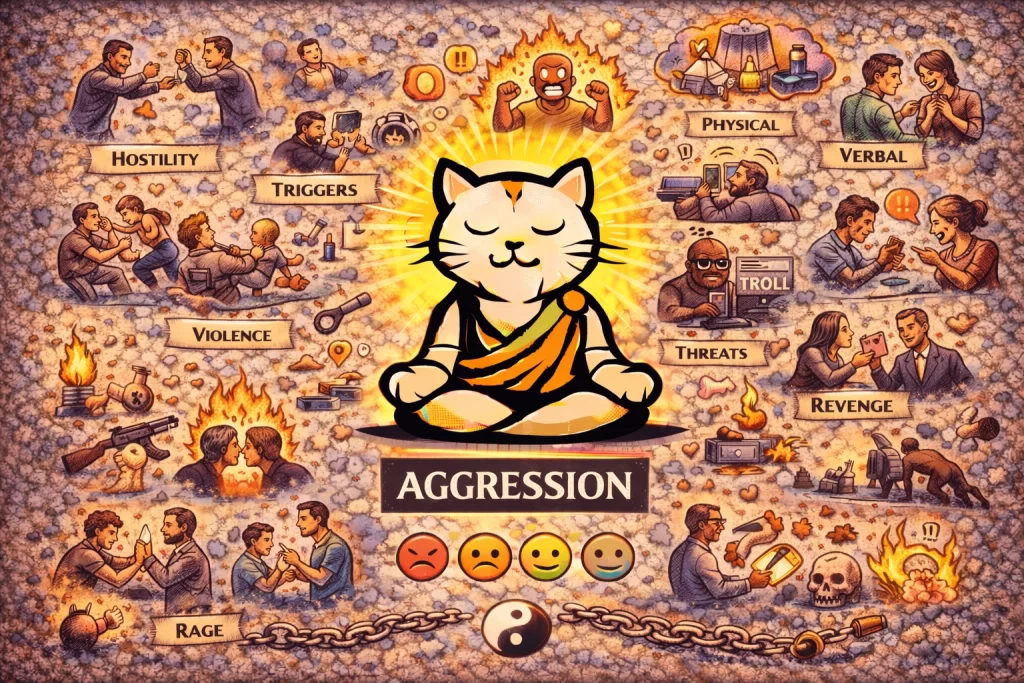
Aggression refers to behavior intended to harm another person, either physically or psychologically. It can range from verbal insults and social exclusion to physical violence. While aggression is often viewed as purely destructive, psychologists study it as a complex behavior influenced by biological predispositions, learned patterns, situational triggers, and cultural norms.
Understanding aggression requires examining both its roots and its regulation. Research shows that aggression is neither entirely instinctual nor entirely learned—it emerges from an interaction of internal drives and external conditions.
Biological Foundations of Aggression
Early theories suggested aggression was an innate instinct. While modern psychology does not fully support instinct theory, biological factors do contribute to aggressive behavior. Research indicates that brain regions such as the amygdala play a role in threat detection and emotional arousal, while the prefrontal cortex helps regulate impulse control.
Studies of individuals with damage to the prefrontal cortex show increased impulsivity and difficulty regulating anger. Hormonal influences have also been examined; some research links higher testosterone levels with increased dominance-related aggression, though findings are complex and influenced by context.
Neuroscientific studies demonstrate that aggression often involves heightened emotional reactivity combined with reduced regulatory control, highlighting the interplay between emotion and executive function.
Learning and Social Influences
Aggression can also be learned through observation and reinforcement. The famous Bobo doll experiment conducted by Albert Bandura demonstrated that children exposed to aggressive adult models were more likely to imitate that aggression. This study provided evidence for social learning theory, suggesting that behavior can be acquired without direct reinforcement.
Media exposure has been widely studied in relation to aggression. Experimental research shows that viewing violent content can temporarily increase aggressive thoughts and behaviors, particularly in individuals already predisposed to aggression.
Family environment also plays a role. Studies indicate that children raised in households with high conflict or harsh discipline are more likely to display aggressive behaviors, illustrating how modeling and reinforcement shape behavioral patterns.
Frustration, Environment, and Situational Triggers
Situational factors can trigger aggression, even in individuals without aggressive tendencies. The frustration-aggression hypothesis, originally proposed by John Dollard and colleagues, suggested that frustration—blocking a goal—leads to aggressive impulses.
Later research refined this idea, showing that frustration increases emotional arousal, which may lead to aggression depending on contextual cues. Laboratory experiments have demonstrated that participants subjected to provocation or unfair treatment are more likely to administer aversive stimuli to others.
Environmental factors also matter. Studies have found correlations between high temperatures and increased aggression rates. Crowding and noise have similarly been linked to irritability and hostile behavior.
Reducing and Managing Aggression
While aggression can be harmful, it is not inevitable. Research shows that self-regulation strategies and social interventions can reduce aggressive tendencies. Cognitive-behavioral approaches help individuals identify triggers, reinterpret provocations, and develop alternative responses.
Anger management programs emphasize relaxation techniques, cognitive restructuring, and problem-solving skills. Studies indicate that these interventions reduce aggressive incidents in clinical and correctional populations.
Empathy training and perspective-taking exercises also reduce aggressive behavior. When individuals consider the feelings of others, they are less likely to act harmfully.
Conclusion
Aggression is a multifaceted behavior shaped by biology, learning, and situational context. Study examples—from Bandura’s Bobo doll experiment to frustration research—demonstrate that aggression can be modeled, triggered, and regulated.
Rather than viewing aggression as purely instinctual or purely environmental, research supports an interactionist perspective. Understanding the roots of aggression allows for more effective prevention strategies, promoting healthier emotional regulation and more constructive social interaction.