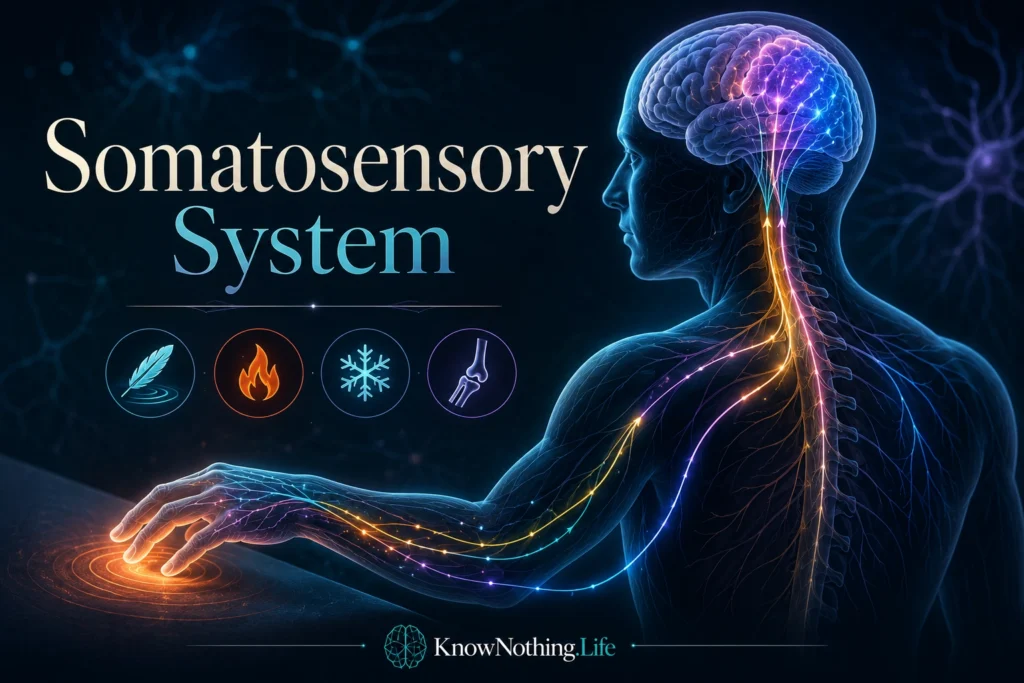
The somatosensory system is the network that allows the nervous system to detect touch, pressure, vibration, temperature, pain, body position, and movement. It is sometimes called the body-sense system because it gives the brain information from the skin, muscles, joints, tendons, and internal tissues. Through it, a person can feel a hand on the shoulder, notice a painful cut, detect warmth from a cup, sense the position of a finger without looking, and maintain awareness of the body in space. StatPearls describes general sensory modalities as including touch, pain, temperature, proprioception, vibration, and pressure, distinguishing them from special senses such as vision, hearing, taste, and smell.
The somatosensory system is not only a passive receiver of bodily information. It helps the brain build a working model of the body. This model allows movement, balance, tool use, protection from injury, emotional comfort through touch, and the sense that one’s body belongs to oneself. When someone reaches into a pocket and identifies keys by feel, walks without staring at their feet, or pulls away from a sharp object, somatosensory pathways are transforming bodily signals into perception and action. The system is therefore central not only to sensation, but to survival, coordination, self-awareness, and everyday life.
Sensory Receptors in the Body
Somatosensation begins with specialized receptors. Mechanoreceptors detect touch, pressure, vibration, and skin stretch. Thermoreceptors detect warmth and cold. Nociceptors detect damaging or potentially damaging stimuli that can become pain. Proprioceptors in muscles, tendons, and joints detect body position and movement. These receptors convert physical events into neural signals, a process called sensory transduction. Without transduction, pressure would remain only pressure, heat only heat, and tissue damage only local injury. The nervous system needs receptors to translate these events into electrical and chemical signals it can process.
Different receptors are tuned for different kinds of information. Some respond quickly to changing stimulation, making them useful for vibration or motion across the skin. Others respond more steadily, helping signal sustained pressure or limb position. Proprioceptors are especially important because they allow the brain to monitor the body without relying only on vision. A person can close their eyes and touch their nose because the nervous system maintains an internal map of limb position. This body map is not a conscious diagram, but an active sensory system updated by receptors in muscles, joints, skin, and connective tissues.
The Dorsal Column-Medial Lemniscus Pathway
One of the major somatosensory routes is the dorsal column-medial lemniscus pathway, often abbreviated DCML. This pathway carries fine touch, vibration, two-point discrimination, and conscious proprioception. Signals from the body enter the spinal cord and ascend through the dorsal columns before synapsing in brainstem nuclei. From there, fibers cross to the opposite side, travel through the medial lemniscus, reach the thalamus, and then project to the somatosensory cortex. StatPearls describes the DCML pathway as carrying fine touch, vibration, two-point discrimination, and proprioceptive information.
This pathway is crucial for detailed body awareness. Fine touch allows a person to distinguish textures and shapes. Vibration sense helps detect rapid mechanical stimulation. Two-point discrimination allows the nervous system to tell whether one or two nearby points are touching the skin, a skill especially refined in the fingertips. Conscious proprioception allows a person to know where body parts are in space. Damage to the DCML pathway can make movement clumsy even when muscles are strong, because the brain loses precise sensory feedback about the body’s position and contact with the world.
The Spinothalamic Tract and Protective Sensation
Another major somatosensory route is the spinothalamic tract. This pathway carries pain, temperature, crude touch, and pressure. Unlike the DCML pathway, many spinothalamic fibers cross to the opposite side soon after entering the spinal cord, then ascend toward the thalamus and cortex. StatPearls describes the lateral spinothalamic tract as carrying pain and temperature and the anterior spinothalamic tract as carrying crude touch and pressure.
The spinothalamic system is essential for protection. Pain and temperature signals help the organism respond to danger. Touching a hot pan, stepping on something sharp, or feeling freezing cold all require rapid sensory processing that can trigger withdrawal, attention, memory, and future avoidance. Pain is not just a simple sensory signal, however. It is shaped by attention, emotion, expectation, memory, and context. The same injury may feel different depending on fear, stress, distraction, or meaning. The spinothalamic tract carries important nociceptive information, but pain as an experience emerges from broader brain networks that include sensory, emotional, cognitive, and bodily systems.
The Thalamus and Somatosensory Cortex
Most somatosensory information eventually passes through the thalamus before reaching the cerebral cortex. The thalamus helps relay, filter, and organize sensory signals. From there, information travels to the primary somatosensory cortex, located in the postcentral gyrus of the parietal lobe. StatPearls describes the somatosensory pathway as carrying information from the periphery to the postcentral gyrus and associated cortices so the brain can process information from the surrounding environment.
The primary somatosensory cortex is organized somatotopically, meaning different regions correspond to different body parts. The feet, legs, trunk, hands, face, and lips are represented in an orderly but distorted body map. This distortion reflects sensory importance rather than physical size. Areas with especially fine sensory discrimination, such as the fingers and lips, occupy large cortical territories. This is why the sensory homunculus is drawn with huge hands, lips, and face. The map reveals a basic principle: the brain devotes more processing space to body parts that provide especially detailed and behaviorally important information.
Penfield, the Homunculus, and Body Maps
The sensory homunculus is one of neuroscience’s most famous images. Wilder Penfield and Edwin Boldrey introduced the cortical homunculus in their 1937 work on somatic motor and sensory representation in the human cerebral cortex, based partly on electrical stimulation during neurosurgery. Modern reviews describe Penfield’s homunculus as a landmark contribution, showing how body parts are represented across the primary somatosensory cortex.
Modern neuroscience has refined the old homunculus model. The primary somatosensory cortex is important, but body representation is not limited to one strip of cortex. A 2020 review notes that although Penfield’s homunculus remains iconic, additional body-part representations exist beyond primary somatosensory cortex, showing that the somatosensory system is distributed across wider cortical networks. This broader view matters because body awareness is more than simple touch detection. It involves posture, movement, attention, emotion, self-location, and the integration of information from many sensory systems.
Touch, Emotion, and Social Connection
Touch is not only mechanical information. It can also be emotional and social. A painful touch, a comforting touch, a tickle, a handshake, or a hug can all carry different meanings even if they involve stimulation of the skin. The somatosensory system works with emotional and social brain networks to interpret touch in context. This is why touch can calm, threaten, reassure, startle, or bond. The body’s surface is both a sensory boundary and a social interface.
This social role also shows why somatosensation is connected to development. Infants learn about the world through touch, handling, movement, and bodily interaction. Motor development depends on sensory feedback. Emotional regulation can be shaped by physical comfort and bodily contact. Even in adulthood, touch helps maintain connection and safety. The somatosensory system therefore contributes to the physical basis of social life. It tells the brain not only what is touching the body, but sometimes what that touch means.
Proprioception and Body Ownership
Proprioception is the sense of body position and movement. It allows the nervous system to know where the limbs are, how joints are angled, how muscles are stretched, and how the body is moving. It is essential for coordination because movement requires constant feedback. A person walking, typing, throwing a ball, playing piano, or climbing stairs is relying on proprioception, often without conscious awareness. Vision can help guide movement, but proprioception allows the body to act without needing to watch every limb.
Proprioception also contributes to body ownership, the feeling that the body is “mine.” The brain integrates proprioceptive signals with touch, vision, vestibular information, and motor commands to create a coherent sense of embodiment. When these signals conflict, the sense of body ownership can become unstable, as shown in illusions, neurological disorders, and phantom limb phenomena. The somatosensory system helps maintain the body as a unified self-experience rather than a collection of separate parts.
Clinical Importance of the Somatosensory System
Damage to the somatosensory system can produce numbness, tingling, burning pain, loss of vibration sense, impaired proprioception, poor coordination, sensory neglect, abnormal pain, or difficulty recognizing objects by touch. A lesion in a peripheral nerve, spinal cord pathway, thalamus, brainstem, or somatosensory cortex can produce different patterns of sensory loss. The postcentral gyrus is especially important because it contains the primary cortical representation of bodily sensation; StatPearls describes it as located on the lateral surface of the parietal lobe between the central and postcentral sulci.
Clinical testing of somatosensation can help localize neurological problems. A physician may test light touch, pinprick, temperature, vibration, joint position, two-point discrimination, and stereognosis, which is the ability to identify objects by touch. These tests reveal whether a problem lies in peripheral nerves, spinal pathways, cortical processing, or higher integration. The somatosensory system is clinically important because sensory symptoms are often early signs of neurological disease, injury, or dysfunction.
Why the Somatosensory System Matters
The somatosensory system matters because it gives the brain access to the body. It allows humans to feel the world, protect themselves from injury, coordinate movement, recognize objects by touch, regulate posture, and maintain a sense of embodiment. Without it, the body would become strangely distant: visible perhaps, but poorly felt, poorly located, and harder to control. Sensation is not an accessory to movement. It is one of the foundations of movement.
The deeper lesson is that consciousness is embodied. The mind is not only built from sight, language, memory, or abstract thought. It is also built from pressure on the skin, stretch in the muscles, temperature, pain, balance, and the felt position of the body in space. The somatosensory system helps create the lived body: the body that touches, moves, suffers, heals, acts, and belongs to the self. To understand it is to understand one of the nervous system’s most intimate functions: turning the body into experience.