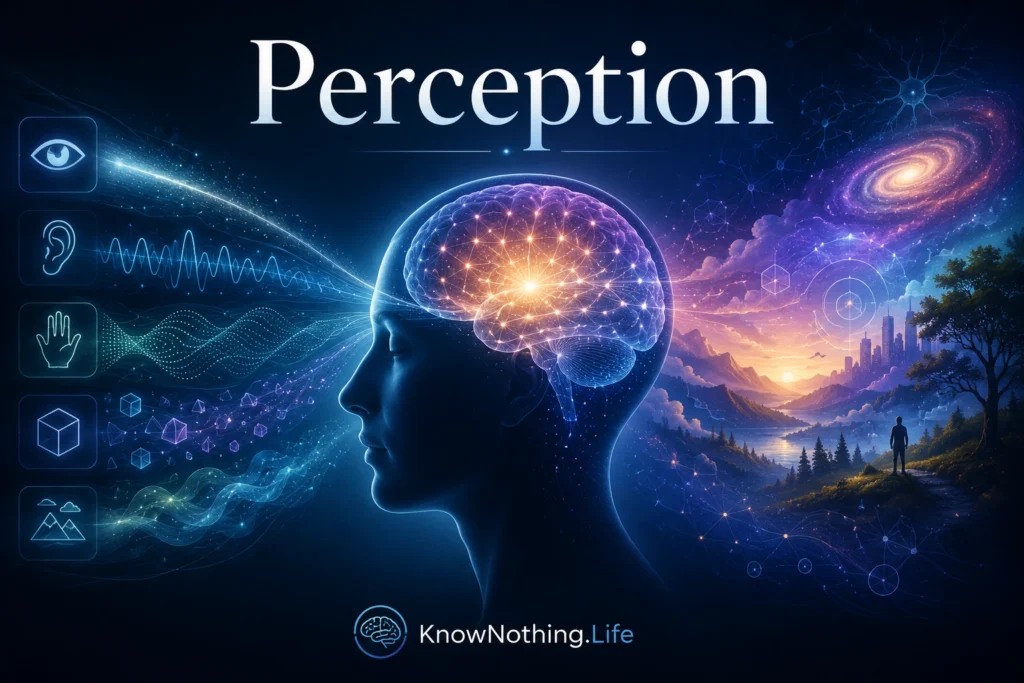
Perception is the process by which the brain organizes, interprets, and gives meaning to sensory information. Sensation begins when receptors detect light, sound, pressure, chemicals, temperature, pain, or body position. Perception begins when the nervous system turns those signals into an experienced world: a face, a voice, a melody, a threat, a familiar room, a distant mountain, or the feeling of one’s own body. NCBI’s neuroscience resources describe sensation as the ability to transduce, encode, and perceive information from external and internal stimuli, emphasizing that much of the brain is devoted to these tasks.
Perception is not a simple copy of reality. The brain does not receive the world like a camera receives light or a microphone records sound. It builds a usable model from incomplete, noisy, and changing sensory input. The same object can look different in bright sun, shadow, fog, or motion, yet still be perceived as the same object. A voice can be recognized across rooms, phones, and background noise. A face can be recognized from many angles. This stability is one of perception’s great achievements: it turns unstable sensory signals into a coherent world that can guide action.
Sensation vs Perception
Sensation and perception are closely related, but they are not the same. Sensation is the detection and encoding of stimuli by sensory receptors and pathways. Photoreceptors respond to light, hair cells respond to vibration, mechanoreceptors respond to pressure, chemoreceptors respond to molecules, and nociceptors respond to potentially damaging stimuli. Perception is the interpretation of those signals. Sensation gives the brain information; perception gives that information structure, meaning, and relevance.
This distinction explains why two people can receive similar sensory input but experience it differently. A sound may be ignored by one person and alarming to another. A smell may evoke comfort, disgust, memory, or hunger depending on past experience. A shadow in a dark room may be perceived as harmless furniture or as a possible threat depending on context and emotional state. Perception therefore depends not only on the stimulus, but also on attention, memory, expectation, emotion, culture, body state, and goals. It is both biological and interpretive.
Bottom-Up and Top-Down Processing
Perception involves both bottom-up and top-down processing. Bottom-up processing begins with incoming sensory data. The nervous system detects features such as brightness, color, pitch, pressure, motion, temperature, or chemical quality, then builds toward more complex representations. In vision, for example, retinal signals travel through the thalamus to visual cortex, where neurons respond to edges, orientation, movement, contrast, and spatial patterns. David Hubel and Torsten Wiesel’s work on the visual cortex showed that cortical cells are organized in columns and respond selectively to features of visual input; they received the 1981 Nobel Prize for discoveries concerning information processing in the visual system.
Top-down processing works in the opposite direction. It uses prior knowledge, expectation, context, memory, and goals to shape what is perceived. Richard Gregory famously argued that perception involves hypotheses, meaning the brain uses stored knowledge and assumptions to interpret sensory signals. His 1980 paper “Perceptions as hypotheses” stated that understanding perception requires discovering both signal codes and the stored assumptions used to derive perceptual hypotheses. This is why ambiguous images, illusions, and incomplete words can be interpreted differently depending on surrounding context. The brain does not merely receive; it predicts and interprets.
Perceptual Organization and Meaning
Perception requires organization. The brain must determine which features belong together, what counts as figure and ground, where one object ends and another begins, and whether something is near or far, moving or still, familiar or unfamiliar. Gestalt psychologists such as Max Wertheimer, Wolfgang Köhler, and Kurt Koffka emphasized that perception is organized into meaningful wholes rather than assembled as a simple sum of parts. Principles such as proximity, similarity, continuity, closure, and figure-ground organization describe ways the mind groups sensory information into patterns.
Visual perception offers clear examples. A few lines can become a triangle, a shadow can define shape, and scattered dots can become a moving object. Auditory perception does something similar across time: separate tones become a melody, syllables become speech, and one voice can be heard within a crowd. Perceptual organization is therefore not decorative. It is necessary for survival and action. The brain must convert sensory fragments into objects, events, people, places, dangers, opportunities, and meanings.
Perception as Inference and Prediction
Many modern theories describe perception as a form of inference. The brain receives partial sensory evidence and tries to infer the most likely cause. A moving shape may be a person, animal, vehicle, or shadow. A sound may be wind, speech, music, or alarm. Perception selects among possibilities based on sensory evidence and prior experience. This approach has roots in Hermann von Helmholtz’s idea of unconscious inference and continues today in Bayesian and predictive-processing theories.
Karl Friston’s predictive-coding and free-energy work is one of the most influential modern frameworks for this view. In a 2009 paper, Friston described perception and categorization as inference problems the brain must solve, and later reviewed the free-energy principle as a theory connecting action, perception, and learning. Predictive-processing theories propose that the brain generates expectations about incoming sensory input and updates those expectations when prediction errors occur. This does not mean perception is imaginary. It means the brain combines what is coming from the senses with what it already expects, producing a best-fit interpretation of the world.
Ecological Perception and Action
Not all theories emphasize internal inference in the same way. James J. Gibson’s ecological approach argued that perception is deeply tied to action and environment. In The Ecological Approach to Visual Perception, Gibson emphasized that natural vision depends on an organism actively moving through an environment, using information available in the world to guide behavior. His idea of affordances became especially influential: organisms perceive not only objects, but possibilities for action. A chair affords sitting, a handle affords pulling, a path affords walking, and a cliff affords danger.
This action-centered view is important because perception did not evolve merely for contemplation. It evolved to guide living bodies. Seeing a cup is not only recognizing its shape; it is also knowing where it is, how far away it is, whether it can be grasped, and what action it allows. Hearing footsteps is not only detecting sound; it is locating movement and judging relevance. Perception and action are therefore intertwined. The brain perceives a world it can move through, reach into, avoid, explore, and use.
Attention, Memory, and Emotion in Perception
Attention shapes perception by selecting some information for deeper processing while suppressing other information. A person focused on a phone may miss a conversation nearby. A driver scanning for pedestrians may become especially sensitive to movement at the roadside. Attention can make a stimulus clearer, more memorable, and more likely to guide action. Without attention, perception would be overloaded by competing signals.
Memory and emotion also shape perception. A familiar face is perceived differently from a stranger’s face because memory gives it identity and meaning. A fearful person may interpret ambiguous sounds as threatening. A hungry person may notice food cues more easily. Richard Gregory’s work on illusions emphasized that perception uses knowledge and working rules, making illusions valuable because they reveal how the brain interprets rather than simply records sensory input. Emotion does not merely interrupt perception; it often helps assign urgency and value.
Multisensory Perception
The world is rarely perceived through one sense at a time. The brain integrates vision, hearing, touch, smell, taste, balance, pain, and body position into unified experience. A meal combines taste, smell, texture, temperature, color, memory, and expectation. A conversation combines voice, facial expression, gesture, rhythm, and context. Balance depends on vestibular input, vision, and proprioception. Multisensory integration helps the brain build a more reliable model of the world than any one sense could provide alone.
Modern neuroscience treats multisensory perception as an active research field involving behavior, anatomy, physiology, and computational approaches. A review on multisensory integration notes that the field now uses many methods and model systems to study how the nervous system combines information across sensory channels. This integration is one reason perception feels seamless. A barking dog is not experienced as separate light patterns, sound waves, and motion cues. It is experienced as one animal in one place doing one thing.
Illusions and the Limits of Perception
Illusions are not failures of perception in a simple sense. They are clues to how perception works. Visual illusions, auditory illusions, body illusions, and memory-related distortions reveal the assumptions the brain uses to interpret ambiguous input. An illusion may occur because the brain applies a normally useful rule to an unusual situation. For example, assumptions about lighting, depth, size, contrast, or motion usually help perception, but they can produce misleading experiences under artificial or ambiguous conditions.
This is why illusions have been so important in psychology and neuroscience. Richard Gregory argued that visual illusions provide evidence of perceptual processes, especially the use of knowledge about objects and the working rules of seeing. Illusions remind us that perception is not the same as reality. It is an adaptive construction. Most of the time, that construction works well enough to guide survival, communication, movement, and understanding. But because it depends on interpretation, it can be fooled.
Clinical Importance of Perception
Perceptual disorders show that perception depends on specific brain systems. Damage to visual pathways may impair sight even when the eyes are healthy. Prosopagnosia can impair face recognition. Neglect can make a person fail to attend to one side of space. Agnosia can impair object recognition despite intact basic sensation. Hallucinations can produce perceptual experiences without ordinary external stimuli. Chronic pain can involve altered perception of bodily threat. These conditions show that perception is not located in one sense organ alone. It depends on pathways, attention, memory, emotion, and cortical interpretation.
Clinical perception also matters in mental health. Anxiety can bias perception toward threat. Depression can shape how social signals and future possibilities are interpreted. Trauma can make neutral cues feel dangerous. Predictive-processing approaches have been applied to symptom perception and placebo effects, proposing that expectations and prior beliefs can shape bodily and perceptual experience. This does not mean symptoms are unreal. It means perception is embodied and interpretive, including the perception of the body itself.
Why Perception Matters
Perception matters because it is the mind’s doorway to reality. Everything a person knows about the outside world and much of what they know about the body arrives through perceptual systems. Vision, hearing, touch, smell, taste, balance, pain, and body awareness allow people to navigate, communicate, recognize danger, enjoy beauty, learn, and act. Without perception, the brain would be cut off from the world it is built to understand.
The deeper lesson is that perception is active, constructive, and practical. The brain does not merely receive sensory information; it selects it, predicts it, organizes it, compares it with memory, and turns it into meaning. Perception is where biology becomes experience. To understand perception is to understand one of neuroscience’s central truths: the world we live in is not just sensed by the brain, but interpreted, stabilized, and made usable by it.