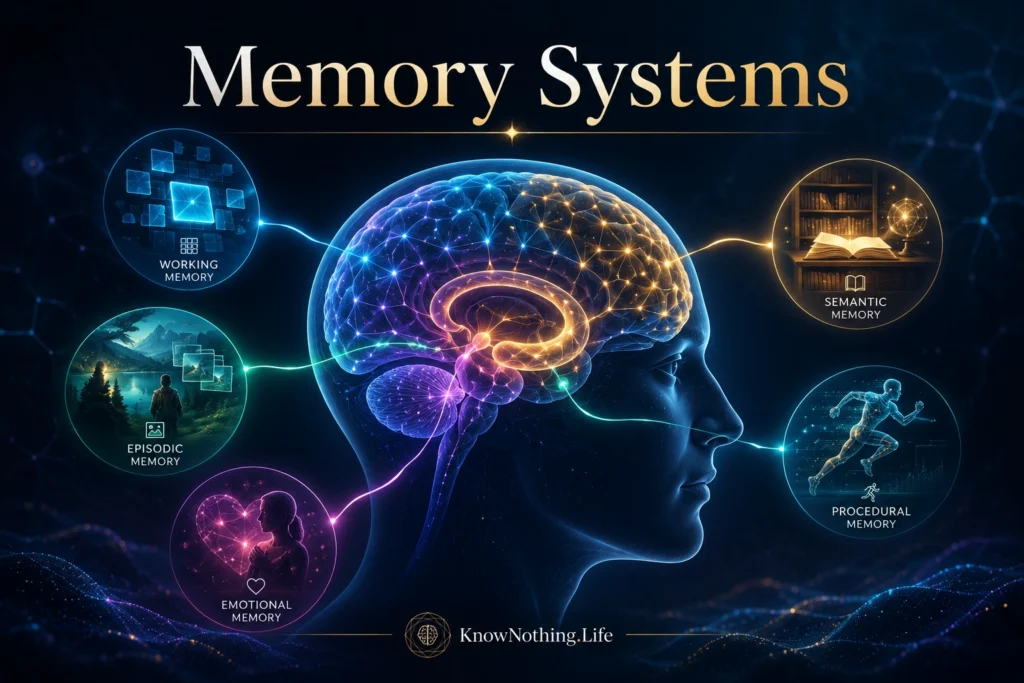
Memory systems are the brain’s organized ways of encoding, storing, retrieving, and using information. Memory is not one single faculty kept in one mental container. It includes short-term holding, working memory, episodic recall, semantic knowledge, procedural skill, emotional learning, habit formation, and sensory memory. Each system depends on different but interacting brain networks. This is why a person can remember how to ride a bicycle without remembering the exact day they learned, or recognize a familiar face without recalling the person’s name immediately. Larry Squire’s work on multiple memory systems helped distinguish declarative memory, which includes facts and events, from nondeclarative memory, which includes skills, habits, priming, and conditioning.
The term “memory systems” matters because memory is not merely storage. It is an active set of processes that support identity, learning, prediction, decision-making, language, emotion, and action. Memories are encoded through attention and perception, stabilized through consolidation, altered through retrieval, and used to guide future behavior. A memory is not a perfect recording of the past. It is a biological reconstruction shaped by neural circuits, context, emotion, and later experience. The brain remembers because remembering helps organisms adapt, not because it was designed to preserve an exact archive of life.
Sensory, Short-Term, and Working Memory
One influential early framework was the multistore model proposed by Richard Atkinson and Richard Shiffrin in 1968. Their model distinguished sensory memory, short-term memory, and long-term memory, while also emphasizing control processes such as rehearsal and attention. Sensory memory briefly holds incoming information from the senses. Visual sensory memory, for example, allows a trace of visual input to persist for a moment after a stimulus disappears. Auditory sensory memory can preserve sound briefly enough for speech and music to be understood as sequences rather than isolated fragments.
Short-term memory refers to temporary retention over seconds, but modern psychology often emphasizes working memory instead. Alan Baddeley and Graham Hitch’s 1974 working memory model challenged the idea of short-term memory as a passive store. They proposed a system for actively holding and manipulating information, later developed into components such as the phonological loop, visuospatial sketchpad, central executive, and episodic buffer. Working memory is used when solving mental arithmetic, following directions, reading a complex sentence, or keeping a goal active while resisting distraction. It is less like a shelf and more like a mental workspace.
Episodic and Semantic Memory
Endel Tulving’s distinction between episodic and semantic memory is one of the most important ideas in cognitive neuroscience. Semantic memory is general knowledge: facts, meanings, concepts, vocabulary, categories, and information not tied to one specific personal episode. Knowing that Paris is the capital of France, that dogs are animals, or that the word “neuron” refers to a nerve cell depends heavily on semantic memory. Episodic memory, by contrast, is memory for personally experienced events. It allows a person to remember a birthday dinner, a first day at school, a conversation, or the place they were when they heard important news.
Episodic memory is sometimes described as mental time travel because it allows people to revisit past events from a first-person perspective. It also helps people imagine future events, because future thinking often uses the same ability to assemble people, places, emotions, and scenes. Semantic and episodic memory are different, but they interact constantly. Personal events are interpreted through general knowledge, while repeated episodes can gradually build semantic understanding. A child may learn what a “doctor” is through many specific appointments, stories, and observations. Over time, those episodes contribute to a general concept.
The Hippocampus and Declarative Memory
The hippocampus and nearby medial temporal lobe structures are central to the formation of new declarative memories. One of the most famous cases in neuroscience was patient H.M., studied after surgery that removed large parts of his medial temporal lobes. William Scoville and Brenda Milner’s 1957 report showed that bilateral hippocampal damage produced severe loss of recent memory while leaving many other abilities intact. This case helped prove that memory depends on specific brain systems rather than being distributed everywhere in the brain in the same way.
The hippocampus is especially important for binding elements of experience into relational memories: who was there, where it happened, what occurred, and when it belonged in a sequence. It is not usually treated as the permanent storage site for all memory. Instead, it helps encode and retrieve patterns that are gradually integrated with broader cortical networks. This is one reason hippocampal damage can severely impair new episodic learning while sparing older knowledge, procedural skills, and some forms of conditioning. The hippocampus helps turn experience into retrievable episodes, but memory as a whole depends on a wider system.
Procedural Memory, Habits, and Skill Learning
Procedural memory is memory for skills and actions. It allows people to type, ride a bike, play an instrument, drive a familiar route, pronounce words, or perform practiced movements without consciously recalling every step. This kind of memory often depends on the basal ganglia, cerebellum, motor cortex, and sensory-motor circuits rather than the hippocampus alone. Cohen and Squire’s 1980 study of amnesic patients showed that people with severe declarative memory impairment could still acquire and retain a mirror-reading skill, supporting the distinction between knowing facts and learning skills.
Habit learning is closely related to procedural memory but is especially tied to repeated action patterns and reinforcement. The basal ganglia help select actions, reinforce useful routines, and make behavior more automatic with practice. This automaticity is useful because it frees conscious attention for other tasks. A skilled pianist does not consciously command every finger movement; years of practice have shaped motor and procedural systems. Procedural memory shows that the brain can learn even when conscious recollection is limited. Experience changes behavior through many pathways, not only through memories that can be described in words.
Emotional Memory and Consolidation
Emotion strongly affects memory. Events that are frightening, joyful, humiliating, dangerous, or deeply meaningful are often remembered differently from neutral events. The amygdala helps mark emotional significance and can influence memory consolidation through interactions with the hippocampus, stress hormones, and arousal systems. James McGaugh’s work on memory consolidation emphasized that new memories stabilize slowly over time and that hormones and neural systems can regulate how strongly memories are consolidated.
Consolidation explains why memory is not finished at the moment of experience. After learning, the brain continues to stabilize and reorganize traces through molecular, synaptic, and systems-level processes. Sleep, rehearsal, emotional arousal, and later retrieval can all influence what becomes durable. Eric Kandel’s work on the molecular biology of memory helped connect long-term memory with synaptic plasticity, gene expression, and protein synthesis. His research showed that lasting memory requires biological change, not just temporary electrical activity.
Memory Retrieval and Reconstruction
Retrieval is the process of bringing stored information back into use. It may feel like opening a file, but memory retrieval is more reconstructive than reproductive. The brain reassembles a memory from stored traces, context, cues, emotion, and current goals. This is why memories can change over time. Each act of remembering can strengthen, update, distort, or reframe the original memory. The past is not simply replayed. It is reconstructed in the present.
This reconstructive quality does not make memory useless. It makes memory adaptive. A perfectly fixed record would be less useful than a flexible system that can apply past experience to new situations. The same memory may be retrieved differently during grief, therapy, learning, conflict, or reflection. Memory systems allow humans to preserve identity, learn from mistakes, recognize patterns, imagine futures, and make decisions. But they also create vulnerability to forgetting, bias, suggestion, and false confidence. Memory is powerful because it is flexible, and imperfect for the same reason.
Why Memory Systems Matter
Memory systems matter because they explain how the brain uses the past to guide the present and future. Working memory keeps information active. Episodic memory preserves lived experience. Semantic memory stores knowledge. Procedural memory builds skill. Emotional memory marks significance. Habit systems automate repeated behavior. Together, these systems make learning, identity, language, expertise, culture, planning, and relationships possible.
The deeper lesson is that memory is not one thing. It is a family of brain systems that cooperate and compete. Some memories are conscious, others implicit. Some are verbal, others bodily. Some are personal, others factual. Some stabilize over time, while others are revised through retrieval. To understand memory systems is to understand one of neuroscience’s central truths: the mind is shaped not only by what it experiences, but by how the brain stores, transforms, and uses that experience.