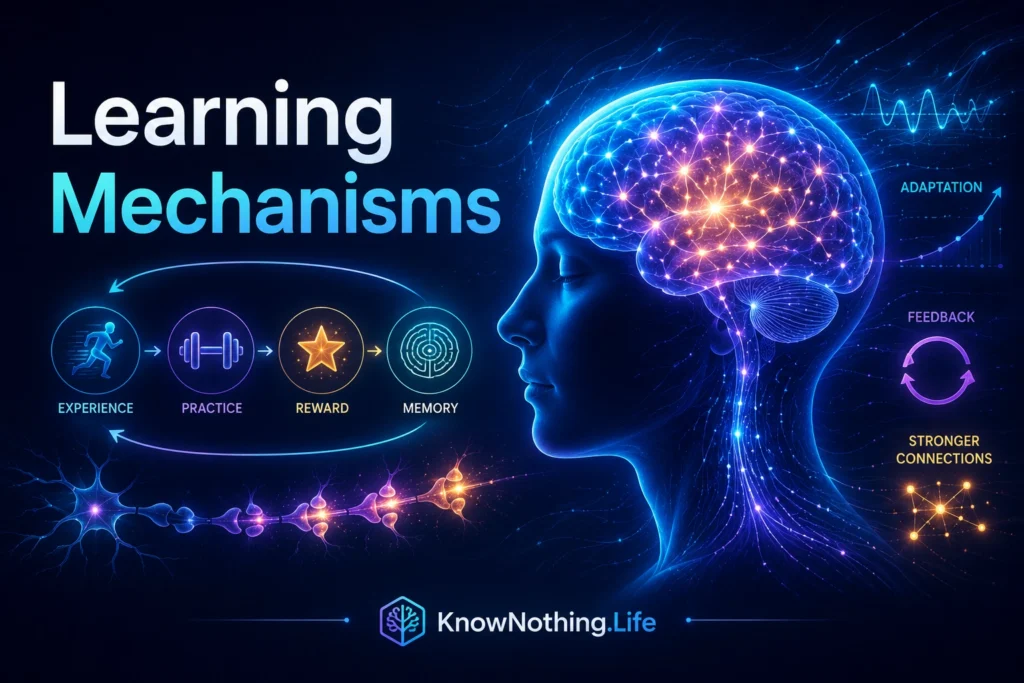
Learning mechanisms are the biological, cognitive, and behavioral processes that allow the nervous system to change through experience. Learning is not only what happens in school or during deliberate study. It occurs when a child learns a language, an athlete refines a movement, a person avoids a painful mistake, a driver recognizes a familiar route, or the brain connects a smell with a memory. At the broadest level, learning means that experience changes future perception, thought, emotion, or behavior. It is one of the central functions of the nervous system because organisms must adapt to a changing world.
Learning mechanisms operate across many levels. At the cellular level, synapses strengthen or weaken. At the circuit level, pathways become more efficient or more sensitive. At the behavioral level, actions are shaped by consequences. At the cognitive level, people form concepts, maps, rules, expectations, and memories. Neuroscience does not reduce learning to one single mechanism because the brain learns many kinds of things in many different ways. A fear association, a vocabulary word, a tennis serve, a moral lesson, and a route through a city all depend on learning, but they rely on partly different systems.
Associative Learning and Conditioning
One of the oldest scientific approaches to learning is associative learning, in which the nervous system links events that occur together or predict one another. Ivan Pavlov’s work on conditioned reflexes showed that animals could learn to respond to a previously neutral cue after it had been repeatedly paired with a biologically important stimulus. His 1927 work Conditioned Reflexes became foundational for the study of learning because it connected behavior with physiological activity in the nervous system.
Classical conditioning is not merely a laboratory curiosity. It helps explain why certain sounds, smells, places, or social cues can trigger expectation, fear, comfort, craving, or disgust. A person may feel anxious in a place where something frightening happened, or hungry when smelling a familiar food. Robert Rescorla and Allan Wagner later gave associative learning a more precise computational form, arguing that learning is especially driven by surprise or prediction error: the difference between what is expected and what actually happens. Modern reviews describe the Rescorla-Wagner model as a major framework for understanding how prediction error governs Pavlovian learning.
Reinforcement Learning and Reward Prediction
Reinforcement learning is learning from consequences. Actions that produce rewarding or useful outcomes become more likely, while actions that produce harm, failure, or no benefit may become less likely. This form of learning is central to habit formation, decision-making, motivation, addiction, skill acquisition, and everyday trial-and-error behavior. It allows organisms to discover which actions work in a particular environment without needing all rules to be known in advance.
Dopamine is strongly involved in reinforcement learning, especially through reward prediction error. Wolfram Schultz, Peter Dayan, and Read Montague’s 1997 paper, “A Neural Substrate of Prediction and Reward,” became one of the most influential studies connecting dopamine neuron activity with prediction errors. Later reviews by Schultz emphasized that reward prediction errors are differences between received and predicted rewards and are crucial for learning about rewards. This does not mean dopamine is simply a “pleasure chemical.” Its role is more precise: it helps the brain update expectations, reinforce actions, and learn from better-than-expected or worse-than-expected outcomes.
Hebbian Learning and Synaptic Change
At the neural level, one of the most famous learning principles is Hebbian learning. Donald Hebb’s 1949 book The Organization of Behavior proposed that coordinated activity between neurons could strengthen their connection. The common phrase “neurons that fire together wire together” is a simplified version of this idea, but Hebb’s deeper contribution was the concept of cell assemblies: groups of neurons whose repeated coactivation could form a functional unit. A historical review describes Hebb’s cell assembly as a set of neurons and connecting pathways that act together through reverberating activity.
Hebbian learning is important because it gives a biological logic to association. If two neural events reliably occur together, their relationship can become easier to reactivate in the future. This helps explain how repeated practice, repeated thoughts, repeated emotional responses, and repeated sensory experiences can shape neural circuits. Hebbian learning is not the only mechanism of learning, and the brain also depends heavily on inhibition, timing, neuromodulation, and error correction. Still, it remains one of neuroscience’s core ideas: experience can alter connection strength.
Long-Term Potentiation and Synaptic Plasticity
One of the best-studied cellular mechanisms of learning is long-term potentiation, or LTP. LTP is a long-lasting strengthening of synaptic transmission after certain patterns of activity. Tim Bliss and Terje Lømo’s 1973 study of the rabbit hippocampus showed that stimulation of the perforant path could produce long-lasting increases in synaptic efficiency and granule-cell excitability. This discovery became a major experimental model for how synapses might store traces of experience.
Learning also involves weakening, not only strengthening. Long-term depression, or LTD, reduces synaptic strength and helps refine circuits. Together, LTP and LTD allow the brain to adjust the influence of connections. A good learning system cannot simply strengthen everything. It must reinforce useful pathways, weaken irrelevant ones, reduce noise, and prevent instability. Synaptic plasticity therefore gives learning both flexibility and selectivity. The brain becomes better not by changing randomly, but by changing connection patterns in response to activity, feedback, and context.
Memory Consolidation and Protein Synthesis
Some learning produces short-lived changes, while other learning becomes durable. Memory consolidation is the process by which fragile new learning becomes more stable over time. Eric Kandel’s work on Aplysia helped connect learning with synaptic plasticity, molecular signaling, gene expression, and protein synthesis. In his Nobel lecture, Kandel emphasized that synaptic plasticity can be short- or long-lived depending partly on the number and spacing of learning stimuli.
Long-term learning often requires new proteins because stable circuit change requires biological construction. Receptors may be added or removed, dendritic spines may change shape, synapses may grow stronger, and gene-expression programs may help maintain altered neural function. Sleep also plays an important role in consolidation. Matthew Walker and Robert Stickgold reviewed evidence that sleep supports memory consolidation and brain plasticity, helping explain why learning is not finished at the moment of practice or study. The brain continues to process experience offline, stabilizing and reorganizing what has been learned.
Skill Learning, Error Correction, and the Cerebellum
Skill learning depends on repetition, feedback, prediction, and correction. Learning to play piano, speak a language, shoot a basketball, draw accurately, or type quickly requires the nervous system to reduce errors over many attempts. The learner does not simply “know” the skill intellectually. Motor systems, sensory feedback, cerebellar circuits, basal ganglia loops, and cortical networks must be trained to produce smoother, faster, more reliable action.
The cerebellum is especially important for error-driven motor learning. A review on motor learning described the cerebellum as essential for detecting and correcting motor errors. Masao Kawato’s computational model of cerebellar motor learning proposed a feedback-error-learning scheme, helping formalize how the nervous system can use error signals to improve future movement. This kind of learning shows why mistakes are not merely failures. They are information. The nervous system uses error to recalibrate prediction and improve control.
Cognitive Learning, Maps, and Insight
Not all learning is immediately visible in behavior. Edward Tolman challenged strict behaviorist views by showing that animals could form cognitive maps of environments. His 1948 paper “Cognitive Maps in Rats and Men” became a classic because it suggested that organisms learn internal representations, not only stimulus-response habits. A rat exploring a maze may learn its layout even before a reward reveals that learning in performance.
Human learning often works this way. People learn concepts, categories, rules, explanations, social meanings, and spatial relationships that may not be expressed immediately. A student may understand a principle before using it on a test. A traveler may absorb the structure of a neighborhood before needing directions. A child may learn social patterns before articulating them. Cognitive learning therefore includes hidden organization: the brain builds internal models that can guide future decisions when the right context appears.
Learning Systems in the Brain
Learning depends on multiple brain systems rather than one center. The hippocampus is important for episodic and relational learning. The cortex supports knowledge, perception, concepts, and long-term representation. The amygdala contributes to emotional learning, especially threat and salience. The basal ganglia support reinforcement, habit, and action selection. The cerebellum supports error correction and motor learning. Larry Squire’s work on declarative and nondeclarative memory helped show that different kinds of learning rely on different operating characteristics and brain systems.
This division explains why a person can lose one kind of learning while preserving another. Someone with damage to medial temporal lobe memory systems may struggle to form new declarative memories but still improve on certain skills. Someone with basal ganglia dysfunction may have difficulty with habits or action selection. Someone with cerebellar damage may know what movement to perform but struggle to coordinate it. Learning is therefore not one mental storage process. It is a family of adaptive systems working together.
Why Learning Mechanisms Matter
Learning mechanisms matter because they explain how experience becomes change. A stimulus becomes expectation. Practice becomes skill. Error becomes correction. Reward becomes motivation. Repetition becomes habit. Reflection becomes knowledge. Emotion becomes memory. These transformations are not vague psychological events; they depend on synapses, neurotransmitters, circuits, gene expression, sleep, attention, feedback, and behavior.
The deeper lesson is that the brain is not fixed. It is structured by biology, but continuously shaped by experience. Learning mechanisms allow humans to adapt to environments, build culture, recover from injury, acquire expertise, avoid danger, form identity, and change behavior. To understand learning mechanisms is to understand one of neuroscience’s central truths: the brain is a living system that uses experience to rewrite its own future.