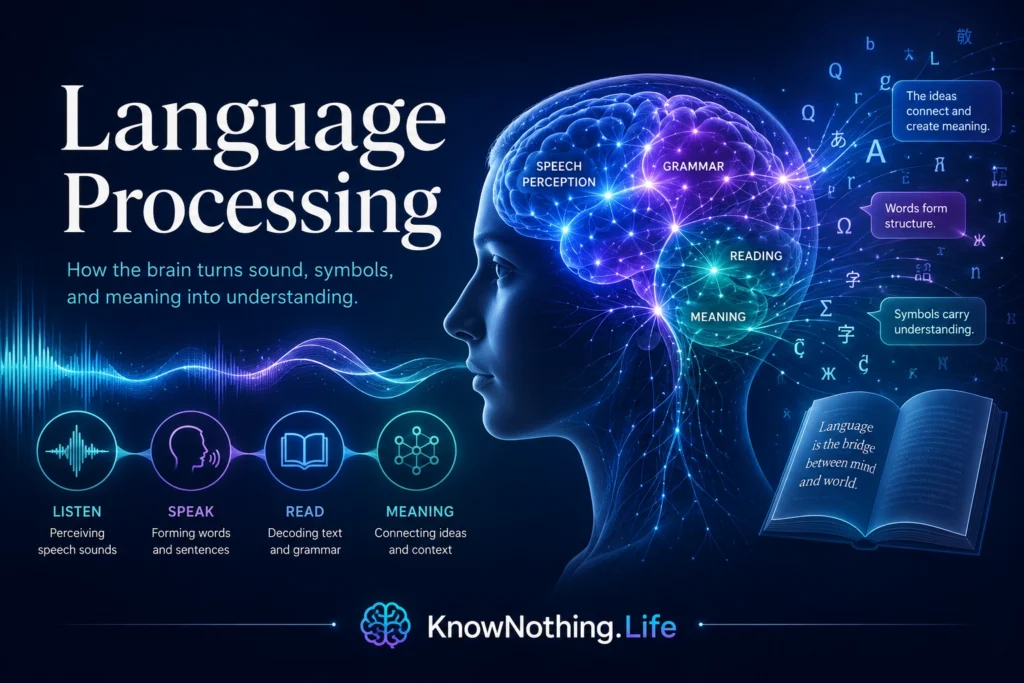
Language processing is the brain’s ability to understand, produce, read, write, and interpret language. It includes turning sound waves into speech, letters into words, words into meanings, meanings into sentences, and sentences into social communication. Language is not one simple skill. It involves hearing, vision, memory, attention, motor control, grammar, vocabulary, emotion, prediction, and social understanding. A person listening to a sentence must identify speech sounds, recognize words, interpret syntax, infer meaning, track context, and often prepare a response within fractions of a second.
Language processing is one of the most complex achievements of the human brain because it connects biology with culture. Humans are born with brains prepared for language learning, but each person learns a specific language through exposure, interaction, memory, and social use. Noam Chomsky’s work in linguistics helped shift attention toward the generative structure of language and the human capacity to produce and understand sentences never heard before. Cognitive neuroscience later added a biological question: how do brain networks make this capacity possible? Modern research shows that language depends on distributed networks, especially in the left hemisphere, rather than a single isolated “language center.”
Broca’s Area and Speech Production
One of the oldest landmarks in language neuroscience is Broca’s area, located in the inferior frontal region of the dominant hemisphere, usually the left hemisphere for most people. In the 1860s, French physician Paul Broca studied patients who had lost fluent speech after damage to the left frontal lobe. His work helped establish that language functions could be linked to specific brain regions, challenging older views that mental faculties were spread uniformly across the brain. StatPearls describes Broca’s area as involved in both language production and comprehension, with a major role in speech-related motor planning and sentence formation.
Broca’s area should not be reduced to a simple “speech output box.” People with Broca’s aphasia often have slow, effortful, nonfluent speech, but they may also struggle with grammar, sentence structure, repetition, and complex comprehension. This suggests that the region participates in organizing language, sequencing speech, and linking linguistic structure with motor output. It is especially important when speech requires controlled production, syntactic planning, and the transformation of thought into articulate expression. Broca’s area is not language by itself, but it is a major node in the network that allows language to become spoken action.
Wernicke’s Area and Language Comprehension
Another classic language region is Wernicke’s area, traditionally associated with the posterior superior temporal gyrus of the dominant hemisphere. Carl Wernicke described this area in 1874 after studying patients whose speech remained fluent but whose comprehension was severely impaired. A recent historical review describes Wernicke’s area as located in the posterior segment of the superior temporal gyrus in the dominant hemisphere, while another review notes that Wernicke’s model helped introduce the idea that language could be disrupted not only by damage to cortical centers but also by damage to connecting pathways such as the arcuate fasciculus.
Wernicke’s area is often described as the comprehension center, but that is also an oversimplification. Understanding language requires auditory processing, word recognition, semantic access, syntax, working memory, and context. The posterior temporal region is important because speech sounds must be mapped onto meaningful words and phrases. A person hearing “the glass fell off the table” must identify sounds, recognize words, determine relationships among them, and build a mental representation of an event. Wernicke’s area participates in this broader comprehension process, but modern neuroscience views comprehension as distributed across temporal, frontal, parietal, and subcortical pathways.
From Classical Centers to Language Networks
The classical Broca-Wernicke model was valuable because it showed that language has biological organization. However, modern cognitive neuroscience has moved beyond a two-center model. Language depends on networks that connect frontal, temporal, parietal, auditory, motor, and white-matter systems. The arcuate fasciculus and other pathways help link speech perception, comprehension, repetition, and production. Dronkers and colleagues describe how Wernicke incorporated Broca’s findings into a model that included connecting pathways, and how later models by Lichtheim and Geschwind shaped textbook accounts of language for generations.
Modern imaging and lesion studies show that language processing is distributed but not random. Angela Friederici’s work emphasizes that different brain regions support particular language functions, with left-lateralized temporal and inferior frontal networks especially involved in syntax, while semantic processes rely on less strictly lateralized temporo-frontal networks. This network view matters because speaking, listening, reading, and writing require different combinations of processes. A conversation activates auditory perception, word meaning, grammar, memory, emotion, social inference, and speech planning at the same time.
Speech Perception and the Dual-Stream Model
Speech perception begins with sound, but language comprehension requires more than hearing. The auditory system must identify phonemes, syllables, stress patterns, rhythm, and words even when speech is fast, accented, noisy, or incomplete. Gregory Hickok and David Poeppel’s dual-stream model has become influential because it distinguishes two broad pathways for speech processing. The ventral stream supports mapping speech sounds onto meaning, while the dorsal stream helps map speech sounds onto articulatory and motor systems.
This model helps explain why language is both perceptual and motor. When a person listens to speech, the brain is not only decoding sound; it may also activate systems related to producing speech. The dorsal pathway is especially important for repetition, phonological working memory, and the sensorimotor connection between hearing and speaking. The ventral pathway is especially important for understanding what words and sentences mean. In ordinary conversation, these streams cooperate. The listener hears sounds, recognizes words, builds meaning, predicts what may come next, and prepares a response through overlapping perceptual, semantic, and motor networks.
Syntax, Semantics, and Meaning
Language processing requires both syntax and semantics. Syntax refers to the rules and structures that organize words into meaningful sentences. Semantics refers to meaning: the concepts, categories, relationships, and references carried by words and sentences. The sentence “the dog chased the boy” differs from “the boy chased the dog” not because the words are different, but because their grammatical roles are different. The brain must track who did what to whom, when, where, and why.
Friederici’s research on the brain basis of language processing argues that syntax and semantics rely on partially different networks, with syntactic processing strongly involving left inferior frontal and temporal systems, while semantic processing is more broadly distributed. This division is useful, but real comprehension blends the two. A sentence is understood when structure and meaning converge. Grammar without meaning becomes empty form; meaning without structure becomes confusion. Language processing is the brain’s ability to combine both into a coherent mental model.
Reading, Writing, and Visual Language
Language processing is not limited to speech. Reading converts visual symbols into language. The brain must recognize letters, map them onto sounds or word forms, access meanings, and integrate words into sentences and larger ideas. Writing reverses part of this process by transforming meaning into written symbols through language planning, spelling, motor control, and visual feedback. Reading is culturally recent compared with spoken language, so the brain does not have an ancient reading organ in the same way it has older auditory and visual systems. Instead, reading recruits and reshapes existing visual, language, and attention networks.
This makes literacy a powerful example of neural plasticity. Learning to read changes how the brain processes visual symbols and connects them with speech and meaning. Skilled readers do not sound out every letter consciously. They develop fast recognition of word forms, spelling patterns, and sentence structures. Dyslexia and other reading disorders show how fragile this coordination can be when phonological processing, visual word recognition, timing, attention, or working memory systems develop differently. Written language reveals the adaptability of the language network: the brain can turn marks on a page into inner speech, abstract thought, and shared culture.
Bilingualism and Language Control
Bilingual and multilingual language processing adds another layer of complexity. A bilingual person must manage more than one sound system, vocabulary, grammar, and cultural context. The languages may influence one another, and both may be partially active even when only one is being used. This requires language control: selecting the intended language, suppressing interference, switching when needed, and adapting to conversational context. Bilingualism therefore involves not only language knowledge, but also attention, executive control, memory, and social awareness.
The bilingual brain shows that language processing is dynamic. Language is not stored as isolated dictionaries. It is embedded in networks shaped by age of acquisition, proficiency, exposure, emotional context, and use. A person may count more easily in one language, feel emotion more strongly in another, or switch languages depending on topic and audience. This flexibility illustrates a central principle of language neuroscience: language is not a fixed module sealed away from the rest of the mind. It is integrated with identity, memory, attention, emotion, and social life.
Aphasia and Clinical Importance
Aphasia is an acquired language disorder, often caused by stroke, traumatic brain injury, tumor, or neurodegenerative disease. It can affect speech production, comprehension, repetition, naming, reading, or writing. Broca’s aphasia is often associated with nonfluent, effortful speech. Wernicke’s aphasia is often associated with fluent but impaired comprehension. Conduction aphasia can involve difficulty repeating speech, often linked to damage in pathways connecting language regions. StatPearls describes aphasia as a language disorder that can involve Broca’s area, Wernicke’s area, and the arcuate fasciculus, among other structures.
Aphasia shows that language is both localized and networked. Damage to one node can produce a recognizable pattern, but real patients often show mixed symptoms because strokes and injuries do not respect textbook boundaries. Modern clinical language mapping uses neuropsychological testing, structural imaging, functional imaging, and sometimes direct cortical stimulation during brain surgery. The goal is not only to understand language, but to preserve and restore it. Language is central to independence, relationships, work, memory, and identity, which is why aphasia can be so life-altering.
Why Language Processing Matters
Language processing matters because language is one of the main ways human beings think, learn, remember, teach, plan, persuade, comfort, argue, and belong. It allows private thought to become public communication. It allows culture to move across generations. It allows a person to name the world, describe the past, imagine the future, and share inner experience with others. Neuroscience shows that this ability depends on coordinated brain networks rather than a single language organ.
The deeper lesson is that language is biological, cognitive, and social at once. Speech requires muscles and motor plans. Comprehension requires auditory and semantic systems. Grammar requires structural processing. Reading requires visual-symbolic mapping. Conversation requires memory, attention, emotion, and theory of mind. To understand language processing is to understand one of neuroscience’s most human questions: how a living brain turns sound and symbols into meaning, and meaning into connection.