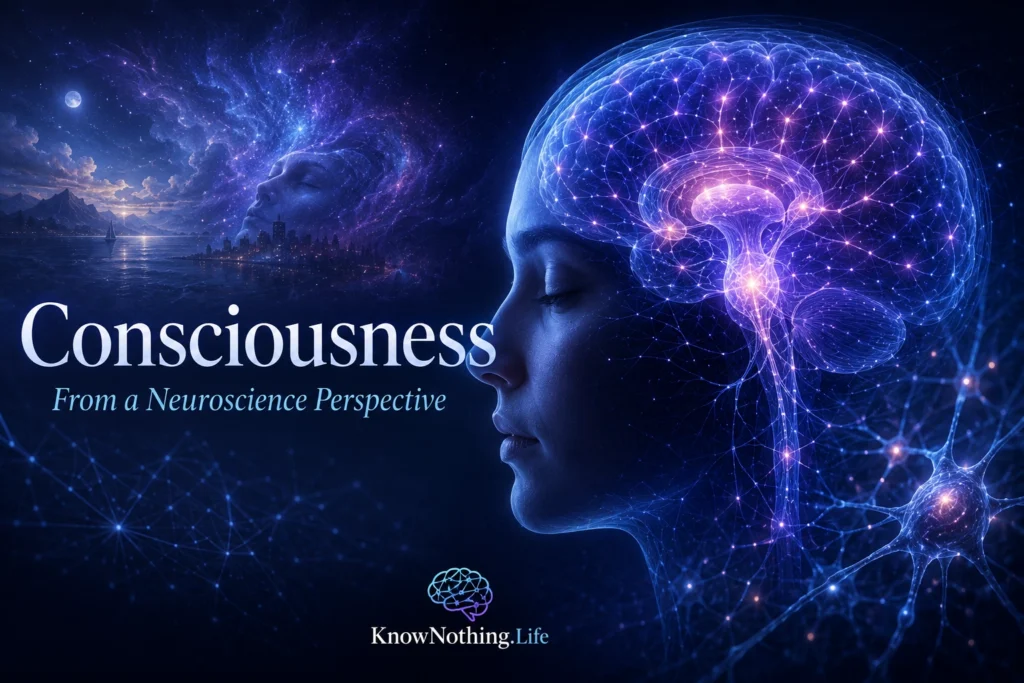
From a neuroscience perspective, consciousness usually refers to the brain’s capacity for subjective experience and awareness. It includes the basic state of being awake or aware, as well as the specific contents of experience: seeing a color, hearing a voice, feeling pain, remembering a moment, noticing one’s body, or thinking a thought. Neuroscientists often distinguish between the level of consciousness and the contents of consciousness. Level refers to global state, such as wakefulness, sleep, anesthesia, coma, or minimally conscious state. Content refers to what is experienced at a given moment. A person may be awake but not aware of a particular stimulus, or dreaming while disconnected from the outside world.
Consciousness is difficult to study because it is both private and biological. Scientists can measure behavior, brain activity, eye movements, speech, neural rhythms, blood flow, and responses to stimulation, but subjective experience itself is known directly only from the first-person point of view. This makes consciousness different from many other neuroscience topics. Still, the scientific study of consciousness has made major progress by examining neural correlates of consciousness, anesthesia, sleep, dreaming, attention, perception, brain injury, and disorders of consciousness. The goal is not to explain consciousness with one simple brain region, but to understand which neural mechanisms are necessary for conscious state and conscious content.
Wakefulness, Arousal, and Brain State
Consciousness requires more than sensory processing. The brain must also maintain a state that can support awareness. Arousal systems in the brainstem, hypothalamus, basal forebrain, and thalamus help regulate wakefulness, sleep, alertness, and responsiveness. Damage to these systems can severely reduce consciousness even if parts of the cortex remain structurally intact. Recent reviews emphasize that consciousness depends on interactions among brainstem arousal nuclei, thalamic systems, and thalamocortical networks rather than on the cortex alone.
The thalamus is especially important because it helps regulate communication across the cortex and contributes to both conscious state and conscious content. A 2024 review in Neuron argued that the thalamus contributes not only to global states such as sleep and wakefulness, but also to the integrated and continuous nature of conscious experience. A 2025 systematic review also found strong evidence for central thalamic regions in the generation, modulation, and maintenance of consciousness level. This does not mean the thalamus is “the seat of consciousness.” Rather, it is part of a larger system that helps the brain sustain the conditions under which experience becomes possible.
Neural Correlates of Consciousness
The neural correlates of consciousness, often abbreviated NCC, are the minimal neural mechanisms sufficient for a particular conscious experience. For example, scientists may ask what changes in the brain when a visual stimulus is consciously seen rather than processed unconsciously. This approach allows researchers to compare brain activity across conditions where the stimulus is present but awareness differs. The aim is to separate neural activity related to consciousness itself from activity related to attention, reporting, memory, decision-making, or motor response.
A major debate concerns whether the most important correlates of conscious content lie mainly in posterior sensory cortices, frontoparietal networks, or broader recurrent systems. Koch and colleagues reviewed evidence suggesting that the anatomical neural correlates of specific conscious percepts are often localized to a posterior cortical “hot zone” involving sensory regions rather than primarily to frontoparietal networks used for task reporting and monitoring. This view remains debated, but it has pushed researchers to distinguish consciousness from the ability to verbally report consciousness. A person’s report may require frontal and language systems, while the experience itself may depend more heavily on posterior cortical networks.
Attention and Conscious Awareness
Attention and consciousness are closely related, but they are not identical. Attention selects information for priority processing, while consciousness refers to subjective experience. A person can attend to something without fully becoming aware of all its features, and some experiences can occur with little deliberate attention. Still, attention often increases the likelihood that a stimulus becomes conscious. It amplifies certain signals, stabilizes neural representations, and helps selected information influence memory, decisions, and action.
This distinction is important because many experiments on consciousness require a participant to report what they saw, heard, or felt. Reporting requires attention, working memory, language, decision-making, and motor output. If researchers are not careful, they may confuse the neural correlates of consciousness with the neural correlates of reporting about consciousness. This is why “no-report” paradigms have become important in the field. These methods attempt to infer conscious perception without requiring explicit verbal or button-press reports, helping scientists separate experience from the cognitive machinery used to describe it.
Global Neuronal Workspace Theory
One influential theory is Global Neuronal Workspace Theory, associated with Bernard Baars, Stanislas Dehaene, Jean-Pierre Changeux, and others. The theory proposes that information becomes conscious when it is amplified and broadcast across a large-scale network, making it globally available to many specialized brain systems. A review by Mashour and colleagues describes the global neuronal workspace hypothesis as involving nonlinear “ignition,” recurrent processing, amplification, and sustained neural representation that allows information to be accessed by multiple processors.
This theory explains why conscious information can be reported, remembered, used for planning, and shared across cognition. A visual signal that remains local and weak may influence behavior unconsciously, but a signal that ignites the global workspace can become available to attention, memory, language, and action. Global workspace theory therefore treats consciousness partly as access: information becomes conscious when it is no longer trapped in one local processor, but becomes available to the wider brain. Critics argue that this may explain conscious access and reportability more clearly than subjective feeling itself, but it remains one of the most productive frameworks in consciousness science.
Integrated Information Theory
Another major theory is Integrated Information Theory, developed by Giulio Tononi and colleagues. IIT begins from the structure of experience itself and asks what kind of physical system could account for it. Tononi’s original 2004 paper presented a theory of what consciousness is and how it might be measured, while a later Nature Reviews Neuroscience article described IIT as deriving requirements for the physical substrate of consciousness from the essential properties of phenomenal experience.
IIT emphasizes that conscious experience is both differentiated and unified. At any moment, experience contains many possible distinctions, but it is also integrated into one whole. According to IIT, a conscious system must have intrinsic causal power organized in a way that is both informative and irreducible. This theory is ambitious because it attempts to explain not only when consciousness occurs, but also why experience has a specific structure. It is also controversial. Some researchers see IIT as a powerful formal theory; others challenge its assumptions, testability, or implications. A 2025 Nature adversarial collaboration directly compared predictions of IIT and Global Neuronal Workspace Theory, showing how the field is increasingly using structured tests rather than only philosophical debate.
Consciousness, Complexity, Sleep, and Anesthesia
One of the most practical ways to study consciousness is to compare the awake brain with states such as deep sleep and anesthesia. During unconscious states, the brain may still show activity, but that activity often becomes less complex, less integrated in the right way, or less capable of sustaining differentiated communication. This is why consciousness is not simply “more activity.” A seizure can involve massive neural activity without normal consciousness. Deep sleep can involve synchronized waves that are widespread but not richly differentiated.
Marcello Massimini, Adenauer Casali, and colleagues developed the perturbational complexity index, or PCI, to estimate consciousness by stimulating the cortex with transcranial magnetic stimulation and measuring the complexity of the EEG response. A 2013 Science Translational Medicine study introduced PCI as a theory-driven index of consciousness, and later work has examined PCI across sleep, anesthesia, and disorders of consciousness. This approach is important because it does not rely only on whether a person can speak or move. It asks whether the brain can generate a complex, integrated response to perturbation, which may be closer to the biological capacity for consciousness.
Disorders of Consciousness
Disorders of consciousness show why this research matters medically and ethically. Coma, unresponsive wakefulness syndrome, vegetative state, minimally conscious state, and cognitive motor dissociation all involve different relationships between wakefulness, awareness, behavior, and brain activity. Giacino and colleagues defined the minimally conscious state as a condition with inconsistent but clearly discernible behavioral evidence of consciousness, distinguishable from coma and vegetative state.
Brain imaging and EEG have shown that some patients who appear behaviorally unresponsive may still have covert awareness. Monti and colleagues reported that a small proportion of patients diagnosed as vegetative or minimally conscious showed brain activation reflecting awareness and cognition, and that such methods might help establish basic communication in some apparently unresponsive patients. A 2024 study of cognitive motor dissociation found that some patients unable to respond behaviorally could perform cognitive tasks detectable with fMRI or EEG. These findings are profound because they show that the absence of movement is not always the absence of consciousness.
The Limits of Current Neuroscience
Neuroscience has made progress in identifying the systems associated with conscious state, conscious perception, reportability, complexity, and awareness after brain injury. But no theory has fully solved consciousness. Global workspace theory explains access, broadcasting, and reportable awareness. Integrated information theory emphasizes intrinsic causal structure and unified experience. Posterior hot-zone theories focus on the sensory cortical regions most closely tied to specific contents. Thalamocortical and arousal theories explain the state conditions that allow consciousness to occur. Each framework captures part of the problem.
The remaining difficulty is that consciousness is not just information processing from an outside perspective. It is lived experience from the inside. Neuroscience can identify correlations, mechanisms, disruptions, and clinical markers, but explaining why certain neural activity feels like something remains one of the hardest problems in science. A careful neuroscience perspective should therefore avoid both extremes: it should not pretend consciousness is already fully explained, but it should not treat consciousness as beyond science. The most useful view is that consciousness is biologically grounded, scientifically measurable in important ways, and still theoretically incomplete.
Why Consciousness Matters
Consciousness matters because it is the condition under which the world appears to someone. It allows pain to hurt, music to move, memories to return, colors to glow, choices to feel personal, and life to have a first-person point of view. From a neuroscience perspective, consciousness depends on arousal systems, thalamocortical loops, cortical networks, recurrent processing, integration, complexity, attention, memory, and bodily state. It is not produced by one tiny location, but by organized brain activity across multiple systems.
The deeper lesson is that consciousness is not separate from the nervous system, but neither is it reducible to a single switch. It is a dynamic biological process involving wakefulness, awareness, integration, differentiation, and meaningful content. To study consciousness scientifically is to study how matter becomes experience: how neural activity becomes a world, a body, a self, and a moment that feels like something from within.