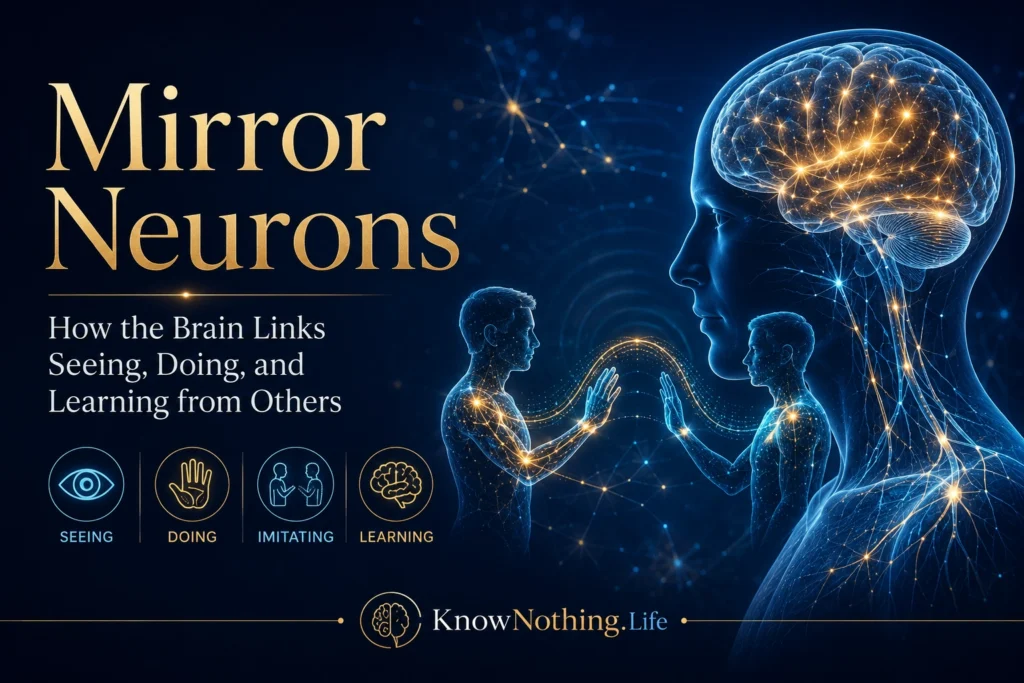
Mirror neurons are nerve cells that become active both when an individual performs a particular action and when that individual observes a similar action performed by someone else. They were first identified in the early 1990s by researchers studying area F5 of the macaque premotor cortex. In the original experiments, some neurons fired when a monkey grasped or manipulated an object and also when it watched an experimenter perform a comparable goal-directed movement. The response generally required a meaningful interaction between an agent and an object rather than the mere sight of an isolated hand or object.
The discovery suggested that the motor system does more than issue commands to muscles. It may also participate in representing the actions of others by mapping observed events onto neural patterns related to the observer’s own movement repertoire. Vittorio Gallese, Luciano Fadiga, Leonardo Fogassi, and Giacomo Rizzolatti described 92 mirror neurons in macaque area F5 and found that many showed a close relationship between the observed action and the action coded during execution. Some were broadly congruent, responding to the same general goal achieved in different ways, while others were highly specific to movements such as a precision grip.
From Monkeys to the Human Brain
Directly recording individual neurons is rarely possible in healthy humans, so most human research has relied on functional magnetic resonance imaging, electroencephalography, magnetoencephalography, and transcranial magnetic stimulation. These methods cannot ordinarily prove that a particular cell is a mirror neuron, but they can identify regions that respond during both action observation and action execution. Human studies consistently implicate a frontoparietal action-observation network that includes portions of the inferior frontal gyrus, ventral premotor cortex, inferior parietal lobule, and sensorimotor cortex.
Giovanni Buccino and colleagues found that watching actions involving the mouth, hand, or foot activated premotor and parietal areas in a roughly somatotopic pattern, meaning that different observed body parts recruited different sectors of the motor system. Marco Iacoboni and colleagues likewise found overlapping inferior frontal and parietal activity during observation and imitation of finger movements. More direct evidence came from Roy Mukamel and colleagues, who recorded individual neurons in patients undergoing clinical monitoring and found cells in supplementary motor and medial temporal regions that responded during both the observation and execution of hand actions or facial expressions.
Action Recognition, Goals, and Prediction
One influential proposal is that mirror neurons help the brain recognize actions by translating what is seen into a motor format. Evidence from macaques shows that some mirror neurons respond even when the final phase of a familiar grasp is hidden behind a screen, provided the monkey has enough contextual information to infer what is happening. Other neurons respond when an action is heard rather than seen. Evelyne Kohler and colleagues found audiovisual mirror neurons that fired when monkeys performed actions such as breaking a peanut and when they merely heard the characteristic sounds of those actions.
These findings suggest that some mirror responses represent more than a visual snapshot of movement. They may encode an action’s goal, likely outcome, or sensory consequences. Yet motor matching is only one part of action understanding. Recognizing why a person reaches toward a cup may require knowledge of the setting, the person’s beliefs, and whether the cup is being used for drinking, cleaning, or demonstration. Studies comparing action observation with explicit judgments about intentions show that mentalizing regions outside the classic mirror network become especially important when observers infer hidden motives or beliefs.
Imitation and Observational Learning
Mirror mechanisms are well suited to imitation because they provide a possible bridge between seeing a movement and producing a related movement. In a landmark imaging study, Iacoboni and colleagues reported increased activity in inferior frontal and parietal regions when participants imitated observed finger actions. Transcranial magnetic stimulation experiments have also shown that watching another person move can selectively increase excitability in the observer’s motor pathways, often in muscles corresponding to those used in the observed action. The brain appears to prepare elements of an observed movement without necessarily producing it.
Observation can improve later performance even without immediate physical practice. Paul Mattar and Paul Gribble found that participants learned aspects of a novel motor environment by watching another person adapt to it, although learning depended on the relationship between the observed movement and its outcome. Research on complex action sequences likewise shows that observation recruits frontoparietal action systems together with basal ganglia, cerebellar, and memory networks. Mirror-like activity may therefore support observational learning, but successful learning also requires attention, prediction, error monitoring, memory, and knowledge of consequences.
Mirror Neurons, Emotion, and Empathy
Mirror neurons are often presented as the biological foundation of empathy, but the evidence requires careful interpretation. Observing facial expressions, touch, pain, or emotion can activate some of the same broad brain regions involved in personally experiencing related states. These shared activations may help an observer simulate visible expressions or bodily conditions. However, shared regional activity does not demonstrate that the same individual neurons are active, nor does it show that motor mirroring alone produces compassionate understanding.
Empathy includes emotional resonance, perspective-taking, self–other distinction, memory, attention, and concern for another person’s welfare. Critical reviews have concluded that the motor mirror system may contribute to recognizing expressions and linking perception with bodily representations, but it cannot by itself explain the full complexity of empathy. Someone can imitate an expression without understanding its cause, understand another person’s distress without reproducing the expression, or accurately read another person’s state without caring about it. Mirror processes are therefore best viewed as one component within broader social, emotional, and mentalizing networks.
Are Mirror Neurons Innate or Learned?
Early accounts sometimes treated mirror neurons as an evolutionary adaptation specifically designed for action understanding. An alternative associative-learning account, developed prominently by Cecilia Heyes, proposes that mirror properties emerge through repeated sensorimotor experience. People frequently see their own hands while moving them, watch themselves in mirrors, imitate caregivers, and experience other people responding to their actions. These correlated visual and motor events could strengthen connections between sensory descriptions of actions and the motor programs used to perform them.
Experimental findings support substantial plasticity. Sensorimotor training can strengthen ordinary mirror-like responses or create “counter-mirror” effects in which observing one movement facilitates a different trained movement. Caroline Catmur and colleagues showed that premotor stimulation influenced both mirror and counter-mirror motor facilitation after participants learned unusual observation–execution pairings. Other work has found that experience with particular skills changes how action-observation networks respond to familiar movements. Such results do not prove that every mirror neuron is entirely learned, but they demonstrate that experience can reshape the correspondence between seen and performed actions.
Scientific Debate and the Limits of the Theory
The strongest controversy concerns whether mirror neurons are necessary for understanding actions. Gregory Hickok argued that the classic theory faces several problems, including evidence that people can understand actions they cannot perform and that damage to motor regions does not always eliminate action recognition. Neuroimaging overlap also has limits: the fact that the same area is active during seeing and doing does not prove that identical neurons or computations are involved. Some adaptation studies have failed to find the cross-modal repetition effects expected from a simple shared neural code.
Researchers must also distinguish a mirror neuron from a mirror-neuron system. A mirror neuron is an individual cell identified through direct recording. A human mirror system is generally inferred from regional activity, connectivity, motor facilitation, or behavioral effects. Functional imaging measures the combined activity of large populations of cells, many of which may perform different tasks. Describing an area as having “mirror properties” is therefore scientifically safer than assuming that all activity within it comes from neurons that match observation and execution. The direct human recordings by Mukamel and colleagues confirmed that matching neurons exist, but they also revealed diverse response patterns, including neurons excited during execution and inhibited during observation.
The Modern Understanding of Mirror Neurons
Criticism of sweeping claims does not make mirror neurons unimportant. Meta-analyses identify a reliable human action-observation network with mirror-like properties, while physiological studies show that observing movements can influence the observer’s motor system in muscle-specific and time-sensitive ways. The more defensible conclusion is that mirror mechanisms help connect perception and action, facilitate prediction and imitation, and contribute to learning from other people. They operate alongside visual analysis, conceptual knowledge, mentalizing, memory, emotion, and executive control rather than replacing those systems.
Mirror neurons transformed neuroscience because they challenged the assumption that perception and action are sharply separate. Watching another person act can prepare the observer’s motor system, activate learned movement representations, and make behavior easier to predict or reproduce. Their significance lies not in offering a single explanation for language, empathy, culture, autism, or social intelligence, but in revealing an important principle of brain organization: understanding events often involves partially reusing systems that allow the body to act within the world.