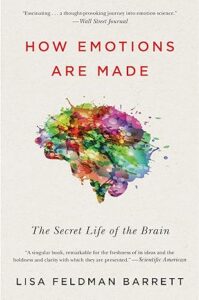
How Emotions Are Made (2017) by Lisa Feldman Barrett challenges the traditional view that emotions are hardwired, universal reactions, arguing instead that they are constructed by the brain.
Drawing on neuroscience and psychology, Barrett proposes the “theory of constructed emotion,” which holds that the brain uses past experience, cultural concepts, and bodily sensations to predict and create emotional experiences in the moment. Rather than being triggered automatically by specific stimuli, emotions like anger, fear, or happiness are assembled by the brain as interpretations that help regulate the body and guide action.
She disputes the idea of universal facial expressions and emotion “fingerprints,” suggesting that emotional life is more variable and context-dependent than commonly believed. Ultimately, the book reframes emotions not as fixed biological reflexes but as dynamic, learned processes—deeply shaped by language, culture, and individual history.