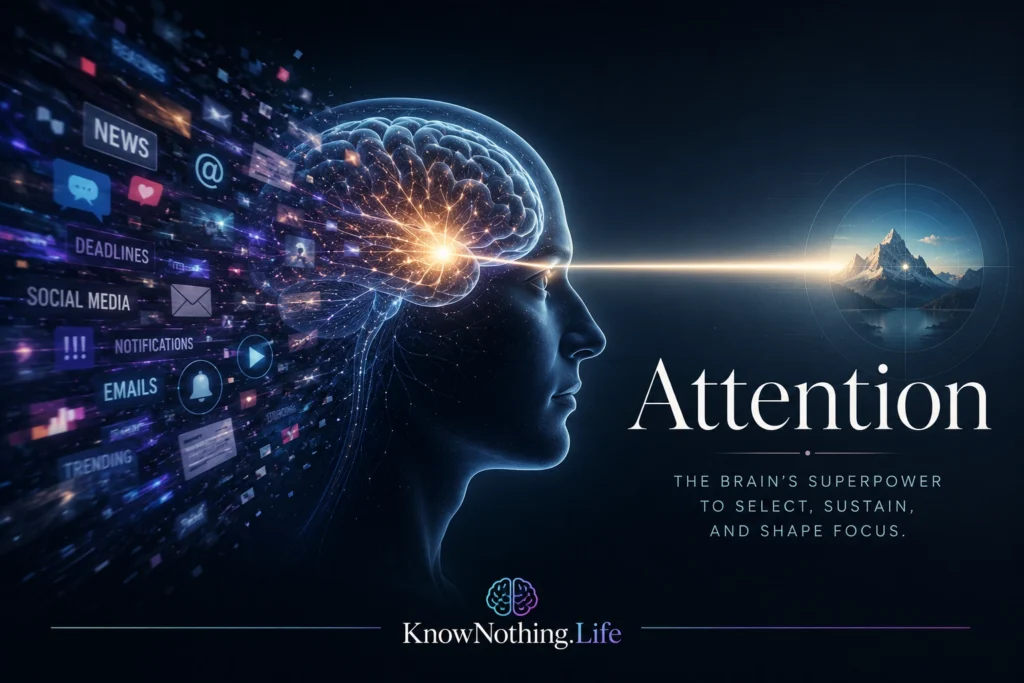
Attention is the brain’s ability to select some information for deeper processing while limiting, suppressing, or delaying other information. It allows a person to read a sentence in a noisy room, follow one voice in a crowd, drive while monitoring traffic, notice a sudden movement, or stay focused on a difficult task. Attention is not a single mental spotlight. It is a family of processes that includes alertness, orienting, selective attention, sustained attention, divided attention, executive control, and the ability to shift between tasks. Michael Posner and Steven Petersen’s influential 1990 review, “The Attention System of the Human Brain,” helped frame attention as a networked brain system rather than one isolated faculty.
Attention matters because the brain is always receiving more information than it can fully process at once. Sounds, sights, bodily sensations, memories, worries, goals, and emotions compete for priority. Without attention, mental life would be flooded by undifferentiated input. With attention, the brain can organize experience according to relevance. It can ask, in effect: What matters now? What should be ignored? What should be acted on? Attention is therefore one of the central mechanisms connecting perception, thought, memory, emotion, and behavior.
Selective Attention and the Bottleneck Problem
Selective attention is the ability to focus on one source of information while filtering out others. This is the process used when someone listens to one conversation at a party while ignoring nearby voices, or when a student searches a page for one important term. Early attention theories emphasized the idea of a bottleneck: because information-processing capacity is limited, some information must be selected before everything can receive full analysis. Donald Broadbent’s 1958 book Perception and Communication became a classic early model of selective attention, proposing that attention filters information partly on physical features before deeper processing occurs.
Later research showed that selection is more flexible than a single early filter. Unattended information can sometimes influence awareness, especially when it is emotionally important, personally meaningful, or strongly connected to current goals. This means attention is not merely a gate that opens or closes. It is a dynamic priority system. The brain can select based on physical features, meaning, expectation, threat, reward, novelty, or task relevance. Selective attention helps protect the mind from overload while still allowing important unexpected events to break through.
Feature Integration and Visual Attention
Visual attention is especially important because the visual world contains many features at once: color, shape, motion, location, brightness, depth, and texture. Anne Treisman and Garry Gelade’s 1980 feature-integration theory proposed that attention helps bind separate visual features into coherent objects. Their classic paper argued that some simple features can be detected efficiently, while combinations of features often require focused attention.
This theory helped explain why the brain can quickly notice a red dot among green dots, but may need more focused search to find a red vertical line among red horizontal and green vertical distractors. In the first case, one feature stands out. In the second, features must be combined correctly. Later reviews describe Treisman’s feature-integration theory as one of the most influential models in the history of attention research. The larger lesson is that perception is constructed. The brain does not simply receive finished objects. It organizes features into meaningful things, and attention helps determine how that organization happens.
Sustained Attention and Vigilance
Sustained attention is the ability to maintain focus over time. It is used when watching the road during a long drive, studying for an exam, monitoring a screen, listening through a long lecture, or staying alert during repetitive work. Sustained attention is difficult because the brain naturally fluctuates. Fatigue, boredom, stress, sleep loss, emotion, and distraction can all reduce vigilance. Unlike brief selective attention, sustained attention requires maintaining readiness even when nothing interesting is happening.
This form of attention is central to safety and performance. Pilots, drivers, surgeons, air-traffic controllers, security workers, students, and machine operators all depend on sustained attention. The challenge is that attention declines when tasks are monotonous but still important. A person may be most likely to miss a signal precisely when the task feels routine. Sustained attention therefore depends not only on motivation, but also on arousal, sleep, working memory, frontal-parietal control networks, and the brain’s ability to resist mind-wandering.
Divided Attention and Mental Effort
Divided attention is the ability to manage more than one stream of information or task at a time. In everyday language, people call this multitasking. However, cognitive science has repeatedly shown that multitasking is often task-switching rather than true simultaneous performance. The brain can handle some parallel processes, especially when one task is automatic, but performance usually declines when two tasks require the same limited cognitive resources. Daniel Kahneman’s 1973 book Attention and Effort helped popularize a resource-based view of attention, emphasizing that mental effort is limited and must be allocated among competing demands.
This explains why a person can walk and talk easily, but may struggle to text while driving, solve math while listening to instructions, or read while following a conversation. Attention is limited because tasks compete for working memory, perception, response selection, and executive control. Practice can reduce the demand of some tasks by making them more automatic, but automaticity is not the same as unlimited capacity. Divided attention works best when tasks are simple, practiced, or use different systems; it breaks down when both require conscious control.
Attention Networks in the Brain
Modern cognitive neuroscience often describes attention through interacting brain networks. Posner and Petersen’s model identified major systems related to alerting, orienting, and executive control, and later work expanded this framework. Petersen and Posner’s 2012 review noted that the original attention-network framework helped integrate behavioral, systems, cellular, and molecular approaches, and that later research added more detailed brain networks involved in orienting and executive function.
The alerting network helps maintain readiness. The orienting network helps select information from a location or sensory channel. The executive-control network helps resolve conflict, inhibit distractions, and guide behavior according to goals. Jin Fan and colleagues developed the Attention Network Test to measure alerting, orienting, and executive attention within a single testing session. These networks do not function as isolated modules. They interact constantly. A sudden noise may trigger alerting, orienting may shift attention toward the source, and executive control may decide whether it is relevant or should be ignored.
Top-Down and Bottom-Up Attention
Attention can be guided from the inside or captured from the outside. Top-down attention is goal-directed. It happens when a person looks for a lost key, listens for a name, reads a paragraph carefully, or focuses on a task despite distraction. Bottom-up attention is stimulus-driven. It happens when a flashing light, loud crash, sudden movement, or emotional expression captures awareness automatically. Both forms are necessary. Top-down attention supports goals, while bottom-up attention protects the organism from missing important unexpected events.
Maurizio Corbetta and Gordon Shulman’s 2002 review proposed that partially separate brain networks support goal-directed and stimulus-driven attention. They described a dorsal frontoparietal system involved in preparing and applying top-down selection, and a more ventral system involved in detecting behaviorally relevant or unexpected stimuli. This distinction helps explain everyday conflict. A person may intend to study, but a phone notification captures attention. A driver may focus on the road ahead, but sudden motion at the side pulls attention away. Attention is therefore a competition between goals and salience.
Attention, Working Memory, and Executive Control
Attention is closely tied to working memory, the system that holds information temporarily available for use. When someone solves a problem, follows directions, reads a complex sentence, or plans a sequence of actions, attention helps keep relevant information active while suppressing irrelevant information. Working memory without attention would be unstable; attention without working memory would be shallow. Together, they allow thought to continue across time.
Executive attention is the control side of attention. It helps resist impulses, resolve conflict, shift strategies, and keep behavior aligned with goals. This is the kind of attention required when someone ignores a distraction, corrects an error, stops an automatic response, or chooses a long-term goal over an immediate temptation. Executive attention depends heavily on frontal and parietal systems, but it also interacts with emotion, reward, habit, and bodily state. A tired, stressed, hungry, anxious, or overstimulated brain has a harder time maintaining executive control.
Attention and Emotion
Attention and emotion are deeply connected. Emotional stimuli often capture attention because they may signal danger, reward, social meaning, or personal importance. A fearful face, angry voice, sudden threat, or emotionally charged memory can redirect attention quickly. This is adaptive when emotional signals are relevant, but it can become harmful when attention is repeatedly pulled toward worry, threat, shame, craving, or rumination. Anxiety, for example, often involves heightened attention to possible danger, while depression may involve difficulty disengaging from negative thoughts.
Emotion also influences what becomes memorable. When attention is captured by emotionally intense material, memory systems may prioritize it. This is why emotionally meaningful events can feel vivid and hard to ignore. However, emotional attention can distort judgment if it narrows awareness too much. A healthy attention system does not eliminate emotion. It allows emotion to inform attention without completely controlling it.
Attention, ADHD, and Clinical Importance
Attention is clinically important because many disorders affect attention directly or indirectly. Attention-deficit/hyperactivity disorder, traumatic brain injury, anxiety, depression, dementia, schizophrenia, sleep disorders, chronic pain, and substance-use disorders can all alter attention. ADHD is especially associated with difficulties in sustained attention, inhibitory control, motivation regulation, response variability, and executive function. A review on ADHD and attention networks discussed major neural systems relevant to ADHD, including attention networks, reward and feedback processing, timing, and default-mode interference.
Attention problems are not simply laziness or lack of willpower. They often reflect differences in arousal regulation, executive control, reward sensitivity, sleep, stress, working memory, or network coordination. This is why attention can improve or worsen depending on interest, structure, deadlines, novelty, medication, fatigue, environment, and emotional state. Clinical attention is not just the ability to “try harder.” It is the nervous system’s ability to allocate limited processing resources in a stable and adaptive way.
Why Attention Matters
Attention matters because it shapes consciousness. What a person attends to becomes clearer, more influential, more memorable, and more likely to guide action. Attention determines whether the mind stays with a task, drifts into memory, scans for threat, follows a goal, responds to novelty, or becomes captured by distraction. It is one of the brain’s main tools for organizing mental life.
The deeper lesson is that attention is not merely concentration. It is selection, readiness, effort, control, filtering, shifting, and prioritization. It connects perception with action, memory with goals, emotion with awareness, and the brain with the world. To understand attention is to understand one of neuroscience’s central truths: the mind is not defined only by what information enters it, but by what it selects, sustains, and uses.