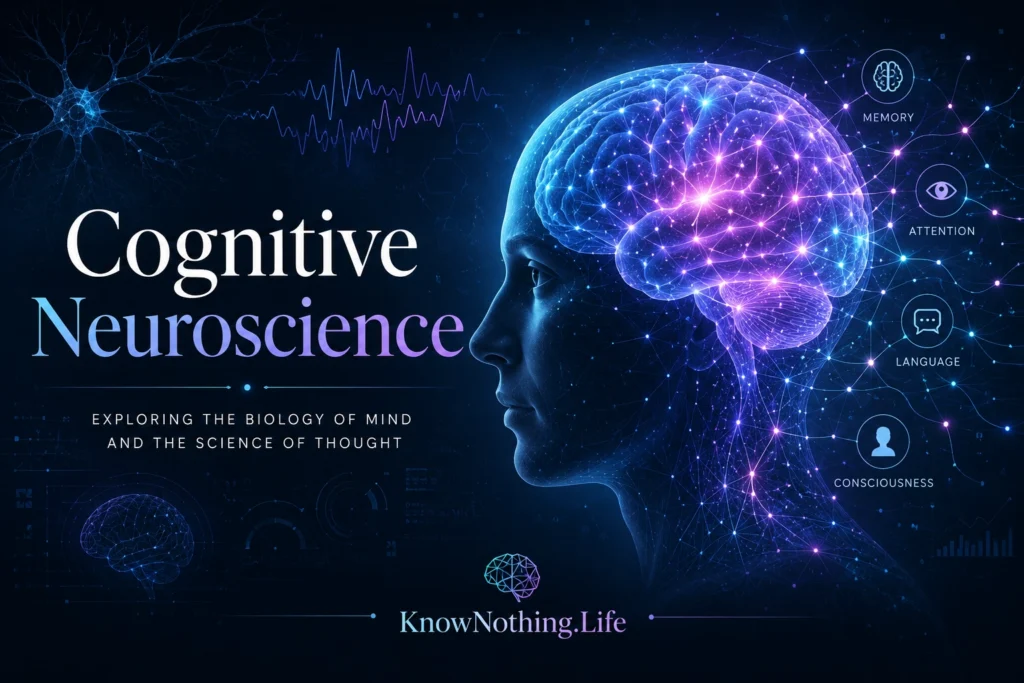
Cognitive neuroscience is the scientific study of how the brain supports the mind. It asks how neural systems make possible perception, attention, memory, language, reasoning, decision-making, emotion, self-awareness, imagination, and consciousness. Cognitive psychology traditionally studied mental processes through behavior and information processing, while neuroscience studied the nervous system through anatomy, physiology, and biology. Cognitive neuroscience brings these fields together. It tries to explain how mental operations are generated by the brain’s information-processing architecture, while also recognizing that cognition is shaped by the body, environment, culture, and social life. A review in Frontiers in Systems Neuroscience describes cognitive neuroscience as seeking the biological foundations of the human mind.
The field is important because human experience cannot be understood only by studying isolated neurons, and it cannot be fully explained by behavior alone. Remembering a childhood event, recognizing a face, solving a problem, reading a sentence, or resisting an impulse involves many levels at once: molecules, synapses, neural circuits, brain regions, body states, learned meanings, and conscious goals. Cognitive neuroscience therefore works across levels. It asks not only what people do, but what brain systems allow them to do it; not only which brain regions activate, but what computations and representations those regions support.
Origins and Major Ideas
Cognitive neuroscience emerged from several traditions, including neuropsychology, experimental psychology, neurology, computer science, linguistics, philosophy of mind, and systems neuroscience. Michael Gazzaniga is widely described as one of the founders of the field, especially through his split-brain research and his role in building institutions such as the Cognitive Neuroscience Society and the Journal of Cognitive Neuroscience. A PubMed interview describes Gazzaniga as “widely considered the father of the field of cognitive neuroscience” and notes his influence in founding major centers and organizations devoted to the field.
Another major influence was David Marr, whose 1982 work Vision argued that complex cognitive systems should be understood at multiple levels: what problem is being solved, what representations and algorithms solve it, and how those operations are physically implemented in the brain. A 2026 MIT Open Encyclopedia of Cognitive Science entry summarizes Marr’s framework as involving computational, algorithmic, and implementation levels. This framework remains useful because cognitive neuroscience must connect mental function with biological mechanism. It is not enough to say that the brain “lights up” during a task. Scientists must ask what information is represented, how it is transformed, and how neural tissue makes that transformation possible.
Attention and Perception
Attention is one of cognitive neuroscience’s central topics because the brain cannot process everything with equal depth at once. Attention selects information, enhances some signals, suppresses others, and helps coordinate perception and action. Michael Posner and Steven Petersen’s influential 1990 paper, “The Attention System of the Human Brain,” helped frame attention as a set of interacting brain systems rather than one single mental spotlight. This approach helped move the study of attention away from vague introspection and toward identifiable networks involved in alerting, orienting, and executive control.
Perception is also active rather than passive. The visual system does not merely receive pictures; it extracts features, organizes objects, recognizes patterns, and connects perception with meaning. Nancy Kanwisher and colleagues’ 1997 study of the fusiform face area became a landmark because it identified a region of human extrastriate cortex strongly associated with face perception. Work like this does not mean that a single region “contains” face recognition in isolation. Rather, it shows how specialized processing systems can contribute to larger cognitive networks. Perception is built from cooperation among sensory pathways, memory systems, attention systems, and decision systems.
Memory and Mental Time Travel
Memory is one of the clearest examples of how cognition depends on brain systems. Endel Tulving’s distinction between episodic and semantic memory reshaped cognitive science by separating memory for personally experienced events from memory for general knowledge. A review of episodic and semantic memory notes that Tulving’s 1972 theory distinguished semantic memory as general knowledge from episodic memory as memory for events. Episodic memory allows people to mentally revisit a specific time and place, while semantic memory allows them to know facts, meanings, categories, and concepts.
Modern cognitive neuroscience shows that memory is constructive. The hippocampus helps bind elements of experience, the prefrontal cortex helps organize retrieval, the amygdala influences emotional memory, and cortical networks store distributed knowledge over time. Tulving later described episodic memory as a neurocognitive brain-mind system that enables humans to remember past events. active maintenance of goal-related patterns of activity in the prefrontal cortex, allowing behavior to be organized according to internal aims rather than immediate impulses.
This idea helps explain why human cognition is flexible. People can follow rules, delay gratification, switch strategies, hold instructions in mind, and act for reasons that are not immediately present. Cognitive control also explains why the same stimulus can produce different behavior depending on context. A red light means stop while driving, but it may mean something else in a laboratory task, a theater, or a warning display. The brain does not simply react to stimuli. It interprets them through goals, rules, memory, and context.
Emotion, Decision-Making, and the Body
Cognitive neuroscience has also challenged the old idea that reason and emotion are separate systems. Emotion shapes attention, memory, valuation, risk assessment, and action. Antonio Damasio’s somatic marker hypothesis argued that body-related emotional signals help guide decision-making, especially when choices are complex ommary of Damasio’s 1996 paper states that the hypothesis proposes “marker” signals that influence responses to stimuli across multiple levels of operation.
This view does not mean that every feeling is automatically wise or that emotion should dominate reason. It means that cognition is embodied. The brain evaluates choices partly through signals from the body, autonomic nervous system, memory, and emotional learning. Fear can bias attention toward threat, disgust can guide avoidance, guilt can shape social repair, and reward anticipation can motivate pursuit. Cognitive neuroscience therefore studies emotion not as an interruption of thought, but as one of the systems through which the brain assigns meaning and value.
Brain Networks and the Resting Mind
One of cognitive neuroscience’s major shifts has been from isolated regions to large-scale networks. The brain is active even when a person is not performing an obvious task. Marcus Raichle and colleagues’ 2001 pape brain function proposed that certain organized brain activity decreases during specific goal-directed tasks, suggesting a baseline mode of brain function. Later work connected the default mode network with self-referential thought, memory, imagination, social cognition, and internal mentation.
This network perspective matters because cognition is distributed. Language involves temporal, frontal, parietal, motor, and auditory systems. Memory involves hippocampal, cortical, thalamic, and prefrontal systems. Attention involves frontal and parietal networks. Self-reflection involves default-mode and control networks. A thought is not usually located in one brain spot. It emerges from coordinated activity across systems that exchange information, compete, synchronize, and regulate one another.
Clinical Importance of Cognitive Neuroscience
Cognitive neuroscience has practical importance for understanding brain injury, dementia, attention disorders, language disorders, psychiatric conditions, developmental differences, addiction, trauma, and aging. Neuropsychological testing can reveal which cognitive systems are impaired. Brain imaging can help identify networks involved in symptoms. Computational models can test theories of how cognition breaks down. The field has also influenced education, rehabilitation, psychotherapy, artificial intelligence, and human-computer interaction.
Its clinical value comes from connecting symptoms to mechanisms. A person with memory impairment may have hippocampal or network-level dysfunction. A person with poor impulse control may have altered prefrontal-basal ganglia regulation. A person with depression may show changes in mood, reward, attention, self-referential thought, and bodily regulation. Cognitive neuroscience does not reduce people to brain scans. Instead, it gives medicine and psychology a richer language for understanding how mind, brain, body, and behavior interact.
Why Cognitive Neuroscience Matters
Cognitive neuroscience matters because it addresses one of the deepest questions in science: how does biological tissue create mental life? It shows that thinking is not separate from the brain, but it also shows that the brain is not a simple machine with one region for each ability. Human cognition arises from dynamic systems: neurons, synapses, circuits, brain regions, body states, social contexts, and learned meanings working together.
The deeper lesson is that the mind is both biological and organized. Memory, attention, language, emotion, and consciousness are not mysterious substances floating above the brain, but neither are they explained by a single cell or chemical. They emerge from patterns of activity shaped by evolution, development, learning, culture, and personal history. To understand cognitive neuroscience is to understan the bridge between brain and mind: the living systems through which matter becomes perception, thought, meaning, and self-awareness.