Neurochemistry is the study of the chemical processes that make the nervous system work. It focuses on neurotransmitters, neuromodulators, receptors, enzymes, hormones, ions, proteins, metabolites, and molecular pathways that allow neurons and glial cells to communicate. If neuroanatomy explains where brain structures are, and neurophysiology explains how electrical signals move, neurochemistry explains the chemical language beneath those signals. Every thought, sensation, movement, memory, emotion, habit, sleep rhythm, and stress response depends on chemical activity inside and between nervous-system cells.
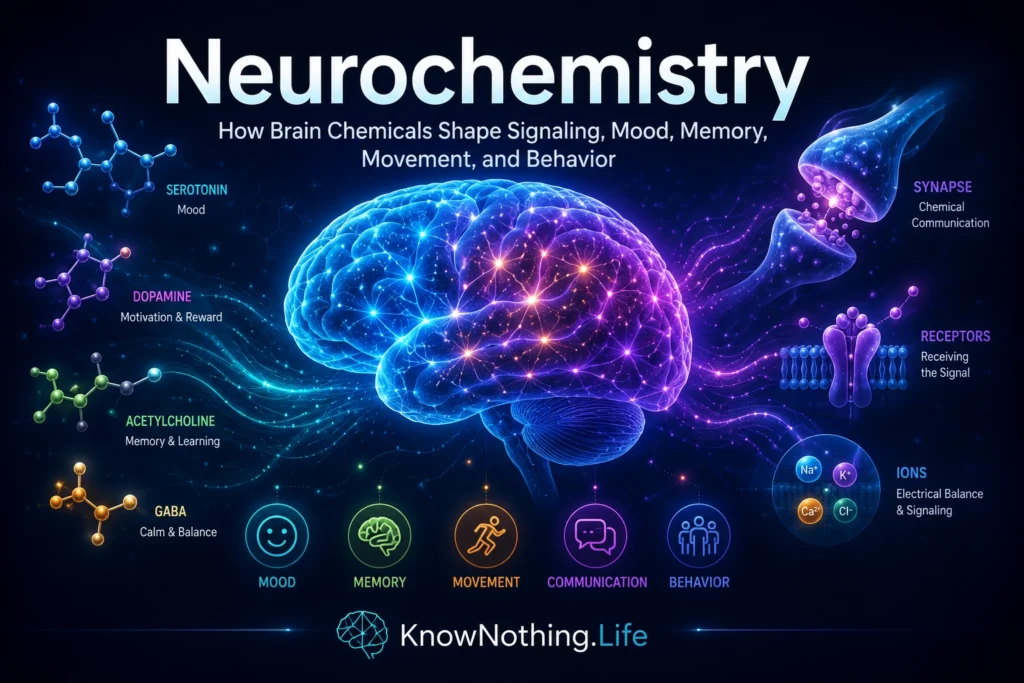
The brain is often described as an electrical organ, but it is equally a chemical organ. Action potentials carry electrical signals along neurons, but communication between neurons usually depends on chemical messengers released at synapses. Neurotransmitters such as glutamate, GABA, dopamine, serotonin, norepinephrine, acetylcholine, and glycine help regulate excitation, inhibition, arousal, attention, movement, mood, learning, and bodily control. A medical overview of neurotransmitter physiology identifies acetylcholine, glutamate, GABA, glycine, dopamine, norepinephrine, and serotonin as major neurotransmitters, with glutamate described as the principal excitatory neurotransmitter in the brain.
Neurotransmitters and the Chemical Synapse
The most familiar part of neurochemistry is synaptic transmission. When an electrical impulse reaches the end of a neuron, it can trigger the release of neurotransmitters into the synaptic cleft. These molecules cross the small gap between cells and bind to receptors on the receiving neuron, muscle cell, or gland cell. The result may be excitation, inhibition, or modulation. This is how one neuron influences the next. Neural communication is therefore not simply a wire-like electrical event; it is an electrochemical process in which voltage, calcium, vesicles, neurotransmitters, receptors, and enzymes all work together.
Different neurotransmitters serve different roles, but none has one simple meaning everywhere in the brain. Glutamate usually drives excitation, GABA usually supports inhibition, dopamine helps shape movement and reward learning, serotonin participates in mood and regulation, norepinephrine supports arousal and vigilance, and acetylcholine contributes to attention, memory, autonomic function, and muscle activation. Their effects depend on receptor type, brain region, timing, and circuit context. A neurotransmitter is not a feeling by itself. It is a chemical signal interpreted by a living network.
Glutamate, GABA, and Neural Balance
Glutamate and GABA form one of the most important chemical partnerships in the nervous system. Glutamate is the major excitatory neurotransmitter, helping neurons activate, communicate, and undergo synaptic plasticity. It is essential for perception, learning, memory, movement, and cortical processing. But glutamate must be carefully regulated because too much excitation can destabilize circuits or damage neurons. NCBI’s overview of the glutamatergic system describes glutamate as the major excitatory neurotransmitter in the nervous system and notes that glutamate dysfunction can have serious consequences in disease and injury.
GABA is the brain’s major inhibitory neurotransmitter and provides the restraint that makes precise signaling possible. Inhibition does not simply turn the brain off. It shapes timing, suppresses noise, regulates rhythms, prevents runaway activity, and allows attention and movement to remain controlled. The relationship between glutamate and GABA is often described as excitation-inhibition balance. Healthy brain function depends on this balance because the nervous system must be active enough to process information but stable enough to avoid chaos. Much of neurochemistry is the study of how this chemical balance is created, adjusted, and sometimes disrupted.
Dopamine, Motivation, and Movement
Dopamine is one of the most famous brain chemicals, but it is often oversimplified. It is not merely a pleasure chemical. Dopamine participates in movement, motivation, reward learning, reinforcement, attention, habit formation, and prediction. Dopamine systems help the brain learn which actions are worth repeating and which outcomes are better or worse than expected. This makes dopamine central to motivation, but also to motor control and clinical disorders involving movement and compulsive behavior.
The importance of dopamine became clear through the work of Swedish pharmacologist Arvid Carlsson. In the late 1950s, Carlsson showed that dopamine was a neurotransmitter in the brain rather than merely a precursor of norepinephrine, and he found high dopamine concentrations in the basal ganglia. His work helped connect dopamine depletion with Parkinsonian movement symptoms and opened the way for L-DOPA treatment in Parkinson’s disease. This discovery changed neuroscience because it showed that a specific chemical system could explain major features of a neurological disorder and could be targeted therapeutically.
Serotonin, Norepinephrine, and Brain States
Serotonin is involved in mood, sleep, appetite, pain, digestion, sexual function, impulse regulation, and emotional processing. Many serotonin-producing neurons arise from the raphe nuclei in the brainstem and project widely across the brain, which helps explain why serotonin-related drugs can affect many functions at once. Serotonin should not be reduced to happiness. Its role is broader and more regulatory, influencing how brain systems respond to internal state, environmental stress, and behavioral context.
Norepinephrine, also called noradrenaline, is strongly involved in alertness, vigilance, stress response, attention, and readiness for action. Much of the brain’s norepinephrine comes from the locus coeruleus, a small brainstem nucleus with widespread projections. When a person becomes startled, focused, anxious, challenged, or alert, norepinephrine systems help adjust brain and body state. Together, serotonin and norepinephrine show that neurochemistry is not only about moment-to-moment synaptic messages. It also shapes broader states of consciousness, energy, mood, attention, and bodily readiness.
Acetylcholine and Chemical Transmission
Acetylcholine is involved in muscle contraction, autonomic nervous-system function, attention, learning, memory, and sleep. At the neuromuscular junction, motor neurons release acetylcholine to activate skeletal muscle. In the brain, cholinergic systems help regulate attention and memory-related processing. In the autonomic nervous system, acetylcholine participates in parasympathetic functions such as digestion, gland secretion, and internal regulation. Its wide range of effects shows how one neurotransmitter can act differently depending on where it is released and which receptors are present.
Acetylcholine also has a major place in the history of neurochemistry. Henry Dale and Otto Loewi helped establish the principle of chemical neurotransmission. Loewi’s famous experiments suggested that nerve stimulation could release a chemical substance affecting heart activity, and Dale’s work helped identify acetylcholine’s role in nervous-system signaling. Their discoveries helped shift neuroscience away from a purely electrical view of nerve communication and toward the modern electrochemical model of synaptic function.
Neurochemistry, Astrocytes, and Brain Metabolism
Neurochemistry is not only about neurons. Astrocytes and other glial cells help regulate the chemical environment of the brain. Astrocytes take up neurotransmitters, regulate extracellular ions, support metabolism, contribute to the blood-brain barrier, and help maintain synaptic function. One important example is the glutamate/GABA-glutamine cycle. In this cycle, astrocytes take up glutamate and GABA from synapses, convert these neurotransmitters into glutamine, and provide glutamine back to neurons as a precursor for new neurotransmitter synthesis.
This metabolic partnership shows that brain chemistry is circular and cooperative. Neurotransmitters are not simply released and forgotten. They must be cleared, recycled, rebuilt, and balanced. Energy metabolism is also closely tied to neurotransmission because active neurons require ATP, glucose, oxygen, mitochondrial function, and astrocyte support. Studies of brain energetics and the glutamate-glutamine cycle emphasize that neuronal activity depends on metabolic cooperation between neurons and astrocytes. Neurochemistry therefore includes both signaling chemistry and the metabolic chemistry that keeps signaling possible.
Neurochemistry, Plasticity, and Memory
Learning changes brain chemistry. When neurons fire together repeatedly, synapses can strengthen or weaken, receptor numbers can shift, intracellular pathways can activate, and gene expression can change. Long-term memory often requires more than a temporary electrical pattern. It depends on molecular changes that stabilize altered communication between neurons. Eric Kandel’s Nobel lecture, “The Molecular Biology of Memory Storage,” emphasized the relationship between genes, synapses, and memory, showing how long-term memory involves molecular processes that change synaptic function.
This makes neurochemistry central to plasticity. Calcium signaling, glutamate receptors, dopamine modulation, cyclic AMP, protein kinases, CREB-dependent gene transcription, and synaptic protein synthesis all help turn experience into lasting change. A memory is not a single chemical, and learning is not a simple chemical switch. But chemical mechanisms allow experience to modify circuits. Neurochemistry explains how a conversation, lesson, trauma, reward, habit, or skill can leave a biological trace in the nervous system.
Clinical Importance of Neurochemistry
Many neurological and psychiatric conditions involve neurochemical disruption. Parkinson’s disease involves dopamine loss in motor circuits. Epilepsy can involve imbalances between excitation and inhibition. Depression, anxiety, schizophrenia, addiction, migraine, chronic pain, Alzheimer’s disease, and sleep disorders all involve neurotransmitters, receptors, signaling pathways, inflammation, metabolism, plasticity, and circuit regulation. This does not mean every disorder is caused by a simple “chemical imbalance.” That phrase is too crude. Brain disorders usually involve networks, genes, environment, development, stress, immune activity, and brain-body systems as well as chemistry.
Still, neurochemistry is central to treatment. Antidepressants can affect serotonin, norepinephrine, or dopamine signaling. Antipsychotics often influence dopamine receptors. Benzodiazepines enhance GABA-related inhibition. Antiseizure medications may alter ion channels, glutamate signaling, or GABA function. Parkinson’s medications target dopamine pathways. Anesthetics, pain medications, stimulants, and sleep medications also work by changing chemical signaling. Neurochemistry matters clinically because changing chemical communication can change movement, mood, consciousness, pain, attention, and behavior.
Why Neurochemistry Matters
Neurochemistry matters because it reveals the brain as a chemical communication system. Electrical impulses are essential, but chemicals determine how neurons influence one another, how circuits change, how moods shift, how memories consolidate, how movement is controlled, and how the body responds to stress. The brain’s chemistry is not separate from thought and behavior. It is one of the biological foundations that makes thought and behavior possible.
The deeper lesson is that human experience depends on regulated chemical balance. Too much or too little signaling can disrupt function. Poor clearance, receptor changes, metabolic stress, inflammation, or neurotransmitter dysfunction can alter entire circuits. But healthy neurochemistry is not about one perfect level of one chemical. It is about dynamic coordination among many systems. To understand neurochemistry is to understand one of neuroscience’s central truths: the mind emerges from living cells that communicate through molecules, electricity, energy, and time.