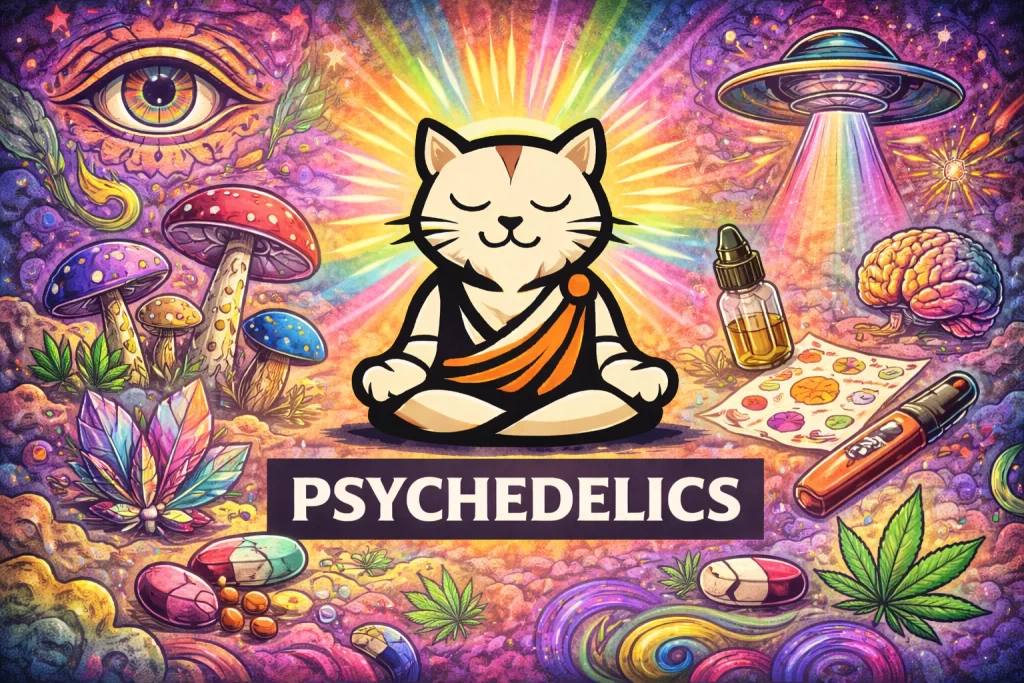
Psychedelics occupy a strange and shifting place in human history. Once revered as sacred tools, later condemned as dangerous drugs, and now cautiously reexamined by science, they sit at the intersection of neuroscience, spirituality, culture, and philosophy. Substances such as Lysergic acid diethylamide (LSD), Psilocybin, N,N-Dimethyltryptamine (DMT), and Mescaline have the unusual capacity to alter perception, emotion, and the sense of self in profound ways. To understand psychedelics is to confront questions not only about chemistry, but about consciousness itself.
Altered States and the Brain
Psychedelics primarily affect serotonin receptors in the brain, particularly the 5-HT2A receptor, which plays a role in mood, cognition, and perception. Neuroimaging studies suggest that these substances temporarily reduce activity in the brain’s default mode network—a system associated with self-referential thinking and the maintenance of a stable ego. When this network quiets, users often report a dissolution of the boundaries between self and world, a phenomenon sometimes called “ego dissolution.”
Subjectively, psychedelic experiences can include vivid visual distortions, intensified emotions, synesthesia, and a heightened sense of meaning. Time may feel stretched or compressed. Ordinary objects may appear luminous or symbolically charged. For some, these experiences are deeply mystical; for others, they can be confusing or distressing. The effects depend heavily on “set and setting”—the individual’s mindset and the environment in which the experience occurs.
Modern research has revived interest in psychedelics as potential therapeutic tools. Clinical studies have explored the use of psilocybin-assisted therapy for depression, anxiety associated with terminal illness, and addiction. Early findings suggest that, in controlled settings with professional guidance, these substances may help individuals reframe rigid thought patterns or confront suppressed emotions. However, psychedelics are not universally beneficial and carry psychological risks, particularly for individuals predisposed to psychotic disorders. Their power lies precisely in their capacity to destabilize ordinary mental frameworks.
Meaning, Culture, and Controversy
Long before contemporary laboratories began studying psychedelics, many Indigenous cultures incorporated psychoactive plants into spiritual and communal rituals. In these contexts, altered states were not recreational diversions but sacred encounters—means of accessing insight, healing, or communion with the divine. Modern Western societies, by contrast, often oscillated between fascination and fear. The cultural upheavals of the 1960s linked psychedelics to countercultural movements, provoking legal prohibitions that halted research for decades.
Today, a cautious renaissance is underway. Universities and medical institutions are reopening lines of inquiry that were once closed. At the same time, commercialization raises ethical questions. Who benefits from psychedelic research? How should traditional knowledge be respected? Can substances rooted in ritual contexts be ethically integrated into clinical practice?
Philosophically, psychedelics challenge assumptions about reality and identity. If a small molecule can radically alter one’s perception of self and world, what does that imply about the stability of consciousness? Are mystical experiences chemically induced illusions, or do they reveal aspects of mind normally hidden? Such questions do not yield easy answers, but they underscore the importance of approaching psychedelics with humility rather than hype.
In the end, psychedelics are neither miracle cures nor mere escapist tools. They are catalysts—capable of amplifying insight, confusion, healing, or fear, depending on context. Their renewed study reflects a broader human curiosity about consciousness and suffering. As research progresses, the challenge will be to balance scientific rigor, cultural respect, and ethical responsibility, ensuring that exploration of altered states deepens understanding rather than repeating past excesses.