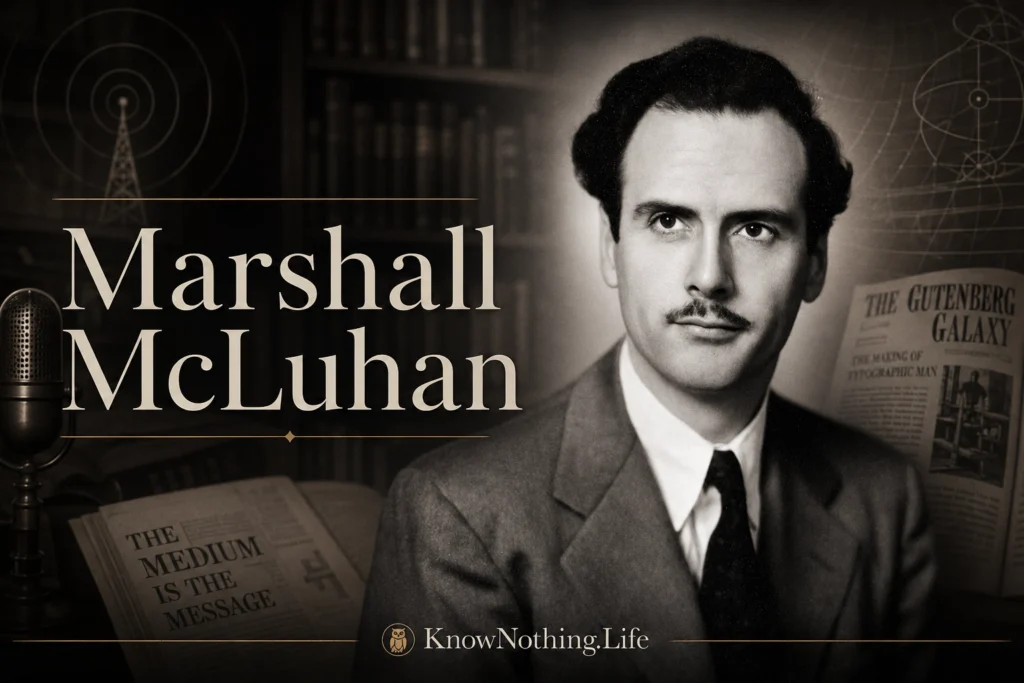
Marshall McLuhan was a Canadian literary scholar, communication theorist, and public intellectual whose ideas transformed the study of media. Long before smartphones and social networks, he argued that technologies do more than transmit information. They reorganize perception, reshape institutions, and change the scale at which people live together. His best-known statement, “the medium is the message,” condensed this argument into a phrase that entered popular language. McLuhan was not saying that content had no importance. He was directing attention toward the deeper effects of a medium, which often remain unnoticed when people focus on programs and messages rather than the structures carrying them.
His work crossed literature, psychology, anthropology, art, education, advertising, and technology. McLuhan wrote in an unconventional style filled with puns, historical juxtapositions, and compressed statements that he called “probes.” Critics found him obscure or exaggerated, while admirers saw an unusual ability to recognize patterns before they became obvious. His reputation rose during the 1960s, faded after his death, and returned with the internet age, when the global village, technological extensions, and simultaneous communication appeared newly relevant. His lasting importance comes less from predicting specific inventions than from teaching readers to examine how every medium quietly changes its users.
Early Life and Education
Herbert Marshall McLuhan was born on July 21, 1911, in Edmonton, Alberta, and grew up largely in Winnipeg. His father worked in real estate and insurance, while his mother, Elsie Naomi Hall, became an actress and dramatic reader. Her performances exposed him to the sound and emotional force of language, interests that later shaped his attention to speech, print, and sensory experience. At the University of Manitoba, McLuhan moved from engineering into English, completing a bachelor’s degree in 1932 and a master’s degree in 1934. His thesis examined the poet and novelist George Meredith.
A scholarship took him to the University of Cambridge, where he studied the close analysis of language associated with I. A. Richards and encountered modernist writers such as T. S. Eliot, Ezra Pound, and James Joyce. Cambridge trained him to examine not only what a text said but how its form produced effects. He received another bachelor’s degree in 1936, later completed a master’s degree, and earned a doctorate for research on Thomas Nashe and the classical trivium. His media theory grew from this literary background: he treated technologies as forms whose structures could be interpreted as carefully as poems.
Teaching, Faith, and Popular Culture
McLuhan’s first university appointment was at the University of Wisconsin in 1936. The experience unsettled him because the habits and references of his students seemed unfamiliar. He later recalled, “I was confronted with young Americans I was incapable of understanding.” Instead of dismissing their interests, he began studying advertising, radio, movies, and comic strips. McLuhan taught at Saint Louis University from 1937 to 1944, converted to Roman Catholicism in 1937, and married Corinne Keller Lewis in 1939. After teaching at Assumption College in Windsor, he joined St. Michael’s College at the University of Toronto in 1946.
At Toronto, he formed an intellectual network that included anthropologist Edmund Carpenter and communication historian Harold Innis. Innis’s research on the political and cultural biases of communication systems became an important influence, although McLuhan emphasized sensory and psychological effects. With Ford Foundation support, he helped establish an interdisciplinary seminar on culture and communication and coedited the journal Explorations. In 1963, the University of Toronto created the Centre for Culture and Technology under his direction, providing an institutional home for research into the psychic and social consequences of media.
Major Works and the Global Village
McLuhan’s first major book, The Mechanical Bride: Folklore of Industrial Man, appeared in 1951. Using advertisements, newspaper pages, and comic strips as evidence, he examined the myths embedded in commercial imagery. Its fragmented format invited readers to enter at different points rather than follow a conventional thesis. Advertising became a public dream through which industrial society revealed its desires, anxieties, and mechanical view of the body. Although the book initially attracted limited attention, it anticipated later cultural studies by treating popular media as serious systems of persuasion and perception.
His international reputation began with The Gutenberg Galaxy: The Making of Typographic Man in 1962. McLuhan argued that movable type strengthened habits of uniformity, sequence, repeatability, individualism, and specialization. Print did not merely distribute existing ideas; it encouraged new forms of consciousness and social organization. He contrasted typography’s linear order with the simultaneity of electronic communication, which was reconnecting distant populations in a “global village.” McLuhan did not imagine that village as a peaceful utopia. Greater proximity could create participation and awareness, but it could also intensify disagreement, pressure, and conflict.
Understanding Media and Technological Extensions
McLuhan presented his most influential theory in Understanding Media: The Extensions of Man, published in 1964. He defined media broadly to include clothing, roads, money, clocks, automobiles, electric light, and weapons as well as print, radio, film, and television. Each medium extends a human faculty while modifying relationships among the senses and altering patterns of association. The wheel extends the foot, clothing extends the skin, and electronic communication extends the nervous system across distance. Because these extensions become environments, their most powerful consequences are difficult to perceive from within them.
“The medium is the message” expressed his focus on structural consequences. A technology’s message, McLuhan explained, is the change in scale, pace, or pattern it introduces into human affairs. He also wrote that “the content of any medium is always another medium”: speech becomes the content of writing, writing becomes the content of print, and print becomes the content of telegraphy. Content may therefore distract people from wider transformations. A television program matters, but television also changes domestic space, political performance, attention, and expectations of immediacy regardless of what appears on the screen.
Public Fame, Later Works, and Legacy
The success of Understanding Media turned McLuhan into an unusual academic celebrity. He appeared on television, addressed executives, gave a widely discussed interview to Playboy, and played himself in Woody Allen’s Annie Hall. His public persona combined seriousness, humor, and deliberate provocation. His aphorism “We look at the present through a rear-view mirror” described society’s tendency to interpret new technologies through assumptions inherited from older media. Created with Quentin Fiore, The Medium Is the Massage: An Inventory of Effects used photographs and disruptive typography to enact its argument; “massage” began as a typesetting error that McLuhan enthusiastically accepted.
Other important works included War and Peace in the Global Village, Through the Vanishing Point, Culture Is Our Business, From Cliché to Archetype, and Take Today: The Executive as Dropout. McLuhan became a fellow of the Royal Society of Canada and a Companion of the Order of Canada. A severe stroke in 1979 impaired his speech, and he died in Toronto on December 31, 1980. The digital age later revived his reputation. Online networks confirm his warning that connection does not guarantee harmony and that every medium creates an environment before users recognize it. His enduring lesson is to ask not only what technology delivers, but how it changes perception, behavior, memory, work, and human relationships.