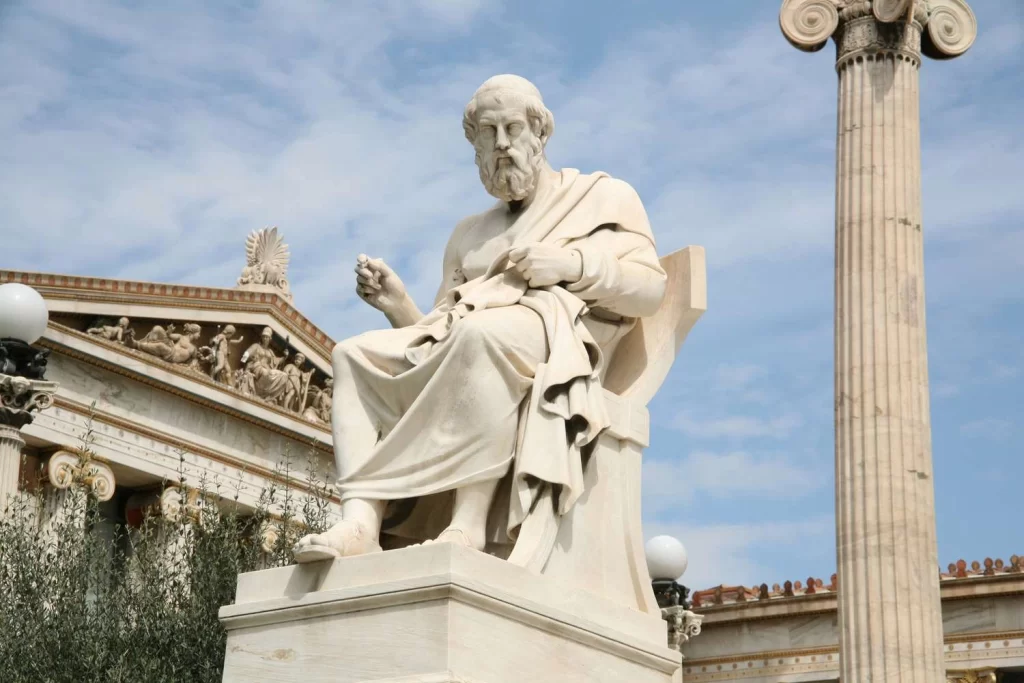
Plato stands as one of the foundational figures of Western philosophy. Born in Athens around 427 BCE during the turbulence of the Peloponnesian War, he would go on to shape Western thought more profoundly than almost any other philosopher. His reflections on truth, justice, politics, and knowledge continue to define philosophical inquiry more than two thousand years later.
Early Life and Influences
Plato was born into an aristocratic Athenian family with political connections. His birth name may have been Aristocles; “Plato,” meaning “broad,” was likely a nickname referring to his physical build or intellectual breadth. Growing up in a city known for its democratic experiments, dramatic arts, and intellectual vibrancy, he was exposed early to political debate and cultural achievement.
The most decisive influence on Plato’s life was his association with Socrates. As a young man, Plato became a devoted student of Socrates, who challenged conventional wisdom through relentless questioning. Socrates’ trial and execution in 399 BCE profoundly affected Plato. Witnessing his teacher condemned by democratic Athens deepened his skepticism about popular rule and intensified his search for stable foundations of justice and knowledge. After Socrates’ death, Plato traveled widely—possibly to Egypt and southern Italy—before eventually returning to Athens to develop his own philosophical system.
The Theory of Forms
One of Plato’s most influential contributions is the Theory of Forms. He argued that the world we perceive through our senses is not the ultimate reality but a shadow of a higher, intelligible realm. In dialogues such as The Republic and Phaedo, Plato suggests that beyond particular objects—beautiful paintings, just laws, equal lines—there exist perfect, unchanging Forms: Beauty itself, Justice itself, Equality itself.
According to this view, the physical world is in constant flux, while the Forms are eternal and immutable. Knowledge, therefore, is not merely sensory observation but rational insight into these deeper realities. Plato’s famous Allegory of the Cave illustrates this distinction. Prisoners chained inside a cave mistake shadows for reality, until one escapes and sees the true source of light. Philosophy, for Plato, is this ascent from illusion to truth.
Politics and the Just Society
Plato’s political philosophy is inseparable from his broader metaphysical vision. In The Republic, he asks: What is justice? His answer unfolds into a model of an ideal city-state governed by philosopher-kings—leaders trained in reason and virtue rather than ambition or wealth. Only those who grasp the Form of the Good, he argues, are fit to rule.
He divides society into three classes: rulers, guardians (soldiers), and producers. Justice consists in harmony among these groups, each performing its proper function. Though critics have labeled his vision authoritarian, Plato believed that wisdom—not popularity—should guide political life. His distrust of democracy was shaped by the execution of Socrates, which he saw as evidence of the dangers of uninformed public opinion.
Plato eventually founded the Academy in Athens, one of the earliest institutions of higher learning in the Western world. There, students studied mathematics, ethics, and metaphysics. Among them was Aristotle, who would later develop his own influential philosophical system.
Enduring Influence
Plato’s legacy extends across philosophy, theology, science, and political theory. His dialogues continue to shape debates about reality, knowledge, morality, and governance. Whether embraced or challenged, his ideas form the backbone of much of Western intellectual history.
At the core of Plato’s work lies a profound conviction: that truth and goodness are real and discoverable, and that human beings are capable of orienting their lives toward them. For Plato, philosophy was not merely abstract speculation—it was a transformative journey of the soul toward wisdom.