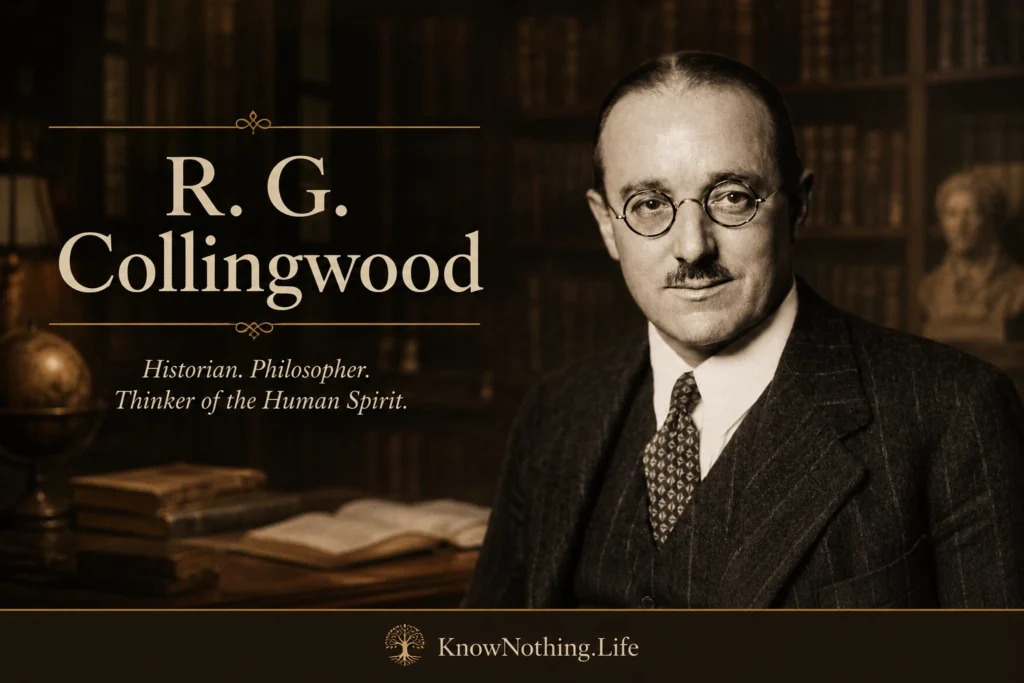
Robin George Collingwood was born on February 22, 1889, at Cartmel Fell in Lancashire, England, into a household where art, archaeology, history, and philosophy were part of ordinary life. His father, W. G. Collingwood, was an artist, writer, archaeologist, and friend of John Ruskin, while his mother, Edith Mary Isaac Collingwood, was also an artist and musician. The younger Collingwood grew up in the Lake District, surrounded by landscapes, Roman remains, Ruskinian ideals, and the practical work of drawing, observing, and interpreting the past.
This upbringing mattered deeply. Collingwood was never only a philosopher in the narrow classroom sense. He became a philosopher, historian, archaeologist, artist, sailor, and public intellectual whose thought grew from doing as much as from reading. He learned early that knowledge is an activity: the artist expresses, the historian reconstructs, the archaeologist interprets evidence, and the philosopher reflects on the conditions that make these forms of knowledge possible. His mature philosophy would always resist the separation of theory from practice.
Oxford and the Making of a Philosopher-Archaeologist
Collingwood studied at Rugby School and then at University College, Oxford, where he read Greats and entered the world of classical scholarship, ancient history, and philosophy. Oxford shaped his intellectual discipline, but he never became a philosopher who lived only among abstractions. He remained devoted to archaeology, especially the study of Roman Britain, and spent years excavating, surveying, and interpreting Roman sites, inscriptions, roads, forts, and artifacts. This practical historical work gave his philosophy of history unusual authority.
His early academic career was centered at Oxford, where he became a fellow of Pembroke College and eventually one of the major philosophical figures of his generation. Yet he never abandoned fieldwork. Collingwood’s archaeology taught him that evidence does not speak for itself. A pot shard, inscription, road, or coin becomes historical evidence only when a historian asks a question of it. This question-and-answer model would become one of his most important philosophical ideas. Historical knowledge is not passive collection; it is active interpretation.
Early Works and Speculum Mentis
Collingwood’s early philosophical work developed through books such as Religion and Philosophy and Speculum Mentis; or, The Map of Knowledge, published in 1924. In Speculum Mentis, he examined forms of experience such as art, religion, science, history, and philosophy, seeking to understand how each makes sense of the world. The book still shows the influence of British Idealism, but it also shows Collingwood’s own developing concern with the distinct logic of different kinds of inquiry.
This concern would remain central throughout his career. Collingwood did not believe that all knowledge should imitate natural science. Science, history, art, religion, and philosophy each ask different questions and therefore follow different methods. Confusion begins when one form of knowledge is forced to behave like another. A historian who treats human action as if it were merely a natural event misses its meaning; an aesthetician who treats art as mere entertainment misses its expressive power. Collingwood wanted philosophy to clarify these differences without ranking every form of knowledge by one external standard.
Philosophy as Reflection on Knowledge
Collingwood’s mature account of philosophy appeared in An Essay on Philosophical Method, published in 1933. In that book, he argued that philosophy is a second-order inquiry. It does not simply discover new facts the way natural science does, nor does it merely repeat common sense. Philosophy reflects on the concepts, assumptions, and forms of thought already at work in first-order inquiries such as history, science, ethics, and art. As he wrote, philosophy “brings us to know in a different way things which we already knew in some way.”
This view made Collingwood different from many analytic philosophers of his time. He cared about clarity, but not as a purely linguistic exercise detached from human practices. Philosophical problems arise because forms of thought contain implicit presuppositions. To philosophize is to uncover these presuppositions and understand how they function. This made philosophy historical in a deep sense. We do not think from nowhere. We inherit questions, assumptions, categories, and problems from living traditions.
The Idea of History
Collingwood’s most famous work, The Idea of History, was published posthumously in 1946, edited from lectures and manuscripts. It became one of the most influential works in the philosophy of history. Its central claim is that history is not merely the study of external events, dates, battles, laws, and institutions. History is the study of human action understood from within. To understand an action historically, the historian must grasp the thought expressed in it.
This is the meaning of Collingwood’s famous statement that “all history is the history of thought.” He did not mean that material conditions, bodies, tools, geography, or institutions do not matter. He meant that human events become historical when they are understood as actions shaped by reasons, intentions, purposes, and meanings. A battle is not only bodies moving across terrain; it is a conflict of plans, fears, decisions, commands, misunderstandings, and aims. The historian must therefore reconstruct not merely what happened, but what people thought they were doing.
Re-Enactment and Historical Understanding
Collingwood’s doctrine of re-enactment is one of his most debated ideas. He argued that the historian understands past thought by rethinking it in the historian’s own mind. This does not mean pretending to become Julius Caesar, an anonymous Roman soldier, or a medieval monk. It means reconstructing the reasoning by which past agents acted, using evidence and disciplined imagination. Historical knowledge is possible because human thought can be revived, questioned, and understood across time.
This approach is often misunderstood as subjective fantasy. Collingwood meant the opposite. Re-enactment must be governed by evidence. The historian does not invent the past freely; he interprets surviving traces in light of questions. His famous line that “the only clue to what man can do is what man has done” expresses the practical value of history. History is human self-knowledge. By understanding past action, human beings learn what kinds of creatures they are, what they have attempted, how they have failed, and what possibilities remain open.
The Logic of Question and Answer
In An Autobiography, published in 1939, Collingwood gave one of his clearest methodological statements: to understand a statement, one must know the question it was meant to answer. He wrote that “you cannot find out what a man means by simply studying his spoken or written statements” apart from the question to which they respond. This idea became known as the logic of question and answer, and it has influenced philosophy, intellectual history, hermeneutics, and the history of ideas.
The point is powerful because it attacks a common mistake. Readers often treat past texts as if they were answering modern questions in modern terms. Collingwood insisted that genuine understanding requires recovering the problem-situation of the writer. A philosopher, politician, theologian, or historian is not merely producing sentences; he is responding to questions, pressures, assumptions, and controversies. To misidentify the question is to misunderstand the answer. This method remains central to serious intellectual history.
Art, Expression, and Imagination
Collingwood’s The Principles of Art, published in 1938, became one of the major works of twentieth-century aesthetics. He distinguished art proper from craft, amusement, magic, and representation. Craft makes a preconceived product by applying technique; amusement produces agreeable feeling; magic arouses emotion for practical social purposes; representation imitates. Art proper, for Collingwood, is expression. The artist does not begin with a fully formed emotion and then package it for an audience. In making art, the artist discovers and clarifies the emotion itself.
This theory made art a form of self-knowledge. Collingwood wrote that the artist is someone who “comes to know himself, to know his emotion.” Art is not decoration added to life after practical matters are settled. It is one of the ways the mind becomes conscious of what it feels. This explains why art matters socially as well as personally. A community that cannot express its emotions honestly becomes confused about itself. Art gives form to what would otherwise remain vague, inarticulate, or hidden.
Metaphysics, Presuppositions, and the War Years
Collingwood’s later work became increasingly urgent. In An Essay on Metaphysics, published in 1940, he argued that metaphysics is not the study of being as such, but the study of absolute presuppositions: the deep assumptions that structure forms of inquiry. Scientists, historians, theologians, and ordinary people work from presuppositions that are not always stated as propositions. Metaphysics uncovers and compares these assumptions, showing how they make certain questions possible.
During the late 1930s and early 1940s, Collingwood suffered from serious illness, including strokes, but continued writing. He produced An Autobiography, An Essay on Metaphysics, The First Mate’s Log, and The New Leviathan, the last of which he regarded as a contribution to the struggle against fascism and barbarism. His final writings show a thinker racing against time, trying to defend civilization, history, reason, and freedom while Europe collapsed into war.
Death and Lasting Legacy
R. G. Collingwood died on January 9, 1943, in Coniston, in the Lake District. He was not yet fifty-four. His early death shaped his reputation. Some works were left unfinished, others were assembled posthumously, and his place in twentieth-century philosophy became difficult to classify. He was not simply an analytic philosopher, though he valued precision. He was not simply a British Idealist, though he inherited parts of that tradition. He was a philosopher of practice, history, art, and self-knowledge.
Collingwood’s lasting importance lies in his insistence that knowing is an activity guided by questions. History is not dead fact, art is not mere ornament, and philosophy is not wordplay detached from life. He taught that evidence becomes meaningful through inquiry, that past thought can be re-enacted, that art expresses what we do not yet fully know we feel, and that civilization depends on understanding its own presuppositions. Collingwood remains essential because he reminds us that the human world cannot be explained only from the outside. It must also be understood from within.