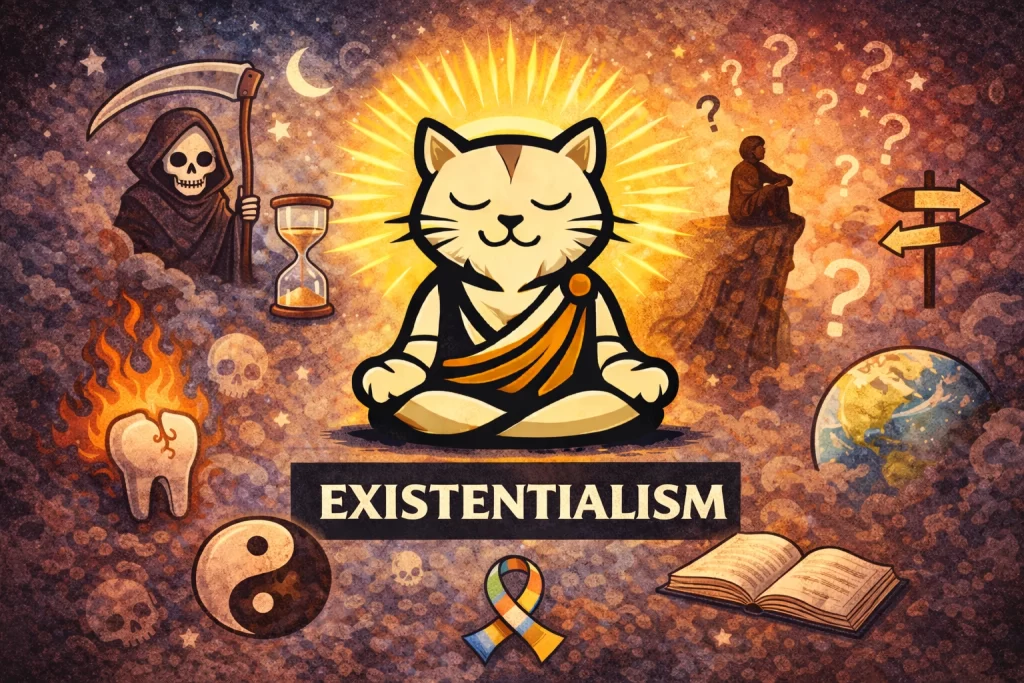
Existentialism is a philosophical movement that confronts one of the most unsettling and liberating ideas in human thought: that existence precedes essence. In other words, human beings are not born with a predetermined purpose or nature. We first exist, and only later define ourselves through our choices. Emerging most prominently in the nineteenth and twentieth centuries, existentialism grapples with freedom, responsibility, anxiety, and the search for meaning in a world that offers no guarantees.
Often associated with thinkers such as Søren Kierkegaard, Friedrich Nietzsche, Jean-Paul Sartre, and Albert Camus, existentialism is less a rigid doctrine than a shared mood or orientation. It takes seriously the individual’s lived experience—especially the tension between the desire for meaning and the apparent indifference of the universe.
Freedom and Responsibility
At the heart of existentialism lies the claim that human beings are radically free. For Sartre, this freedom is unavoidable. Even refusing to choose is itself a choice. We cannot escape responsibility for the direction of our lives. There is no external script, no divine blueprint, no fixed human essence that determines who we must become. This freedom can feel exhilarating, but it also produces anxiety. Without predetermined values, we must create our own.
Existentialists argue that much of human life is spent fleeing this responsibility. We hide behind social roles, conventions, and expectations, pretending that our choices are dictated by circumstance. Sartre called this self-deception “bad faith”—the attempt to deny one’s own freedom by pretending to be a fixed object rather than a choosing subject. Authenticity, by contrast, requires acknowledging our freedom and acting deliberately, even in the face of uncertainty.
Nietzsche approached freedom differently, urging individuals to move beyond inherited moral systems and create values rooted in strength and creativity. Kierkegaard, writing earlier, framed freedom within a religious context, describing the “leap of faith” as a passionate commitment made without rational certainty. Despite their differences, these thinkers agree on a central point: meaning is not handed to us. It is forged in action.
Absurdity and Meaning
Albert Camus, though he rejected the existentialist label, articulated one of the movement’s defining insights: the absurd. The absurd arises from the clash between our longing for clarity and the world’s silence. We ask for purpose; the universe offers none. Camus explored this tension in works such as The Myth of Sisyphus and The Stranger, portraying characters who confront meaninglessness without surrendering to despair.
The existential response to absurdity is not resignation but defiance. Camus famously imagined Sisyphus—condemned to roll a stone up a hill for eternity—as content, even joyful, because he embraces his condition consciously. The point is not to discover ultimate answers, but to live fully within the question. Meaning, in this view, is not cosmic but personal. It arises from engagement, commitment, and awareness.
Existentialism thus resists both nihilism and blind optimism. It refuses to pretend that life has built-in significance, yet it equally refuses to conclude that life is therefore worthless. Instead, it places the burden—and privilege—of meaning squarely on the individual.
In the end, existentialism is less about abstract theory and more about lived courage. It asks us to confront uncertainty without illusions, to recognize our freedom without denial, and to create value without guarantees. In a world that does not explain itself, existentialism invites us to become authors of our own lives—imperfect, finite, and responsible for what we choose to become.