Pleasure is one of the most immediate and persuasive forces in human life. It draws us toward food, warmth, companionship, beauty, achievement, and love. It can be subtle—a quiet sense of ease at the end of a long day—or overwhelming, as in laughter that takes over the body. However varied its forms, pleasure is a signal that something is going well, that some need or desire is being met. To understand pleasure is to understand something fundamental about motivation, meaning, and the structure of experience itself.
Biologically, pleasure functions as reinforcement. The brain rewards behaviors that promote survival and reproduction: eating when hungry, bonding with others, exploring the environment. Neurochemical processes—often involving dopamine and endorphins—create feelings of satisfaction that encourage repetition. In this sense, pleasure is not merely indulgence; it is guidance. It nudges organisms toward patterns that sustain life. Without pleasure, motivation would falter. Life would continue mechanically, perhaps, but without direction or vitality.
Yet human pleasure extends far beyond biological necessity. We take delight in music, mathematics, storytelling, and abstract ideas—activities that offer no immediate survival advantage. A melody can stir emotion; a well-formed argument can satisfy like a meal. This suggests that pleasure is also bound to pattern recognition and coherence. When the mind encounters harmony, insight, or meaning, it responds with a kind of intellectual or aesthetic joy. Pleasure, then, may signal not only survival, but understanding.
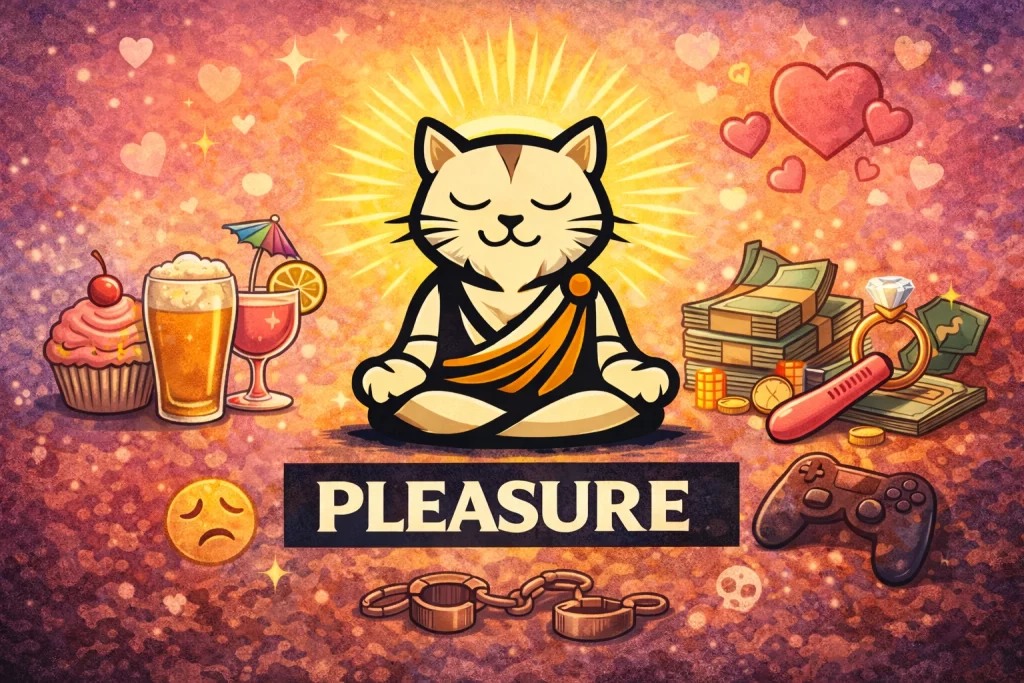
Philosophically, pleasure has long been debated. Some traditions, like hedonism, elevate it as the highest good, arguing that a life filled with pleasure and free from pain is the best life possible. Others warn that pleasure is fleeting and unreliable, easily turning into craving or dependency. The same stimulus that delights today may bore tomorrow; repeated indulgence can dull sensitivity. The pursuit of pleasure alone, detached from reflection or balance, risks becoming compulsive rather than fulfilling.
This tension reveals an important distinction: the difference between immediate gratification and deeper satisfaction. Quick pleasures—sweets, scrolling, impulse purchases—often provide intense but short-lived spikes of enjoyment. By contrast, pleasures tied to growth, mastery, and connection tend to be quieter yet more enduring. Learning a skill, building trust with another person, contributing to something larger than oneself—these forms of pleasure accumulate meaning over time. They are less about stimulation and more about alignment between action and value.
Pleasure is also relational. It often intensifies when shared. A joke is funnier in company; a meal tastes better among friends. Social pleasure strengthens bonds and builds communities. Even solitary pleasures—reading, reflection, creativity—are frequently shaped by cultural and interpersonal contexts. We learn what to enjoy from others; our tastes evolve within shared worlds.
Still, pleasure carries ambiguity. It can liberate, but it can also distract. It can enrich life, but it can also narrow it if pursued without awareness. The challenge is not to reject pleasure, nor to chase it blindly, but to integrate it wisely. When pleasure is connected to health, integrity, and connection, it enhances life’s depth. When detached from these, it can become hollow.
In the end, pleasure is neither trivial nor ultimate. It is a compass—one that must be read carefully. It signals what draws us, what resonates, what feels alive. To live well is not to eliminate pleasure or enthrone it, but to understand its rhythms: to savor it without clinging, to seek it without being ruled by it, and to recognize in its fleeting glow a reminder that being alive can feel not only bearable, but good.