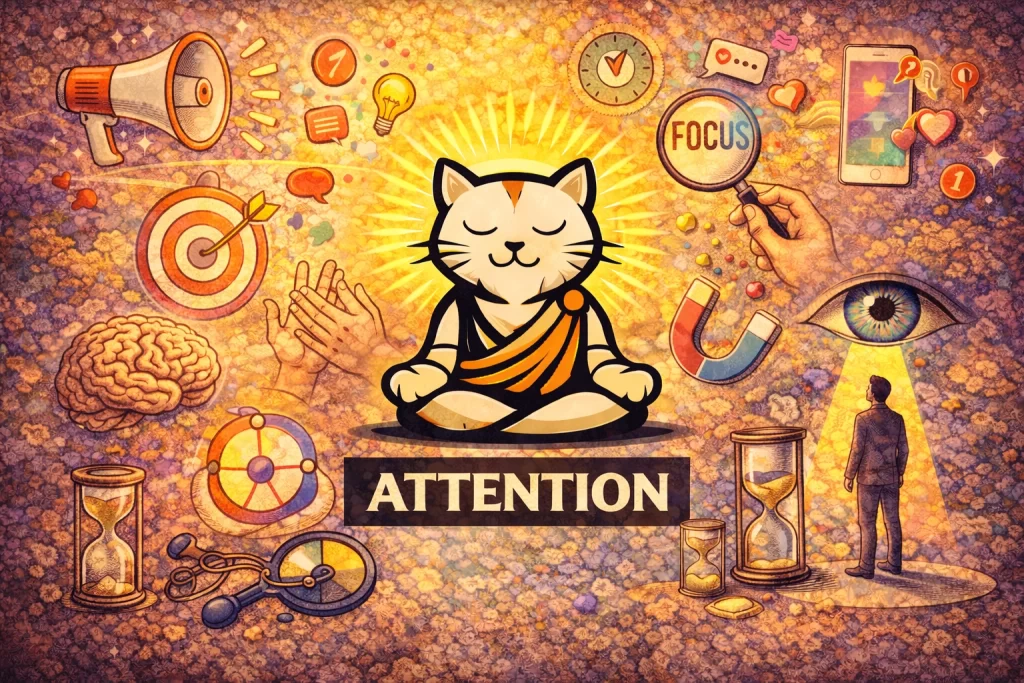
Attention is the cognitive process that allows us to selectively focus on certain aspects of our environment while filtering out others. In a world saturated with stimuli—sounds, images, thoughts, notifications—attention acts as a spotlight, determining what enters conscious awareness and what remains unnoticed. Far from being a passive state, attention is an active, limited resource that shapes perception, memory, decision-making, and ultimately our experience of reality.
Cognitive scientists often describe attention as both selective and competitive. Multiple stimuli vie for processing, but only a fraction receives priority. This selection can be voluntary, as when we focus on reading, or involuntary, as when a loud noise captures our awareness. Understanding how attention works reveals both its power and its fragility.
Selective Attention and Filtering
Selective attention allows us to concentrate on a single task or stimulus while ignoring distractions. One of the earliest demonstrations of this phenomenon was the “cocktail party effect,” first studied by Colin Cherry in the 1950s. Participants wearing headphones were asked to repeat (“shadow”) one audio stream while ignoring another. Most could recall little from the unattended channel—unless their own name was mentioned, suggesting that some information is processed subconsciously.
Selective attention operates like a filter, prioritizing relevant information. However, this filtering is imperfect. Competing stimuli can intrude, particularly when they are emotionally salient or unexpected. This balance between focus and flexibility is essential for survival but can also lead to distraction.
Inattentional Blindness
Perhaps the most striking limitation of attention is inattentional blindness—the failure to notice visible but unexpected objects when attention is engaged elsewhere. Psychologists Daniel Simons and Christopher Chabris demonstrated this in their famous “Invisible Gorilla” experiment (1999). Participants asked to count basketball passes often failed to see a person in a gorilla suit walk through the scene.
The study revealed that attention determines perception. Even dramatic events can go unnoticed if they fall outside our focus. This finding has practical implications in areas such as driving safety, eyewitness testimony, and interface design. It challenges the common belief that we see everything in front of us.
Divided Attention and Multitasking
Modern life frequently demands divided attention. Many people believe they can effectively multitask, but research suggests otherwise. Studies by David Strayer have shown that using a mobile phone while driving significantly impairs reaction time, even when using hands-free devices. Cognitive resources are limited; when attention is split, performance declines.
Experimental evidence indicates that what we call multitasking is often rapid task-switching. Each switch carries a cognitive cost, reducing efficiency and increasing error rates. Neuroscientific research supports this view, showing that the prefrontal cortex must reconfigure goals with each shift in attention. Divided attention may feel productive, but it often sacrifices depth and accuracy.
Sustained Attention and Mental Fatigue
Sustained attention, or vigilance, refers to the ability to maintain focus over extended periods. This capacity is critical in tasks such as air traffic control, medical monitoring, and long-distance driving. Yet sustained attention declines over time, a phenomenon known as the vigilance decrement.
Research during World War II on radar operators first documented this decline. Later laboratory studies confirmed that accuracy decreases as tasks become monotonous. Mental fatigue reduces alertness and increases susceptibility to distraction. Breaks, task variation, and environmental design can mitigate these effects.
In educational settings, attention span research suggests that engagement fluctuates naturally. Learning environments that incorporate interactive elements and varied pacing tend to sustain attention more effectively than prolonged passive listening.
Attention in the Digital Age
The digital environment has transformed the landscape of attention. Notifications, social media feeds, and algorithm-driven content constantly compete for focus. Some researchers argue that technology exploits attentional systems, reinforcing habits of rapid switching and fragmented focus.
Psychologist Gloria Mark has studied workplace attention and found that frequent interruptions increase stress and reduce productivity. Her research suggests that once interrupted, it can take over twenty minutes to fully return to a previous task.
At the same time, attention is trainable. Studies on mindfulness meditation show that regular practice can enhance sustained attention and reduce susceptibility to distraction. Brain imaging research indicates that attentional control networks strengthen with training, demonstrating the brain’s plasticity.
Conclusion
Attention is the gateway to conscious experience. It shapes what we perceive, what we remember, and how we act. Yet it is limited, vulnerable to distraction, and influenced by context. Study after study—from the cocktail party effect to the invisible gorilla—reveals that we do not perceive the world in full; we perceive what we attend to.
In a culture that constantly competes for our focus, understanding attention is more important than ever. By recognizing its limits and cultivating intentional focus, we can reclaim a measure of control over our mental lives. Ultimately, attention is not just a cognitive mechanism—it is the lens through which we experience reality itself.