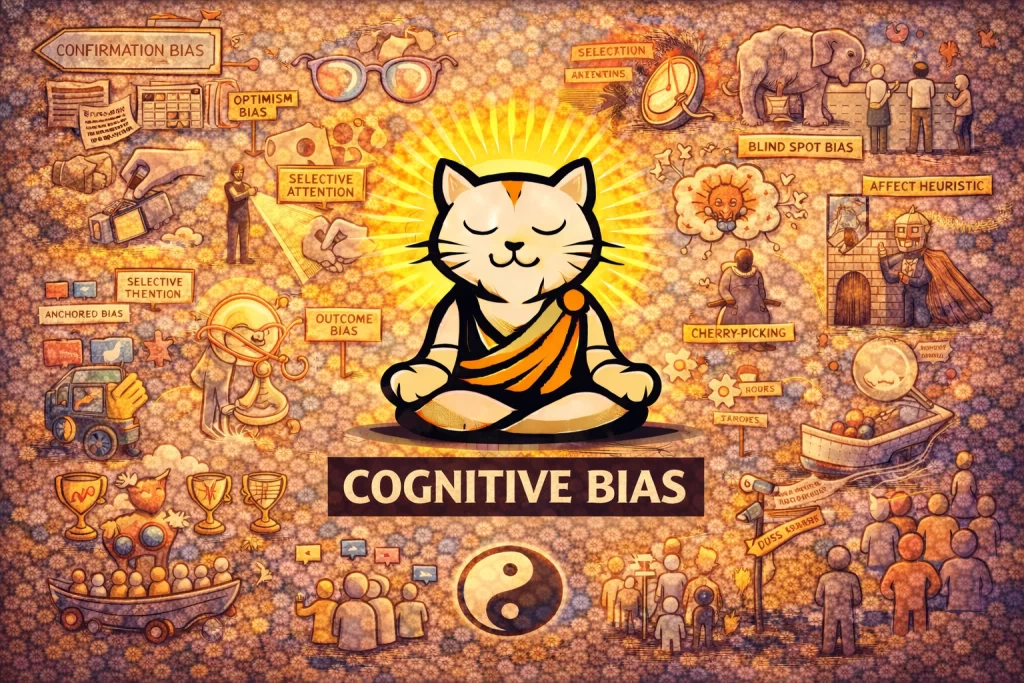
Cognitive bias refers to systematic patterns of deviation from rational judgment. Rather than processing information objectively, the human mind relies on mental shortcuts—known as heuristics—to make decisions efficiently. While these shortcuts often help us navigate complex environments quickly, they can also produce predictable errors in reasoning.
Cognitive biases influence how we interpret evidence, form beliefs, assess risk, and evaluate others. They operate automatically and often unconsciously, shaping perception and decision-making in ways we may not notice. Modern psychology has identified dozens of such biases, many supported by experimental research.
Heuristics and Judgment
The scientific study of cognitive bias was revolutionized by the work of Daniel Kahneman and Amos Tversky in the 1970s. Their research demonstrated that people rely on heuristics—mental rules of thumb—when making judgments under uncertainty.
One example is the availability heuristic. In experiments, participants estimated the frequency of events based on how easily examples came to mind. After hearing vivid descriptions of rare occurrences (such as plane crashes), people overestimated their likelihood. This bias helps explain why dramatic media coverage can distort public perception of risk.
Another well-known study explored the representativeness heuristic. Participants were given a description of a fictional individual named “Linda” and asked whether she was more likely to be a bank teller or a bank teller active in the feminist movement. Many chose the latter, despite it being statistically less probable. This “conjunction fallacy” revealed that people often rely on stereotypes rather than probability rules.
Confirmation Bias and Belief Formation
Confirmation bias is the tendency to seek, interpret, and remember information that supports existing beliefs while ignoring contradictory evidence. This bias plays a powerful role in politics, science, and everyday disagreements.
In a classic study by Peter Wason, participants were asked to test a rule governing number sequences. Instead of attempting to falsify their hypotheses, most participants tried to confirm them, demonstrating a preference for supporting evidence over disconfirming data.
Modern research shows that confirmation bias operates even among trained professionals. Studies indicate that individuals presented with mixed evidence about controversial topics tend to strengthen their original views rather than revise them. This phenomenon contributes to polarization and ideological entrenchment.
Anchoring and Framing Effects
Anchoring bias occurs when individuals rely too heavily on the first piece of information they encounter. In one experiment conducted by Tversky and Kahneman, participants spun a wheel rigged to land on either 10 or 65, then estimated the percentage of African nations in the United Nations. Those who saw the higher number gave significantly larger estimates, despite the wheel being irrelevant to the question.
Framing effects further illustrate how presentation influences judgment. In studies involving medical decisions, participants were more likely to approve a treatment described as having a “90% survival rate” than one described as having a “10% mortality rate,” even though the statistics are identical. The framing altered perception of risk.
These biases demonstrate that reasoning is sensitive to context and initial reference points, often without conscious awareness.
Social and Emotional Biases
Cognitive biases are not limited to abstract reasoning; they shape social perception and emotion. The fundamental attribution error refers to the tendency to attribute others’ behavior to personality traits while attributing our own behavior to situational factors.
Research by Lee Ross illustrated this in studies where participants judged essay writers as genuinely holding assigned positions, even when they knew the writers had no choice in the matter. Observers overemphasized dispositional explanations.
Another influential line of research involves implicit bias. Experiments using the Implicit Association Test (IAT), developed by Anthony Greenwald and colleagues, revealed that people may hold unconscious associations that influence perception and behavior.
Emotional states also affect judgment. Studies show that anxiety increases risk aversion, while anger can increase confidence and perceived control. These findings highlight the interplay between emotion and cognition.
Conclusion
Cognitive bias reflects the mind’s effort to simplify complexity. Heuristics allow rapid decisions, but they can also distort judgment. Study examples—from the Linda problem to anchoring experiments—demonstrate that biases are systematic and predictable.
Recognizing cognitive bias does not eliminate it, but awareness can reduce its influence. By questioning assumptions, seeking disconfirming evidence, and slowing down decision-making, individuals can mitigate some of these distortions.
Ultimately, cognitive bias reveals both the efficiency and vulnerability of human reasoning. The same mental shortcuts that enable swift adaptation can also lead us astray. Understanding them is a step toward clearer thinking and more deliberate judgment.