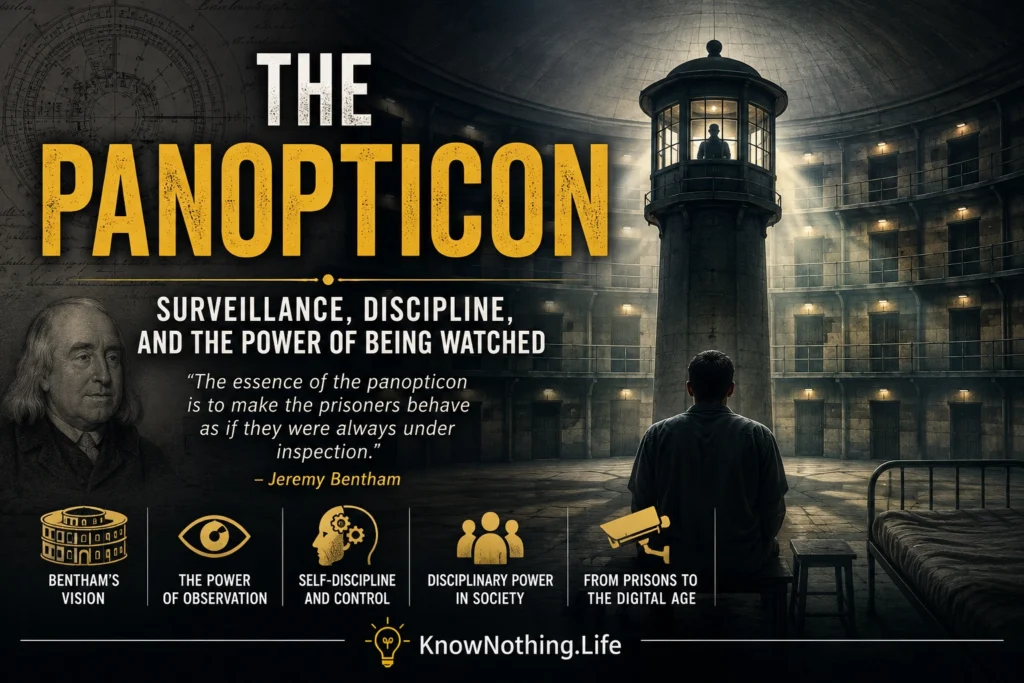
The Panopticon began as an architectural proposal, but it became one of the most influential metaphors in modern political and social thought. During the late eighteenth century, English philosopher and legal reformer Jeremy Bentham developed a plan for an institution organized around continuous visibility. The underlying “central inspection principle” originated with his younger brother, Samuel Bentham, who devised a method for supervising workers while employed in Russia. Jeremy adapted the idea into a proposed prison that he called an “Inspection House,” presenting it in Panopticon; or, The Inspection-House, published in 1791.
Bentham imagined a circular structure with individual cells arranged around the building’s outer wall and an inspection tower positioned at the center. Light would enter each cell from behind, making its occupant visible to the inspector. Blinds, partitions, and other architectural devices would prevent prisoners from seeing whether anyone was actually inside the tower. The essential feature was therefore not uninterrupted observation but uncertainty. Because prisoners could be watched at any moment, they would have to behave as though they were always being watched.
Bentham’s Vision of Reform Through Design
Bentham was a utilitarian who believed that laws and institutions should be judged by their effects on human happiness and suffering. He did not present the Panopticon merely as an instrument of cruelty. He believed its design could reduce the cost of supervision, prevent abuse, encourage productive work, improve sanitation, and reform prisoners through orderly routines. Architecture would accomplish what physical force and large numbers of guards could not. Bentham described the system as a method of gaining “power of mind over mind,” capturing the psychological principle at the center of the project.
The plan was not limited to prisons. Bentham believed the inspection principle could be applied to factories, schools, hospitals, workhouses, and institutions for people receiving poor relief. Any organization in which a small number of supervisors needed to direct a large population might be reorganized around visibility. Although several later buildings borrowed elements of the design, Bentham never succeeded in constructing his intended penitentiary, and no prison fully reproduced both his architectural plans and management system. Its greatest influence would come not through construction but through theory.
Michel Foucault and Disciplinary Power
The Panopticon acquired its broader philosophical importance through Michel Foucault’s 1975 book Discipline and Punish: The Birth of the Prison. Foucault examined the historical movement from spectacular forms of punishment toward institutions that sought to correct, classify, and manage individuals. Earlier sovereign power was displayed publicly through executions, torture, and physical punishment. Modern disciplinary power was quieter. It operated through schedules, examinations, records, training, surveillance, and comparisons between individuals and institutional standards.
For Foucault, Bentham’s design represented this new form of power with unusual clarity. The prisoner is permanently visible, while the observer remains unverifiable. Authority does not need to intervene constantly because the possibility of intervention encourages the prisoner to regulate himself. Control becomes more efficient when people internalize the observer’s expectations and begin monitoring their own conduct. The Panopticon therefore represents more than a prison building. It is a model of power that produces self-discipline by arranging people within a field of possible observation.
Observation, Normalization, and the Examination
Surveillance alone does not explain Foucault’s argument. Disciplinary institutions also establish standards against which people can be measured. Schools compare students through examinations and grades. Hospitals classify patients through diagnoses and medical records. Factories measure output, punctuality, and efficiency. Prisons document conduct and calculate readiness for release. These procedures do not merely determine whether someone has broken a rule. They place individuals along scales of normality, ability, productivity, health, or risk.
Foucault used the examination as an example of the relationship between power and knowledge. An examination produces information about a person while simultaneously directing that person’s behavior. Students study because they will be tested, workers alter their conduct because performance is measured, and patients follow instructions because their progress is recorded. The resulting documents make individuals easier to compare, categorize, and manage. Knowledge is not simply collected after power has acted; producing knowledge about people becomes one of the ways power operates.
The Psychology of Being Watched
Modern behavioral research offers partial support for the idea that perceived observation can influence conduct. Experiments involving images of eyes have investigated whether subtle signs of being watched make people more cooperative or socially responsible. In a 2013 field experiment, Melissa Bateson and her colleagues found that signs displaying watching eyes reduced littering under certain social conditions. Other studies have reported that eye cues can increase honesty or prosocial behavior, suggesting that reminders of observation may activate concerns about reputation.
These effects should not be interpreted as proof that surveillance always improves behavior. Attempts to replicate the watching-eyes effect have produced mixed results, and its strength appears to depend on setting, social context, and experimental design. More importantly, appearing compliant does not mean that a person has accepted an institution’s goals. People who know they are observed may conceal behavior, perform for the observer, or move prohibited activities into less visible spaces. Surveillance can produce obedience, but it can also produce secrecy, anxiety, resistance, and strategic impression management.
Workplaces, Schools, and Everyday Institutions
The Panopticon remains relevant because many modern organizations depend on visibility and measurement. Employees may be monitored through cameras, productivity dashboards, location tracking, email records, keystroke logging, or software that captures screenshots. Students encounter attendance systems, online examination monitoring, behavior reports, and learning platforms that record engagement. Hospitals, insurance systems, and government agencies collect increasingly detailed information about individual conduct. These technologies extend observation beyond a single building and allow records to remain searchable long after the original event.
Greater visibility does not necessarily produce better performance. Ethan Bernstein’s research on the “transparency paradox” found that intense observability can encourage workers to conceal experimentation and adopt behaviors designed to satisfy observers rather than improve the work itself. In some environments, zones of privacy allow people to test ideas, learn from mistakes, and develop more effective practices. Surveillance may improve accountability when its purpose is clear and legitimate, but excessive monitoring can weaken trust, creativity, autonomy, and organizational learning.
The Digital Panopticon
Digital technology appears to fulfill Bentham’s principle without requiring a circular structure or central tower. Smartphones, websites, workplace platforms, security cameras, payment systems, and connected devices continuously generate records. Users often cannot determine when their data is being examined, which information is being combined, or which decisions may be influenced by it. As in the original Panopticon, uncertainty can affect behavior even when no human observer is watching in real time.
Ivan Manokha argues that modern communication technologies can encourage self-restraint and self-censorship by making people conscious that their activities may be recorded or reviewed. Remote-work monitoring provides a particularly clear example: software can transform the home into a measurable workplace while expanding management’s ability to inspect employee activity. The observer may no longer be an identifiable guard. It may be an algorithm that assigns scores, flags unusual behavior, predicts risk, or recommends disciplinary action.
The Limits of the Panopticon Metaphor
Not all surveillance fits the Panopticon model. Bentham’s structure involved a relatively clear relationship between a central observer and isolated subjects. Contemporary surveillance is often decentralized. Governments, employers, advertisers, platforms, data brokers, and ordinary users may all collect information for different purposes. People also participate voluntarily by posting photographs, tracking exercise, sharing locations, rating one another, and documenting daily life. The modern environment is not one tower watching everyone but an overlapping network in which individuals can be observers, observed subjects, and sources of data at the same time.
Sociologist David Lyon warned in “An Electronic Panopticon?” that the metaphor can illuminate computer-based surveillance without fully explaining it. Later surveillance scholars have similarly argued that digital systems differ from Bentham’s design in their scale, invisibility, automation, and commercial objectives. The metaphor remains useful when it directs attention to uncertainty and self-discipline, but it becomes misleading when it suggests that all monitoring has one controlling center or produces the same effects.
Why the Panopticon Still Matters
The enduring lesson of the Panopticon is that power does not always need to issue commands or use visible force. People may modify themselves because they believe their actions are observable, recorded, and open to judgment. Surveillance changes behavior not only when punishment occurs but when people anticipate how an unknown observer might interpret them. Over time, external expectations can become internal habits, making authority appear almost absent even while its standards shape everyday conduct.
The challenge is therefore not simply to choose between total privacy and total visibility. Schools, workplaces, hospitals, and governments sometimes need information to protect safety, distribute resources, or ensure accountability. The more important questions concern proportionality, transparency, consent, access, and the right to challenge decisions. Who watches, what is collected, how long is it retained, and who holds the observer accountable? Bentham’s architectural prison was never completed as he envisioned it, yet its central question remains urgently relevant: how do people change when they can never be certain that no one is watching?