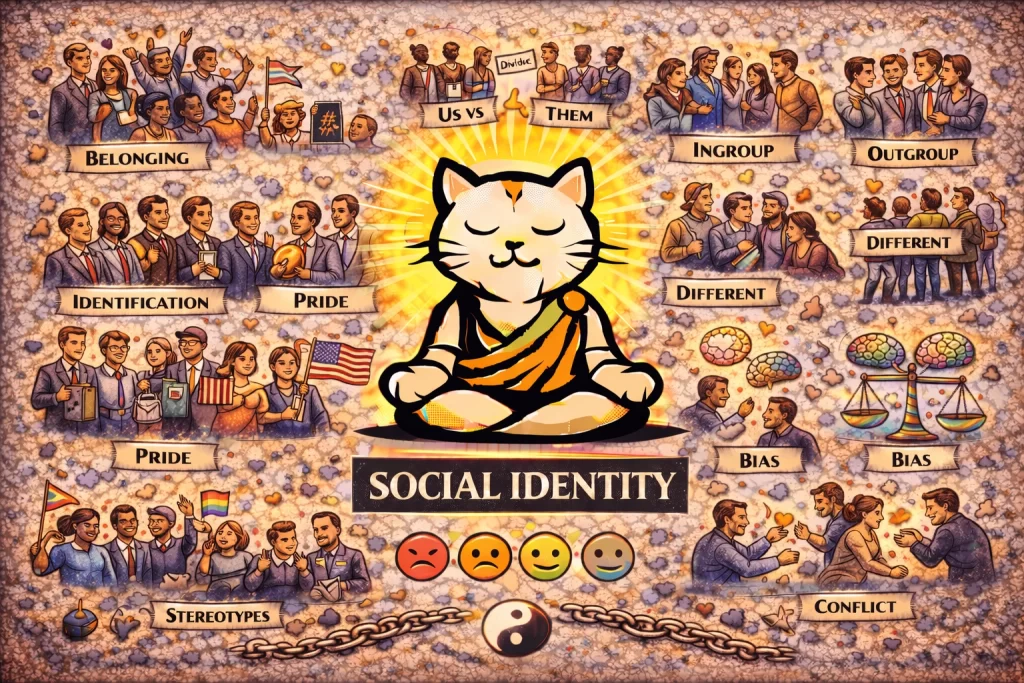
Social identity refers to the part of an individual’s self-concept that derives from membership in social groups. These groups may be based on nationality, ethnicity, religion, gender, occupation, political affiliation, or even arbitrary categories. Social identity shapes how people see themselves and others, influencing attitudes, behavior, and group relations.
Unlike personal identity, which centers on individual traits, social identity emphasizes belonging. Research in social psychology shows that simply identifying with a group can affect perception, loyalty, and moral judgment—often in powerful and automatic ways.
The Foundations of Social Identity Theory
Social identity theory was developed by Henri Tajfel and later expanded with John Turner. Tajfel’s work emerged from attempts to understand prejudice and intergroup conflict.
In the minimal group experiments, participants were randomly assigned to groups based on trivial criteria, such as preference for abstract paintings. Despite the arbitrary nature of these assignments, participants consistently favored their own group when distributing rewards. They allocated more points to in-group members and fewer to out-group members, even when no personal gain was involved.
These findings demonstrated that group categorization alone is enough to produce in-group favoritism. Social identity theory proposes that individuals seek positive distinctiveness for their groups because group status contributes to self-esteem.
In-Group Bias and Intergroup Conflict
Once individuals identify with a group, they tend to favor it over others. This in-group bias can manifest in subtle ways, such as trusting in-group members more readily, or in more serious forms, such as discrimination and hostility.
The Robbers Cave experiment, conducted by Muzafer Sherif, illustrated how intergroup competition fosters conflict. Two groups of boys at a summer camp developed strong hostility when placed in competitive situations. When shared goals requiring cooperation were introduced, hostility decreased.
These results suggest that social identity interacts with situational factors. Competition can intensify divisions, while cooperation can reduce them. Group boundaries are psychologically meaningful, even when initially arbitrary.
Social Identity and Self-Perception
Social identity also shapes how individuals interpret their own behavior. According to self-categorization theory, individuals shift between personal and social identities depending on context. In group settings, people may align attitudes and behaviors with perceived group norms.
Research shows that political or national identity can influence how individuals evaluate information. People are more likely to accept evidence that supports their group’s position and reject contradictory evidence, demonstrating the link between identity and cognition.
Studies of stereotype threat, developed by Claude Steele, show that awareness of negative stereotypes about one’s group can impair performance. This illustrates how social identity influences motivation, anxiety, and outcomes.
Social Identity in Modern Society
In contemporary society, social identities are complex and overlapping. Individuals often belong to multiple groups simultaneously, which can create both solidarity and tension. Globalization and social media amplify group identification, sometimes intensifying polarization.
However, social identity can also foster positive collective action. Shared identity underlies social movements, community solidarity, and cooperation in times of crisis. When group norms promote inclusivity and fairness, identity can become a force for social good.
Interventions aimed at reducing prejudice often focus on expanding shared identities. Research suggests that emphasizing common goals or superordinate identities—such as national unity or shared humanity—can reduce intergroup bias.
Conclusion
Social identity is a powerful psychological force shaping perception, behavior, and intergroup relations. Study examples—from Tajfel’s minimal groups to Sherif’s conflict research and Steele’s stereotype threat studies—demonstrate that belonging influences both self-esteem and social behavior.
Understanding social identity reveals that group membership is not merely a social label; it is a central component of how individuals define themselves and navigate the world. By recognizing the mechanisms behind in-group bias and identity-based division, societies can work toward fostering inclusion while acknowledging the deep human need for belonging.