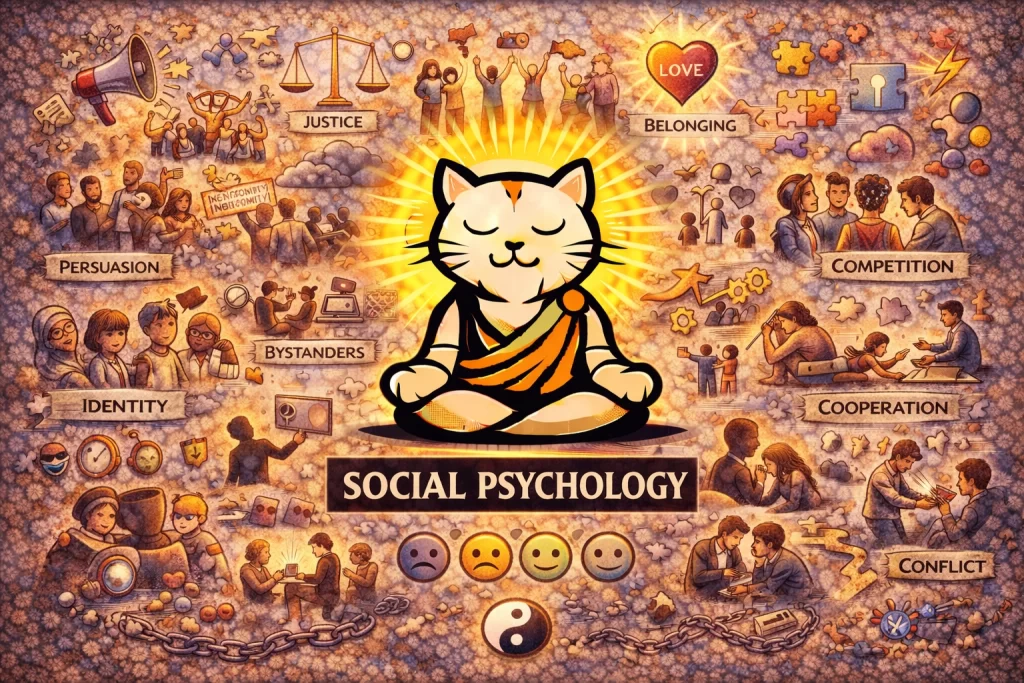
Social psychology is the scientific study of how individuals think, feel, and behave in social contexts. It examines how our thoughts and actions are shaped not only by internal traits, but by the presence—real or imagined—of others. From conformity and prejudice to attraction and group behavior, social psychology explores the invisible forces that influence everyday interactions.
Unlike personality psychology, which focuses on stable individual differences, social psychology emphasizes situational factors. Research consistently demonstrates that context can dramatically alter behavior, often in ways people fail to anticipate.
Conformity and Social Influence
One of the most famous demonstrations of social influence was conducted by Solomon Asch in the 1950s. In Asch’s conformity experiments, participants were asked to judge the length of lines in a group setting. When confederates intentionally gave incorrect answers, many participants conformed to the group’s incorrect judgment, even when the correct answer was obvious.
These findings revealed the powerful role of normative influence—the desire to fit in and avoid social rejection. Even simple perceptual judgments can be swayed by group consensus.
Another landmark study by Stanley Milgram examined obedience to authority. Participants were instructed to deliver increasingly intense electric shocks to a learner (who was actually an actor). A majority complied with instructions to administer what they believed were dangerous shocks. Milgram’s work highlighted the extent to which authority and situational pressure can override personal moral reservations.
Group Behavior and Roles
Social psychology also investigates how group dynamics shape behavior. In the Stanford prison experiment, led by Philip Zimbardo, participants assigned to roles as guards or prisoners quickly adopted behaviors consistent with those roles. Although the study has faced methodological and ethical criticism, it sparked discussion about the influence of situational roles on identity and behavior.
Research on groupthink, a concept developed by Irving Janis, suggests that cohesive groups may prioritize consensus over critical thinking. Historical analyses of political decision-making have been used to illustrate how pressure for agreement can suppress dissenting viewpoints.
The “bystander effect,” studied by John Darley and Bibb Latané, demonstrated that individuals are less likely to help in emergencies when others are present. Experiments showed that diffusion of responsibility reduces intervention. This finding challenged assumptions about altruism and revealed how social context influences moral action.
Social Cognition and Bias
Social cognition examines how we interpret others’ behavior. Research shows that people often commit the fundamental attribution error—overemphasizing personality traits while underestimating situational influences.
In a classic experiment by Lee Ross and colleagues, participants judged essay writers as genuinely holding assigned positions, even when told the writers had no choice. Observers attributed behavior to disposition rather than context.
Implicit bias research further reveals that unconscious associations influence judgment. The Implicit Association Test (IAT), developed by Anthony Greenwald, demonstrated that individuals may hold automatic associations that affect perception and behavior without conscious intent.
These studies highlight that social perception is shaped by mental shortcuts, stereotypes, and cultural norms.
Relationships, Identity, and Culture
Social psychology also explores attraction, relationships, and identity formation. Studies show that proximity, similarity, and reciprocal liking increase interpersonal attraction. Research on social identity theory, developed by Henri Tajfel, demonstrated that individuals form in-group favoritism even in minimal group settings. In experiments, participants assigned to arbitrary groups favored their own group in resource allocation tasks.
Cultural research reveals that social norms vary across societies. Individualistic cultures emphasize autonomy and personal achievement, while collectivist cultures prioritize group harmony. These cultural differences influence behavior, communication, and emotional expression.
Conclusion
Social psychology demonstrates that human behavior is profoundly shaped by context. Study examples—from Asch’s conformity experiments to Milgram’s obedience research and the bystander effect—reveal that ordinary individuals can behave in surprising ways under social pressure.
By uncovering the mechanisms of influence, bias, and group dynamics, social psychology challenges assumptions about independent choice and stable personality. It reminds us that understanding human behavior requires attention not only to the individual mind, but to the social world in which it operates.