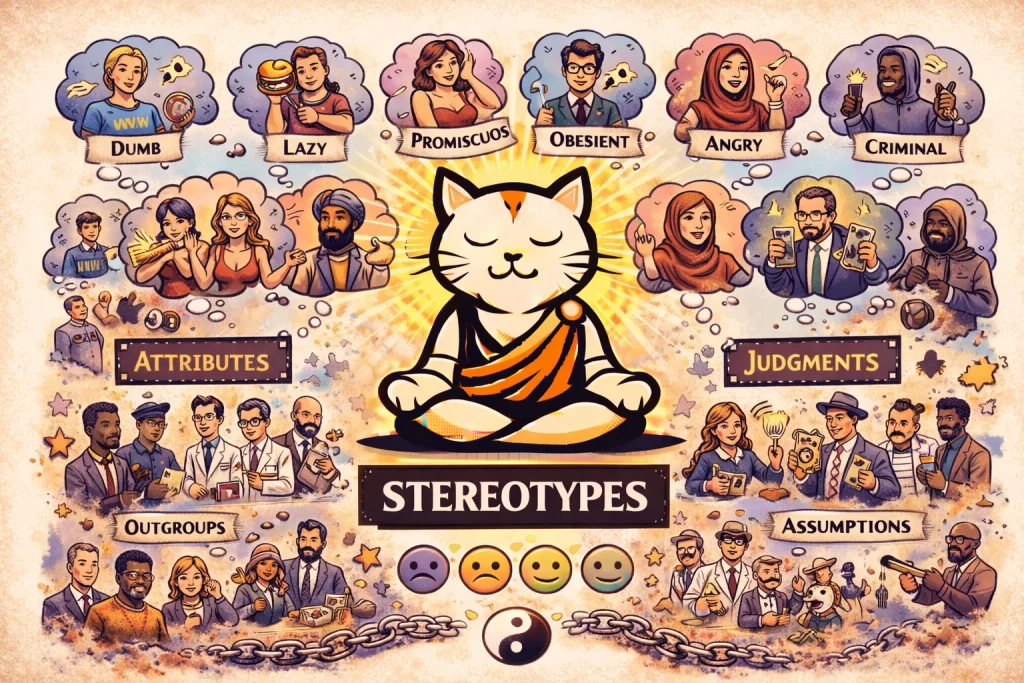
Stereotypes are generalized beliefs about members of a particular group. They simplify social perception by assigning traits, behaviors, or characteristics to individuals based solely on group membership. While stereotyping can help the mind process information quickly, it often leads to inaccurate assumptions, bias, and unfair treatment.
Social psychology examines stereotypes as cognitive shortcuts shaped by culture, experience, and social identity. Research shows that stereotypes operate automatically and can influence judgment even when individuals consciously reject prejudice.
The Cognitive Basis of Stereotyping
Human cognition relies on categorization to manage complexity. Grouping people by age, gender, race, or occupation allows for quick predictions, but it also fosters overgeneralization.
One influential line of research involves implicit bias. The Implicit Association Test (IAT), developed by Anthony Greenwald and colleagues, measures automatic associations between social groups and evaluative concepts. Studies using the IAT suggest that many individuals hold unconscious associations that may influence behavior.
Another foundational experiment is the minimal group paradigm, developed by Henri Tajfel. Participants assigned to arbitrary groups quickly favored their own group, even without meaningful differences. This research suggests that stereotypes can emerge from simple social categorization.
Formation and Reinforcement of Stereotypes
Stereotypes are learned through socialization, media representation, and cultural narratives. Repeated exposure to particular portrayals reinforces associations over time.
Research in social cognition shows that once formed, stereotypes influence information processing. The confirmation bias—the tendency to seek evidence supporting existing beliefs—helps maintain stereotypes. Studies demonstrate that people are more likely to remember stereotype-consistent information and overlook contradictory examples.
The illusory correlation effect, identified by David Hamilton, shows how people overestimate the association between minority groups and rare negative behaviors. Even when statistical relationships are weak, individuals may perceive strong connections due to cognitive bias.
Stereotype Threat and Performance
Stereotypes do not only shape perception of others—they also affect those targeted. The concept of stereotype threat, developed by Claude Steele, refers to the risk of confirming a negative stereotype about one’s group.
In experimental studies, participants reminded of stereotypes about their group before a test performed worse than those who were not reminded. For example, women reminded of gender stereotypes before a math exam showed reduced performance compared to a control group.
Stereotype threat increases anxiety and diverts cognitive resources, demonstrating how social beliefs can influence measurable outcomes. This research highlights the psychological burden imposed by pervasive stereotypes.
Reducing Stereotypes
Although stereotypes are pervasive, research suggests they can be reduced. Intergroup contact under conditions of equal status and cooperation—outlined in Gordon Allport’s contact hypothesis—has been shown to decrease bias.
Perspective-taking exercises also reduce stereotypical thinking. Studies indicate that imagining the experiences of out-group members increases empathy and reduces reliance on automatic categorization.
Education, exposure to counter-stereotypical examples, and awareness of implicit bias can weaken stereotypical associations. While stereotypes may arise naturally from categorization processes, deliberate reflection can mitigate their impact.
Conclusion
Stereotypes are cognitive shortcuts that simplify social perception but often distort reality. Study examples—from Tajfel’s minimal group experiments to Steele’s stereotype threat research—demonstrate how deeply stereotypes influence both judgment and performance.
Understanding stereotypes reveals that bias is not always intentional; it is often embedded in automatic mental processes. Recognizing these mechanisms is the first step toward reducing unfair assumptions and fostering more accurate and equitable social understanding.