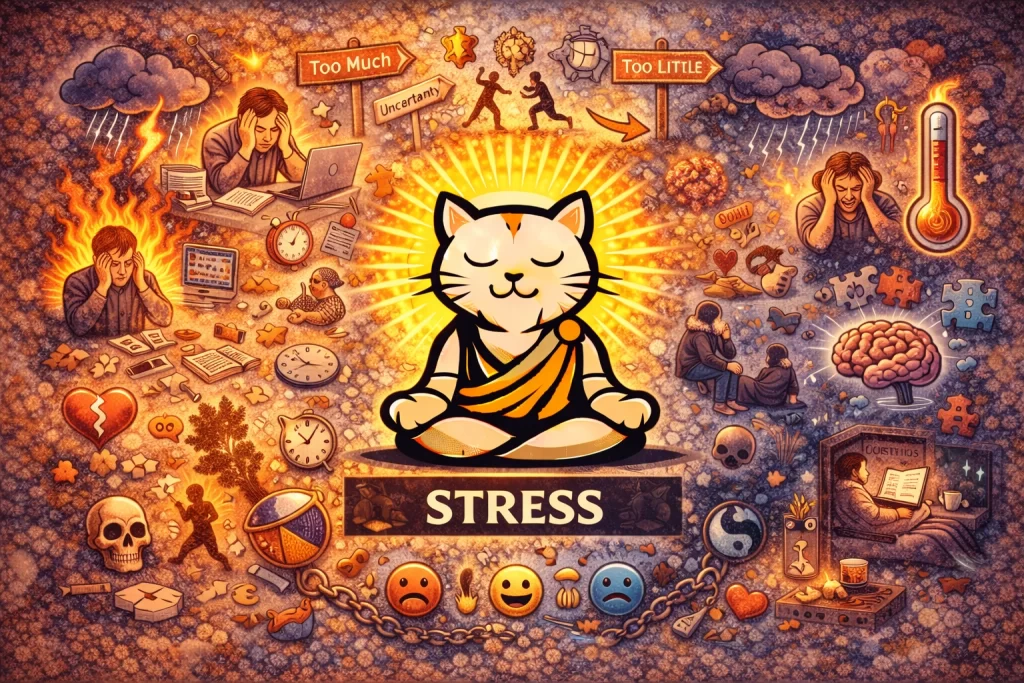
Stress is the body and mind’s response to perceived demands or threats. It is a universal human experience, arising from challenges such as work pressure, academic exams, financial strain, or interpersonal conflict. While stress is often portrayed negatively, it is fundamentally adaptive. In moderate amounts, it enhances alertness, motivation, and performance. However, when stress becomes chronic or overwhelming, it can undermine both physical and psychological health.
Modern stress research integrates biology, cognition, and social context. It examines not only what stress does to the body, but how perception, environment, and coping resources shape its impact.
The Biological Stress Response
The scientific study of stress began in the early twentieth century with Hans Selye, who introduced the concept of the General Adaptation Syndrome (GAS). Selye proposed three stages of stress: alarm (initial activation), resistance (adaptation), and exhaustion (resource depletion). Chronic stress, he argued, could lead to disease if the body remained in a prolonged state of activation.
When a stressor is perceived, the hypothalamic-pituitary-adrenal (HPA) axis is activated, releasing cortisol and adrenaline. These hormones increase heart rate, elevate blood pressure, and sharpen attention—preparing the body for “fight or flight.” While useful in short-term danger, sustained cortisol exposure is linked to weakened immune function, sleep disruption, and cardiovascular risk.
Research shows that individuals experiencing long-term workplace stress often exhibit elevated cortisol patterns and higher rates of burnout, demonstrating the physiological consequences of chronic strain.
Psychological Appraisal and Perception
Stress is not determined solely by events but by how those events are interpreted. Psychologists Richard Lazarus and Susan Folkman proposed the transactional model of stress, emphasizing cognitive appraisal. According to their theory, individuals first evaluate whether a situation is threatening (primary appraisal) and then assess their coping resources (secondary appraisal).
Experimental studies illustrate this process. In research on public speaking anxiety, participants who were instructed to interpret physiological arousal as helpful rather than harmful performed better and reported less distress. This suggests that reframing stress as a challenge rather than a threat can alter its impact.
The Yerkes-Dodson law further demonstrates that moderate levels of arousal enhance performance, while too little or too much impairs it. This inverted-U relationship highlights that stress is not inherently negative—it depends on intensity and context.
Stress and Health Outcomes
Chronic stress is associated with numerous health conditions, including hypertension, depression, and metabolic disorders. Longitudinal research indicates that individuals exposed to ongoing socioeconomic stressors face elevated risk for physical illness.
One influential line of research involves the concept of allostatic load—the cumulative wear and tear on the body caused by repeated stress activation. Studies show that individuals with higher allostatic load scores exhibit greater health vulnerability over time.
The famous Whitehall studies in the United Kingdom examined British civil servants and found that lower job control was linked to higher rates of heart disease. This research demonstrated that stress is not merely about workload but about perceived autonomy and control.
Social and Environmental Factors
Stress does not occur in isolation. Social support significantly buffers its effects. Studies show that individuals with strong social networks experience lower physiological stress responses during challenging tasks. The presence of supportive relationships can reduce cardiovascular reactivity and enhance emotional resilience.
Conversely, chronic exposure to discrimination, poverty, or unstable environments increases stress burden. Research in developmental psychology indicates that early-life stress can influence brain development and long-term health outcomes.
Mindfulness-based stress reduction (MBSR), developed by Jon Kabat-Zinn, has been shown in clinical trials to reduce anxiety and improve stress management. Participants often report decreased perceived stress and improved emotional regulation, illustrating that stress responses can be modified through training.
Conclusion
Stress is a complex interaction between biological activation and psychological interpretation. Study examples—from Selye’s physiological model to the Whitehall studies and appraisal research—demonstrate that stress is shaped by both internal and external factors.
In small doses, stress sharpens focus and motivates action. In chronic excess, it undermines health and well-being. Understanding stress empowers individuals to recognize its mechanisms, manage its effects, and cultivate resilience. Ultimately, stress is not simply a burden—it is a signal that demands adaptation, awareness, and balance.