
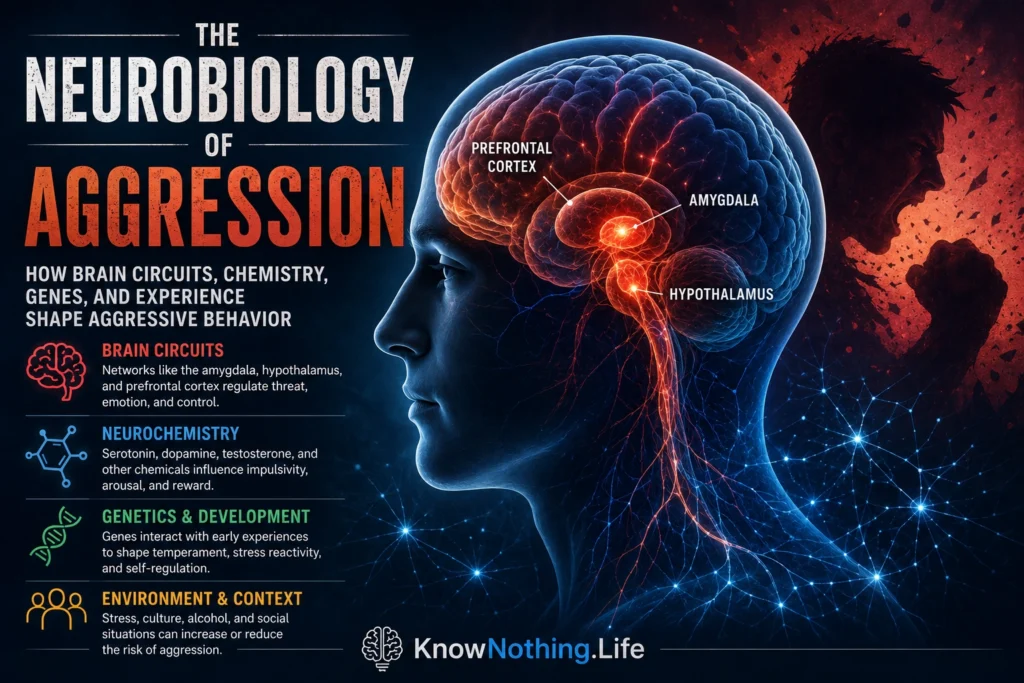
Aggression is behavior intended to threaten, harm, intimidate, dominate, or remove an obstacle. It can be physical, verbal, relational, defensive, or competitive. Neuroscientists commonly distinguish reactive aggression from proactive aggression. Reactive aggression is an emotionally charged response to frustration, provocation, fear, or perceived threat. Proactive aggression is more deliberate and instrumental, used to obtain status, resources, control, or another desired outcome. The two forms can overlap, but they do not necessarily arise from identical psychological or neural processes.
Aggression is not produced by a single brain structure, hormone, neurotransmitter, or gene. It emerges when systems involved in threat detection, reward, emotional arousal, social interpretation, impulse control, memory, and action selection interact within a particular situation. The same neural systems that contribute to destructive violence also support ordinary defense, competition, boundary protection, and survival. The scientific challenge is therefore not to locate an isolated “aggression center,” but to explain why adaptive defensive systems sometimes become excessive, poorly regulated, or directed toward inappropriate targets.
The Hypothalamus and the Organization of Attack
Animal research has shown that parts of the hypothalamus participate in organizing aggressive actions. The hypothalamus receives information about social cues, reproductive state, bodily condition, stress, and environmental threat, then communicates with brainstem and motor systems capable of producing attack, defense, escape, and autonomic arousal. These circuits are especially important because aggression is not only an emotion. It requires the coordinated selection and execution of behavior.
In a landmark 2011 study, Dayu Lin and colleagues identified a population of neurons in the ventromedial hypothalamus of male mice that became active during attacks. Activating these neurons with light caused mice to attack males, females, and even inanimate objects, while inhibiting the same region reduced naturally occurring aggression. The experiment provided strong causal evidence that a specific hypothalamic circuit can help organize attack behavior. It did not show that the region independently creates human violence, however. Human aggression involves language, moral judgment, social rules, long-term planning, and personal history in ways that cannot be reproduced fully in a mouse model.
The hypothalamus functions within a wider network that includes the amygdala, septum, bed nucleus of the stria terminalis, periaqueductal gray, striatum, and prefrontal cortex. Activity in one part of this network can have different behavioral effects depending on the social situation and the state of the organism. Neural circuits do not simply release a fixed aggressive program; they help determine whether confrontation, avoidance, freezing, submission, or another response is most appropriate.
The Amygdala, Threat, and Provocation
The amygdala helps identify emotionally significant information, particularly uncertain or potentially threatening social cues. Facial expressions, hostile gestures, violations of personal space, and memories of earlier conflict can all influence amygdala activity. When another person’s behavior is interpreted as intentionally hostile, the amygdala can contribute to heightened vigilance, bodily arousal, and preparation for defensive action. This does not make it a simple aggression center. The amygdala participates in fear learning, attention, reward, social perception, and memory as well as aggressive responding.
Human imaging studies suggest that reactive aggression may involve heightened responses to provocation combined with weakened communication between emotional and regulatory systems. In a study of violent offenders performing a laboratory aggression task, Niels K. Krämer and colleagues found greater amygdala and striatal reactivity to provocation than in control participants. The violent offenders also showed reduced connectivity between these subcortical regions and areas of the prefrontal cortex. These findings support the view that impulsive aggression can arise when threat and reward signals become highly influential while regulatory communication is less effective.
Research involving healthy participants also shows that provocation recruits a broader network rather than one isolated region. An interactive functional imaging study found that social provocation and retaliatory decisions involved the insula, anterior cingulate cortex, orbitofrontal cortex, medial prefrontal cortex, and dorsolateral prefrontal cortex. Aggression therefore reflects an interaction between emotional reactions and evaluative processes that consider intentions, fairness, consequences, and available responses.
The Prefrontal Cortex and Behavioral Control
The prefrontal cortex supports planning, working memory, emotional regulation, moral evaluation, and the inhibition of actions that conflict with long-term goals. Strong anger does not inevitably result in aggression because prefrontal systems can reinterpret the situation, consider consequences, and select a nonviolent response. Injury, intoxication, extreme arousal, sleep loss, or developmental immaturity may weaken these regulatory processes, although none of these factors guarantees aggression.
Adrian Raine and colleagues used positron emission tomography to study people charged with murder who had pleaded not guilty by reason of insanity. Their 1997 study reported reduced glucose metabolism in several areas, including the prefrontal cortex, along with differences in the corpus callosum and subcortical regions. The findings suggested that violent behavior in this highly selected group was associated with abnormalities across a network involved in regulation, emotion, and information integration. The study could not establish that these brain differences caused murder, and its results should not be generalized to all violent offenders or people with psychiatric disorders.
Reduced prefrontal control is best understood as one possible vulnerability rather than a biological sentence. A person with weaker inhibitory control may never become violent, particularly when supported by stable relationships, clear social expectations, effective coping skills, and environments that limit provocation. Conversely, individuals without an identifiable neurological abnormality may act aggressively under powerful social, emotional, or situational pressures.
Serotonin, Impulsivity, and Emotional Regulation
Serotonin has long been associated with aggression, but the relationship is more complicated than the claim that low serotonin directly causes violence. Serotonin influences mood, patience, punishment sensitivity, impulse control, and the regulation of emotional reactions. Its effects vary across brain regions and receptor types, making it misleading to treat serotonin as a single chemical brake on aggression.
Researchers can temporarily reduce serotonin synthesis by lowering the availability of tryptophan, an amino acid used to produce serotonin. In a controlled study, Tracy K. Bond and colleagues found that acute tryptophan depletion increased aggressive responding among women during the premenstrual phase, although the effect was not uniform across all participants or situations. Other depletion studies have produced mixed results, suggesting that reduced serotonergic function may increase aggression most clearly in people who are already vulnerable to impulsivity, provocation, or poor emotional regulation.
Animal research also illustrates how serotonin interacts with other chemical systems. Studies in golden hamsters found that serotonin and vasopressin acted in opposing ways within the anterior hypothalamus: vasopressin facilitated offensive aggression, while stimulation of particular serotonin receptors inhibited it. Such findings demonstrate that aggressive behavior depends on chemical interactions within specific circuits rather than the total amount of one neurotransmitter throughout the brain.
Testosterone, Status, and Social Context
Testosterone is frequently described as an aggression hormone, but human studies do not support such a simple conclusion. Testosterone appears to influence sensitivity to competition, dominance, status, and social challenge. Whether that motivation produces aggression depends on the situation and on which behavior is likely to protect or improve social standing. In some contexts, aggression may serve status; in others, cooperation, generosity, or restraint may be more effective.
In a placebo-controlled experiment, Justin Carré and colleagues found that testosterone administration increased both antisocial and prosocial status-enhancing behavior in men. Testosterone increased punitive responses to unfair treatment but also increased generosity when generosity could improve social standing. The results suggested that testosterone amplifies status-seeking rather than automatically creating hostility.
Testosterone can also influence how the brain responds to social threat. Jack van Honk and colleagues reported that testosterone administration increased activity within neural circuitry involved in responding to angry facial expressions. This heightened sensitivity could make threatening cues more behaviorally important, but the final response would still depend on appraisal, learning, self-control, and social consequences. Hormones adjust the probability and intensity of certain responses; they do not dictate a single inevitable action.
Genes, Development, and Early Experience
Genes influence the development and function of neural systems involved in temperament, emotional reactivity, and impulse control, but there is no single gene for aggression. One of the best-known findings concerns the MAOA gene, which provides instructions for producing monoamine oxidase A, an enzyme involved in breaking down neurotransmitters such as serotonin, dopamine, and noradrenaline. The gene has sometimes been misleadingly called the “warrior gene,” a label that exaggerates its predictive power.
In a 2002 longitudinal study, Avshalom Caspi and colleagues examined males followed from childhood into adulthood. Childhood maltreatment was associated with a greater risk of later antisocial behavior, but the strength of the association differed according to variation in MAOA activity. Maltreated participants with a genotype associated with higher MAOA expression were less likely to develop antisocial problems than maltreated participants with lower-expression variants. The study demonstrated a gene–environment interaction rather than a direct genetic cause of aggression. Neither genotype alone nor maltreatment alone determined an individual’s future.
Early experience can shape the way developing neural systems interpret threat and regulate emotion. Exposure to violence, unpredictable punishment, neglect, or chronic hostility may encourage vigilance and rapid defensive responding. These adaptations can be useful in dangerous environments but maladaptive in safer settings where ambiguous behavior is more likely to be misinterpreted as hostile. Developmental risk is also not destiny. Supportive caregiving, education, social connection, treatment, and improved environmental stability can alter behavioral pathways across time.
Alcohol, Stress, and Situational Aggression
Biological vulnerability often becomes most visible in a particular context. Alcohol can increase aggression by weakening inhibition, narrowing attention, and altering the evaluation of social cues. In a placebo-controlled imaging study, moderate alcohol intoxication was associated with aggressive responding under provocation, while individual increases in reactive aggression were related to altered amygdala and ventral striatal responses. The findings support the view that alcohol does not insert aggression into the brain; it changes the balance among emotional reactivity, reward, and regulatory control.
Stress can produce a similar shift. Threat and frustration increase autonomic arousal and redirect attention toward immediate concerns. When arousal becomes intense, reflective control may weaken while previously learned defensive habits become more influential. Social exclusion, humiliation, crowd behavior, access to weapons, expectations of masculinity, and perceived injustice can all interact with neural systems. A complete explanation of aggression must therefore include the environment in which the brain operates.
Understanding the Aggressive Brain
Aggression emerges from systems designed to solve important adaptive problems: detecting threat, defending resources, competing for status, protecting others, and responding to provocation. The hypothalamus helps organize attack behavior, the amygdala assigns significance to threat, the striatum represents reward and action, and the prefrontal cortex evaluates consequences and regulates impulses. Serotonin, dopamine, testosterone, cortisol, and vasopressin modify these systems, while genes and experience influence how they develop.
No brain scan, hormone level, or genetic variant can determine whether a person will become violent. Neurobiology describes vulnerabilities and mechanisms, not moral inevitabilities. Aggressive behavior appears when biological tendencies meet learning, culture, relationships, opportunity, and immediate circumstances. The most accurate scientific account is therefore neither purely biological nor purely social. It explains how brains shaped by experience respond to environments that can either provoke aggression or make regulation, cooperation, and restraint possible.