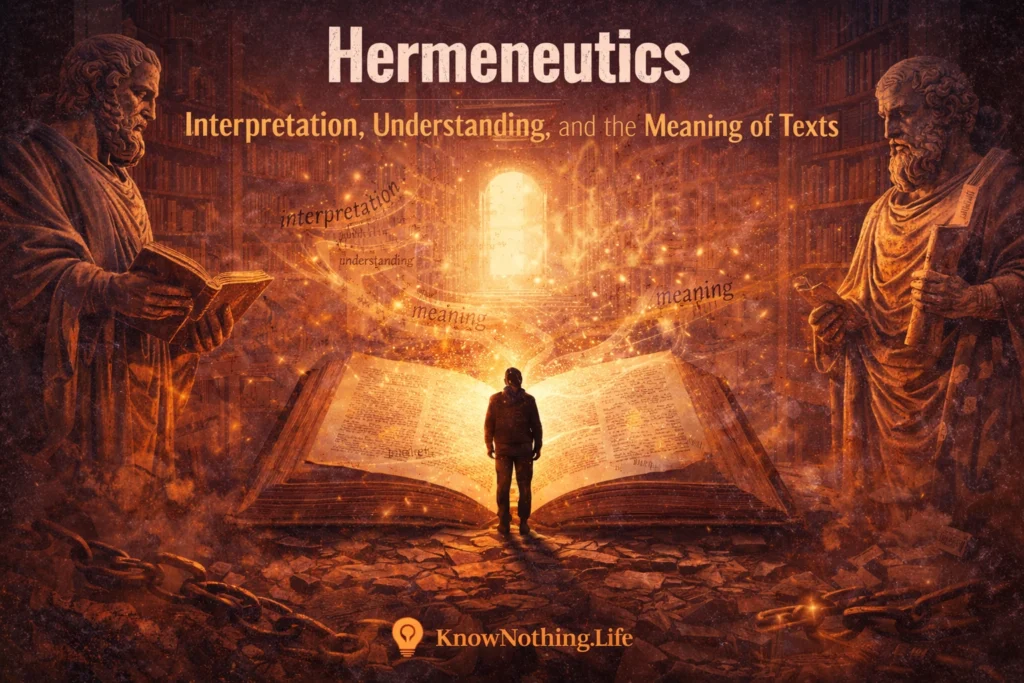
Hermeneutics is the philosophical study of interpretation, concerned with how meaning is understood, communicated, and transformed across contexts. Originally developed as a method for interpreting sacred texts, particularly the Bible, hermeneutics has evolved into a broad philosophical discipline that addresses the nature of understanding itself. It asks fundamental questions about how we interpret language, texts, and human experience, and how meaning is shaped by history, culture, and perspective. Central figures in this tradition include Friedrich Schleiermacher, Wilhelm Dilthey, Martin Heidegger, and Hans-Georg Gadamer.
At its core, hermeneutics recognizes that understanding is not a passive reception of information but an active process of interpretation. Every act of reading or listening involves assumptions, expectations, and prior knowledge that shape how meaning is perceived. This insight challenges the idea that texts have fixed, objective meanings, suggesting instead that meaning emerges through the interaction between the interpreter and the text. Hermeneutics thus moves beyond technical interpretation to explore the deeper structures of understanding that underlie human communication.
Schleiermacher and the Art of Interpretation
The modern development of hermeneutics begins with Friedrich Schleiermacher, who sought to establish a general theory of interpretation applicable to all texts. In his lectures and writings, Schleiermacher argues that understanding involves both grammatical interpretation—analyzing the structure of language—and psychological interpretation—reconstructing the intentions of the author. This dual approach reflects his belief that meaning arises from the interplay between language and the individual who uses it.
Schleiermacher emphasizes the importance of entering into the perspective of the author, attempting to understand the text as it was originally intended. “The task is to understand the author better than he understood himself,” he writes, suggesting that interpretation can reveal dimensions of meaning that even the author may not have fully recognized. This ambitious goal reflects a deep commitment to the possibility of genuine understanding, even across temporal and cultural distances.
At the same time, Schleiermacher acknowledges the challenges inherent in interpretation. Language is inherently ambiguous, and the distance between author and reader introduces potential misunderstandings. His work lays the foundation for later developments in hermeneutics by highlighting the complexity of interpretation and the need for a systematic approach to understanding texts.
Dilthey and the Human Sciences
Wilhelm Dilthey expanded hermeneutics beyond textual interpretation to encompass the broader study of human life and culture. He distinguished between the natural sciences, which seek to explain phenomena through causal laws, and the human sciences (Geisteswissenschaften), which aim to understand human experience from within. For Dilthey, hermeneutics provides the methodological foundation for this understanding.
Dilthey argues that human actions, institutions, and cultural expressions are meaningful and must be interpreted in their historical context. Understanding (Verstehen) involves reconstructing the lived experience that gives rise to these expressions, rather than reducing them to external explanations. This approach emphasizes the importance of empathy and historical awareness in interpretation, recognizing that meaning is embedded in specific cultural and temporal contexts.
His work represents a significant expansion of hermeneutics, transforming it into a philosophy of understanding that applies to all aspects of human life. By emphasizing the interpretive nature of the human sciences, Dilthey highlights the role of meaning and context in shaping our understanding of the world.
Heidegger and the Hermeneutics of Being
A major turning point in the history of hermeneutics occurs with Martin Heidegger, who reinterprets it as a fundamental aspect of human existence. In Being and Time, Heidegger argues that understanding is not merely a methodological activity but a basic condition of being human. He introduces the concept of Dasein, the human being understood as “being-in-the-world,” to explore how interpretation is rooted in our engagement with the world.
For Heidegger, interpretation is always shaped by pre-understanding—our prior experiences, beliefs, and assumptions. These preconceptions are not obstacles to understanding but its very condition, enabling us to make sense of the world. “Understanding is the existential being of Dasein’s own potentiality for being,” he writes, suggesting that interpretation is inseparable from existence itself.
This perspective shifts hermeneutics from a focus on texts to a broader inquiry into the nature of understanding. Heidegger’s work emphasizes the dynamic and situated character of interpretation, where meaning is continually shaped by context and experience. His insights laid the groundwork for subsequent developments in philosophical hermeneutics.
Gadamer and the Fusion of Horizons
Building on Heidegger’s ideas, Hans-Georg Gadamer developed a comprehensive theory of hermeneutics in his major work Truth and Method. Gadamer argues that understanding is a dialogical process, involving a “fusion of horizons” between the interpreter and the text. Each horizon represents a perspective shaped by historical and cultural context, and understanding occurs when these perspectives interact and merge.
Gadamer rejects the idea that interpretation can achieve complete objectivity or recover the original meaning of a text in a pure form. Instead, he emphasizes the productive nature of interpretation, where meaning is continually reinterpreted in new contexts. “Being that can be understood is language,” he writes, highlighting the central role of language in shaping our experience of the world.
He also underscores the importance of tradition in shaping understanding. Far from being a limitation, tradition provides the framework within which interpretation takes place. By engaging with texts and ideas from the past, individuals participate in an ongoing dialogue that enriches their understanding. Gadamer’s work thus presents hermeneutics as a living process, where meaning is continually negotiated and renewed.
Hermeneutics in Contemporary Thought
In contemporary philosophy, hermeneutics continues to influence a wide range of disciplines, including literary theory, theology, and the social sciences. Its emphasis on interpretation and context has shaped approaches to understanding texts, cultural practices, and human behavior. Thinkers such as Paul Ricoeur have further developed hermeneutic theory, exploring the relationship between interpretation, narrative, and identity.
Ricoeur’s work bridges hermeneutics and phenomenology, examining how individuals construct meaning through stories and symbols. He introduces the idea of a “hermeneutics of suspicion,” which involves critically examining texts to uncover hidden meanings and power structures. At the same time, he emphasizes a “hermeneutics of trust,” recognizing the potential for texts to reveal truth and insight. This dual approach reflects the complexity of interpretation, balancing critique with openness.
Hermeneutics also plays a crucial role in contemporary debates about language, culture, and communication. In an increasingly interconnected world, the ability to interpret and understand different perspectives is more important than ever. Hermeneutics provides a framework for navigating these challenges, emphasizing dialogue, empathy, and the recognition of difference.
Final Reflections on Hermeneutics
Hermeneutics offers a profound and far-reaching account of understanding, revealing the interpretive processes that shape human experience. From its origins in textual interpretation to its development as a philosophy of understanding, it has transformed our approach to language, meaning, and communication. Through the work of Schleiermacher, Dilthey, Heidegger, Gadamer, and others, hermeneutics has become a central tradition in modern philosophy.
Its enduring significance lies in its recognition that understanding is never complete or final but always open to reinterpretation. By emphasizing the role of context, history, and perspective, hermeneutics invites us to engage more deeply with the world and with each other. It challenges us to listen, to question, and to remain open to new possibilities of meaning.
In a world marked by complexity and diversity, hermeneutics provides a valuable framework for dialogue and understanding. It reminds us that meaning is not simply given but created through interaction, and that the search for understanding is an ongoing and dynamic process.