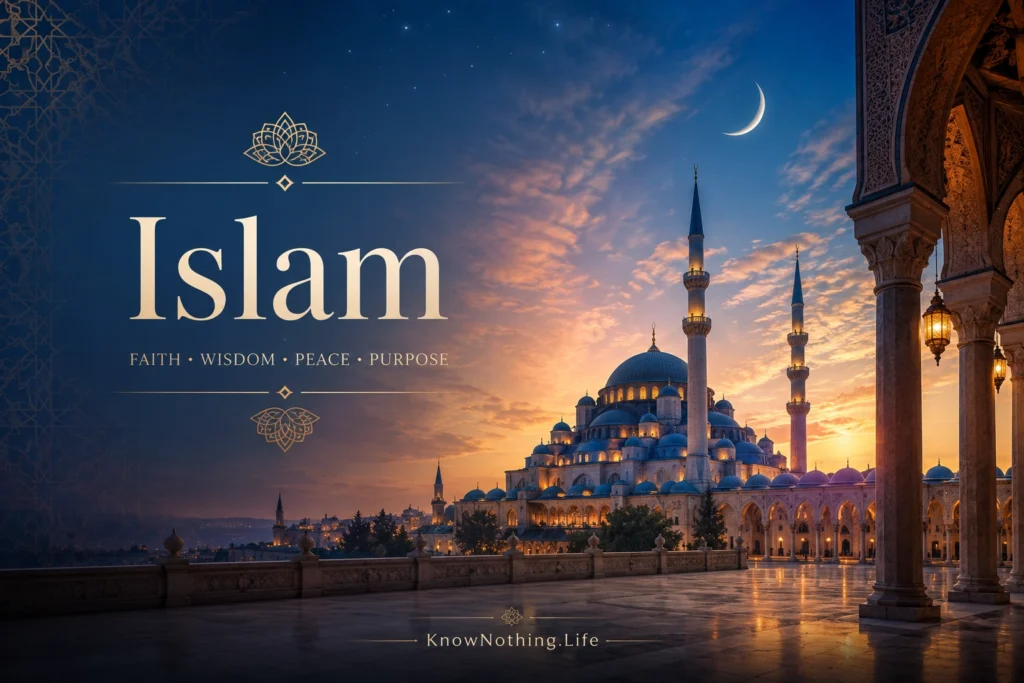
Islam is one of the world’s great monotheistic religions and one of the most influential civilizations in human history. It began in seventh-century Arabia through the preaching of the Prophet Muhammad and rapidly grew into a religious, legal, intellectual, artistic, and political tradition spanning the Middle East, Africa, Asia, Europe, and eventually the entire world. Today, Islam is practiced by more than a billion Muslims across many cultures, languages, ethnicities, and nations. It is not only a system of belief, but a way of life shaped by worship, law, community, ethics, learning, and devotion to God.
The word Islam is commonly understood as submission, surrender, or devotion to God. A Muslim is one who submits to God. At the center of Islam is tawhid, the absolute oneness of God. God, called Allah in Arabic, is not one god among many, but the single creator, sustainer, judge, and merciful Lord of all existence. Islam presents itself not as a new religion invented by Muhammad, but as the restoration of the original monotheistic faith given to prophets throughout history, including Adam, Noah, Abraham, Moses, and Jesus. Muhammad is understood as the final prophet, the “Seal of the Prophets,” who brought the final revelation in the Qur’an.
Muhammad and the Origins of Islam
Muhammad was born in Mecca around 570 CE into the Quraysh tribe. Mecca was an important trading and religious center, home to the Kaaba, a sacred sanctuary associated in Islamic tradition with Abraham and Ishmael. Arabian society at the time included tribal loyalties, poetry, trade networks, social inequality, and religious diversity, including polytheism, Judaism, Christianity, and forms of monotheistic searching. Muhammad became known for his honesty and was called al-Amin, the trustworthy. At about age forty, he began receiving revelations through the angel Gabriel, an experience that marked the beginning of his prophetic mission.
His message was simple but revolutionary: worship one God, abandon idols, care for the poor, practice justice, remember the Day of Judgment, and live with moral accountability. This message challenged Meccan elites because it threatened religious custom, tribal prestige, and economic interests tied to pilgrimage and idol worship. Muhammad and his followers faced persecution, and in 622 CE they migrated to Yathrib, later called Medina. This migration, the Hijrah, became the starting point of the Islamic calendar. In Medina, Muhammad became not only a prophet but a community leader, judge, statesman, and guide for a new religious society.
The Qur’an and Revelation
The Qur’an is the central scripture of Islam. Muslims believe it is the direct word of God revealed to Muhammad in Arabic over approximately twenty-three years. It is not viewed merely as inspired writing or historical record, but as divine speech itself. The Qur’an addresses theology, worship, morality, law, family life, social justice, prophecy, creation, death, resurrection, and the final judgment. Its language is poetic, rhythmic, commanding, consoling, warning, and deeply memorable. For Muslims, the Qur’an is recited, memorized, studied, heard, and lived.
The Qur’an is arranged into chapters called surahs, beginning with Al-Fatihah, the Opening, which is recited in daily prayer. Unlike a modern biography or linear narrative, the Qur’an often moves through themes, reminders, stories of earlier prophets, signs in nature, and calls to repentance. It repeatedly emphasizes God’s mercy and justice. Alongside the Qur’an, Muslims also look to the Sunnah, the example of Muhammad, preserved in hadith literature. Collections associated with scholars such as al-Bukhari, Muslim ibn al-Hajjaj, Abu Dawud, al-Tirmidhi, al-Nasa’i, and Ibn Majah became central to Islamic law, ethics, and devotional life.
The Five Pillars of Islam
The Five Pillars are the basic acts of worship that structure Muslim religious life. The first is the shahada, the declaration of faith: there is no god but God, and Muhammad is the messenger of God. This statement expresses the core of Islam: monotheism and prophethood. The second pillar is salat, ritual prayer performed five times daily. Prayer orients the believer toward God throughout the day, joining body, speech, memory, and devotion. Muslims pray facing Mecca, and the movements of standing, bowing, and prostration embody humility before God.
The third pillar is zakat, obligatory almsgiving, which treats wealth as a trust rather than absolute private possession. It supports the poor, needy, indebted, and vulnerable. The fourth pillar is fasting during Ramadan, when Muslims abstain from food, drink, and marital relations from dawn to sunset. Ramadan is a month of discipline, gratitude, self-restraint, prayer, Qur’an recitation, and compassion for those who suffer. The fifth pillar is hajj, pilgrimage to Mecca, required once in a lifetime for those physically and financially able. Hajj gathers Muslims from across the world in acts of worship that emphasize equality, repentance, memory, and submission to God.
Islamic Belief and Theology
Islamic belief is often summarized through faith in God, angels, revealed books, prophets, the Day of Judgment, and divine decree. God is merciful, just, all-knowing, and beyond comparison. Islam rejects the idea that God has partners, rivals, or equals. It also rejects the Christian doctrine of the Trinity and the divinity of Jesus, while honoring Jesus as a great prophet and Messiah born of the Virgin Mary. Mary, called Maryam in Arabic, is deeply honored in the Qur’an and has an entire chapter named after her.
Islamic theology developed through major schools and debates. Thinkers such as al-Ash’ari, al-Maturidi, and the Mu’tazilites debated reason, revelation, free will, divine attributes, and moral responsibility. Al-Ghazali, one of the most influential Muslim scholars, wrote The Revival of the Religious Sciences, integrating law, theology, ethics, and spirituality. Ibn Rushd, known in the West as Averroes, defended philosophy and Aristotelian reason in works such as The Incoherence of the Incoherence. Islamic theology has never been only abstract speculation. It has always been tied to worship, law, moral life, and the question of how finite human beings can know and serve the infinite God.
Sharia, Law, and Ethical Life
Sharia is often misunderstood. In Islamic thought, Sharia means the path or way ordained by God. It includes worship, ethics, family life, economic conduct, diet, personal behavior, charity, justice, and social responsibility. It is broader than legal punishment and cannot be reduced to politics or criminal law. Islamic jurisprudence, called fiqh, is the human effort to understand and apply Sharia through interpretation of the Qur’an, hadith, consensus, analogy, and other methods.
Major Sunni legal schools include Hanafi, Maliki, Shafi’i, and Hanbali traditions. Shia Islam developed its own legal and theological methods, especially within the Ja’fari school. These schools show that Islamic law has always involved interpretation, debate, context, and scholarship. The ethical aim of Islam is not merely rule-following but God-consciousness, called taqwa. A Muslim life is meant to cultivate humility, justice, honesty, modesty, generosity, patience, mercy, and responsibility before God.
Sunni and Shia Islam
The largest branch of Islam is Sunni Islam. Sunni Muslims emphasize the Qur’an, Sunnah, consensus of the community, and the historical legitimacy of the early caliphs after Muhammad. The name Sunni comes from Ahl al-Sunnah, the people of the prophetic way. Sunni Islam includes a wide range of theological, legal, spiritual, and cultural traditions across the world.
Shia Islam began from disputes over leadership after Muhammad’s death, especially the belief that Ali ibn Abi Talib, Muhammad’s cousin and son-in-law, and his descendants had a special spiritual and political authority. The martyrdom of Husayn ibn Ali at Karbala in 680 CE became one of the defining events of Shia memory, symbolizing sacrifice, injustice, loyalty, and resistance to tyranny. The largest Shia branch is Twelver Shiism, but there are also Ismaili and Zaydi traditions. While Sunni and Shia Muslims share the Qur’an, Muhammad, the Five Pillars, and core monotheistic faith, they differ in authority, history, law, theology, and ritual memory.
Sufism and the Inner Path
Sufism is the mystical and spiritual dimension of Islam. It emphasizes purification of the heart, remembrance of God, love, discipline, humility, and direct awareness of divine presence. Sufis do not see Islam as only outward practice; they seek inner transformation. The Qur’an, prayer, fasting, and law remain important, but Sufism asks whether the heart is awake to God. The central practice of dhikr, remembrance, uses repeated divine names, prayer, breath, music, or silent meditation to deepen awareness.
Major Sufi figures include Rabi’a al-Adawiyya, known for her language of divine love; Junayd of Baghdad, associated with sober mysticism; al-Hallaj, famous for his ecstatic utterances and execution; Ibn Arabi, whose works such as The Meccan Revelations and The Bezels of Wisdom shaped metaphysical Sufism; and Jalal al-Din Rumi, whose poetry in the Masnavi became globally beloved. Sufism influenced Islamic art, music, poetry, ethics, and devotional life across regions from Morocco to India, Turkey, Persia, Africa, and Southeast Asia.
Islamic Civilization and Knowledge
Islam produced one of history’s great intellectual civilizations. Between the eighth and thirteenth centuries, Muslim scholars preserved, translated, criticized, and expanded Greek, Persian, Indian, and other bodies of knowledge. Baghdad’s House of Wisdom became a symbol of translation and scholarship. Thinkers such as al-Kindi, al-Farabi, Ibn Sina, Ibn Rushd, al-Biruni, al-Khwarizmi, Ibn al-Haytham, and many others contributed to philosophy, medicine, mathematics, optics, astronomy, geography, and science.
Islamic civilization also shaped architecture, calligraphy, literature, law, trade, urban life, and education. Mosques, madrasas, libraries, hospitals, gardens, manuscripts, and geometric art reflected a worldview in which beauty and knowledge could become acts of devotion. Because Islam generally avoided divine images in worship, calligraphy and geometric design became especially important artistic forms. The written word, especially the Qur’an, became a visual and spiritual center of Islamic culture.
Islam in the Modern World
Islam today is global and diverse. The largest Muslim populations are not in the Arab world but in countries such as Indonesia, Pakistan, India, Bangladesh, Nigeria, Egypt, Turkey, and Iran. Muslims speak hundreds of languages and belong to many cultures. Some live in secular democracies, others in monarchies, republics, postcolonial states, minority communities, and diasporas. This diversity makes it inaccurate to treat Islam as a single culture or political system.
Modern Muslims debate many questions: tradition and reform, gender, law, democracy, secularism, colonialism, education, extremism, religious authority, science, and interfaith relations. Like all major traditions, Islam has produced saints and scholars, poets and philosophers, reformers and rulers, acts of mercy and acts of violence. A serious understanding must avoid both romantic idealization and hostile caricature. Islam is a living civilization with internal debate, historical depth, and spiritual complexity.
Final Thoughts
Islam is a religion of divine oneness, revelation, worship, law, mercy, discipline, and community. Its central message is that human beings are created by God, accountable to God, dependent on God’s mercy, and called to live with justice and compassion. Through Muhammad, the Qur’an, the Five Pillars, Sharia, theology, Sufism, scholarship, and global Muslim civilization, Islam has shaped the spiritual and intellectual life of humanity for more than fourteen centuries.
To understand Islam is to see more than headlines, stereotypes, or political conflict. It is to encounter a tradition of prayer before dawn, fasting in Ramadan, pilgrimage to Mecca, recitation of the Qur’an, charity for the poor, philosophical debate, mystical poetry, legal reasoning, sacred architecture, and the constant remembrance of God. At its best, Islam calls the human being away from arrogance and forgetfulness toward humility, gratitude, justice, and surrender to the One who is understood as the Most Merciful and the Most Compassionate.