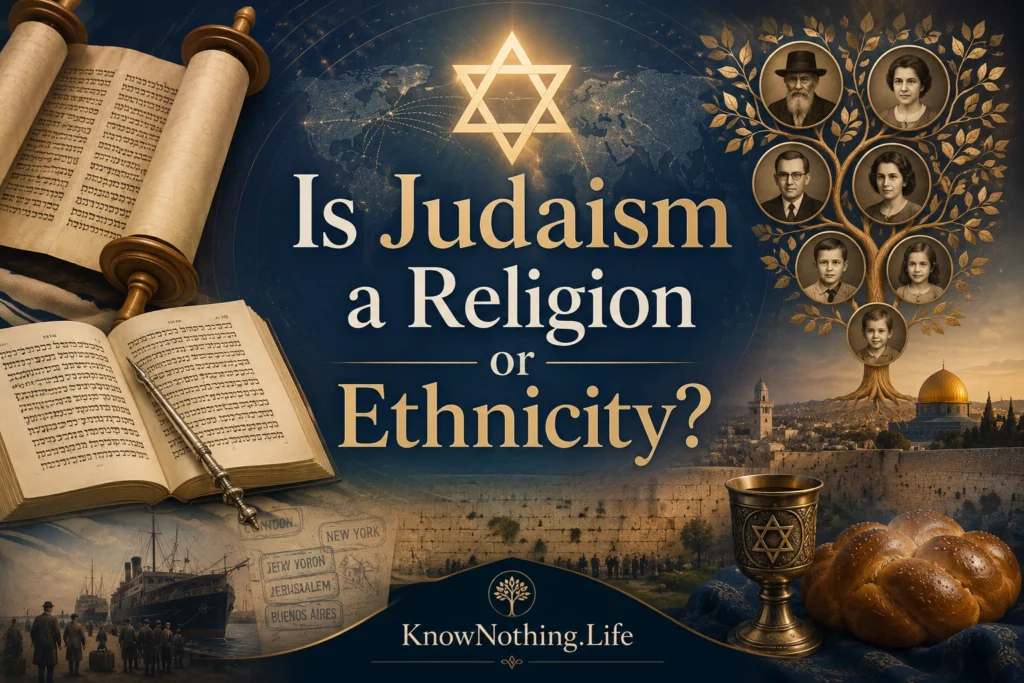
Judaism is often described as a religion, but Jewish identity has never fit neatly into the modern category of religion alone. Judaism includes belief, ritual, law, scripture, worship, ethics, festivals, prayer, and ideas about God. In that sense, it is clearly a religion. Yet Jews have also historically understood themselves, and have been understood by others, as a people: a shared community with ancestry, memory, language, law, homeland, exile, culture, and collective destiny. This is why the question “Is Judaism a religion or ethnicity?” can feel simple from the outside but complicated from within. The most accurate answer is that Judaism is a religion, while Jewishness can also be an ethnicity, culture, ancestry, civilization, and peoplehood.
The confusion comes partly from modern Western categories. Many people today think of religion as a set of beliefs one chooses privately, like Christianity, Islam, Buddhism, or atheism as personal convictions. Ethnicity, by contrast, is often imagined as ancestry, heritage, language, or shared culture. Jewish identity crosses that line. A person can be Jewish by religious practice, Jewish by birth, Jewish by conversion, Jewish by culture, Jewish by ancestry, Jewish by peoplehood, or some combination of these. Someone may be an atheist and still identify as Jewish. Someone may convert to Judaism and become fully Jewish without Jewish ancestry. Someone may have Jewish ancestry but no religious practice. Jewish identity is therefore not reducible to one modern label.
Judaism as a Religion
As a religion, Judaism is one of the world’s oldest monotheistic traditions. It centers on the covenantal relationship between God and the Jewish people, the Torah, commandments, prayer, study, ethical responsibility, and communal life. Jewish religious practice includes Shabbat, kosher dietary laws, circumcision, festivals such as Passover and Yom Kippur, synagogue worship, Torah reading, life-cycle rituals, and rabbinic interpretation. The Hebrew Bible, the Mishnah, the Talmud, medieval commentators, legal codes, mystical writings, and modern Jewish thought all form part of Judaism’s religious inheritance.
Judaism is not only a system of belief but a way of life. The Hebrew word halakhah, often translated as Jewish law, comes from a root meaning “to walk.” It suggests that religion is not only what one believes inwardly but how one walks through the world. This is one reason Judaism differs from traditions that define religious identity mainly through creed. Belief matters in Judaism, but practice, study, community, memory, and obligation also matter deeply. A Jew may be religiously observant, culturally Jewish, secular, Reform, Conservative, Orthodox, Reconstructionist, Humanistic, mystical, philosophical, or non-practicing. The religious tradition contains enormous diversity.
Jewishness as Peoplehood
Jewish identity is also peoplehood. The Bible does not present Israel merely as a voluntary faith group. It presents Israel as a people bound by covenant, memory, law, land, and lineage. The stories of Abraham and Sarah, Moses and the Exodus, Sinai, exile, return, and diaspora are not only theological stories. They are collective identity stories. Jews have preserved themselves through shared texts, rituals, languages, foodways, family structures, legal traditions, mourning practices, and historical memory.
This is why many Jews describe themselves as belonging to the Jewish people even when they are not religious. The sense of peoplehood can be compared, imperfectly, to other ancient ethno-religious identities where religion, ancestry, culture, and law historically developed together. Before the modern separation of religion and nation, many peoples understood their gods, rituals, laws, and ancestry as intertwined. Jewish identity emerged from that older world. It cannot be fully understood if it is forced into a modern box where religion means private belief and ethnicity means bloodline.
Jewishness as Ethnicity
Jewishness can also be ethnic, though ethnicity should not be confused with race. Ethnicity generally refers to shared ancestry, culture, history, language, customs, and group identity. Many Jews belong to ethnic Jewish communities such as Ashkenazi, Sephardi, Mizrahi, Beta Israel, Bukharian, Yemenite, Persian, Kurdish, Mountain Jewish, Cochin Jewish, and others. These communities developed distinct languages, foods, liturgical customs, music, histories, and cultural traditions. Ashkenazi Jews, for example, are historically associated with Central and Eastern Europe and Yiddish culture. Sephardi Jews trace much of their heritage to Spain, Portugal, North Africa, the Ottoman world, and Ladino-speaking traditions. Mizrahi Jews are associated with Jewish communities of the Middle East and North Africa.
Ethnic Jewish identity often persists even when religious observance fades. A secular Ashkenazi Jew may still inherit Yiddish phrases, Passover memories, Holocaust history, humor, food traditions, family names, and a sense of belonging to Jewish history. A Sephardi Jew may carry melodies, recipes, Ladino expressions, and communal memories of Iberian expulsion or Mediterranean life. These are not simply religious beliefs. They are cultural and ethnic inheritances. Yet they are also shaped by Judaism as a religious civilization. Jewish ethnicity and Jewish religion are historically intertwined rather than neatly separate.
Conversion and the Limits of Ethnicity
Conversion shows why Jewishness cannot be defined only by ethnicity. A person who converts to Judaism through a recognized Jewish process becomes Jewish. In traditional Jewish law, a convert is not considered a second-class outsider but a full member of the Jewish people. The biblical figure Ruth is central here. Ruth, a Moabite woman, declares to Naomi, “Your people shall be my people, and your God my God.” That sentence is powerful because it joins peoplehood and faith. Ruth does not merely adopt a belief. She joins a people.
This makes Jewish identity different from purely ethnic identity. One cannot usually convert into an ethnicity in a simple legal-religious sense, but one can convert into Judaism and become part of the Jewish people. At the same time, conversion is not merely signing up for a belief system. It involves entering a covenantal community with history, obligations, practices, and peoplehood. This is why Judaism is sometimes described as an ethno-religion: a tradition in which religious and people-based identity are inseparable.
Secular Jews and Cultural Judaism
The existence of secular Jews further complicates the question. Many Jews do not believe in God or do not practice Judaism religiously but still identify strongly as Jewish. Their Jewishness may be rooted in ancestry, family, history, ethics, humor, literature, food, politics, memory, music, language, or solidarity with other Jews. Thinkers such as Mordecai Kaplan, the founder of Reconstructionist Judaism, described Judaism as an “evolving religious civilization.” That phrase is useful because it recognizes that Judaism is broader than theology alone. It includes art, law, peoplehood, ethics, nationhood, language, and culture.
Secular Jewish identity became especially visible in modern Europe, America, and Israel. Many Jewish writers, scientists, activists, intellectuals, and artists were not traditionally observant but remained deeply shaped by Jewish history and culture. This does not mean religion was irrelevant. Often, even secular Jewish culture developed in conversation with religious texts, festivals, family patterns, and inherited ethical questions. A secular Jew may reject religious belief while still living inside Jewish memory.
Race, Antisemitism, and Misclassification
The question of whether Jews are an ethnicity has often been distorted by antisemitism. Antisemites have repeatedly tried to define Jews as a race in order to exclude, persecute, or dehumanize them. Nazi ideology, for example, treated Jewishness as racial and biological regardless of religious practice. That history makes discussions of Jewish ethnicity sensitive. Jews are not a race in the biological sense, and Jewish identity should not be reduced to genetics. Jewish communities are diverse, and Jews can come from many backgrounds, appearances, nationalities, and ancestries.
At the same time, antisemitism often targets Jews whether they are religious or not. A person with Jewish ancestry may be attacked as Jewish even if they are secular, converted to another religion, or disconnected from Jewish practice. This shows why Jewish identity is not only private belief. Society has often treated Jews as a people, an ethnic group, or a hereditary community. The danger comes when outsiders impose rigid definitions for hostile purposes. A humane understanding lets Jews define Jewish identity through their own religious, cultural, historical, and communal frameworks.
Israel, Diaspora, and National Identity
Jewish identity also includes a national dimension because Jewish history is tied to the land of Israel, exile, diaspora, and return. Ancient Israelite identity was connected to a land, language, temple, law, and people. After exile and dispersion, Jews lived as minority communities across the world while preserving a shared orientation toward Jerusalem, Hebrew scripture, and collective memory. Zionism, in its modern political form, argued that Jews are not only a religious group but a people with a right to national self-determination.
This does not mean all Jews understand Jewish identity the same way politically or religiously. Jews disagree intensely about Zionism, Israel, diaspora, religion, nationalism, ethics, and modern statehood. But the national dimension helps explain why Jewishness cannot be reduced to synagogue attendance or belief in God. Jewish identity includes memory of land and exile, even for Jews who interpret that memory differently.
Final Thoughts: Religion, Ethnicity, and More
So, is Judaism a religion or ethnicity? Judaism is a religion. Jewishness can be an ethnicity. But the fullest answer is that Jewish identity is a combination of religion, peoplehood, culture, ancestry, law, memory, and civilization. Some Jews experience their Jewishness primarily through faith and observance. Others experience it through family, history, language, food, ethics, or belonging. Converts become fully Jewish through religious and communal entry. Secular Jews may remain deeply Jewish through culture and peoplehood. Ethnic Jewish communities preserve distinct histories while sharing a broader Jewish inheritance.
The question matters because it reveals the limits of modern categories. Judaism comes from an ancient world in which religion, law, kinship, culture, land, and people were not separated the way they often are today. To call Judaism “only a religion” ignores Jewish peoplehood and ethnicity. To call it “only an ethnicity” ignores conversion, belief, practice, and covenant. The most accurate answer is both, and more than both. Judaism is a religious tradition; Jewishness is a peoplehood that can include religion, ethnicity, culture, ancestry, memory, and chosen belonging.