Christianity is the world’s largest religious tradition and one of the most influential forces in human history. It began in the first century as a Jewish movement centered on the life, teachings, death, and resurrection of Jesus of Nazareth. From a small group of disciples in Roman-occupied Judea, it spread across the Mediterranean world, entered Africa, Asia, and Europe, became the official religion of empires and kingdoms, shaped philosophy and art, divided into major branches, and continues to influence billions of people today. Christianity is not only a set of beliefs. It is a civilization-shaping tradition of scripture, worship, ethics, theology, ritual, community, and hope.
At the center of Christianity is the claim that Jesus is not merely a prophet, teacher, or moral reformer, but the Christ, the Messiah, the Son of God, and the Savior of the world. Christians believe that in Jesus, God entered human history in a unique way. His life revealed divine love, his death confronted sin and evil, and his resurrection opened the promise of new life. The meaning of those claims has been interpreted in many ways across history, but they remain the heart of Christian identity.
Jesus of Nazareth and the Origins of Christianity
Jesus was born into a Jewish world shaped by Torah, prophecy, temple worship, Roman occupation, messianic expectation, and apocalyptic hope. The Gospels of Matthew, Mark, Luke, and John present him as a teacher, healer, preacher of the kingdom of God, critic of religious hypocrisy, friend of sinners, and challenger of worldly power. His teachings emphasized love of God, love of neighbor, forgiveness, mercy, repentance, humility, justice, and the nearness of God’s reign. The Sermon on the Mount, the parable of the Good Samaritan, the Lord’s Prayer, and Jesus’ command to love enemies became some of the most enduring moral teachings in world history.
The crucifixion of Jesus under Roman authority could have ended the movement. Instead, his followers proclaimed that God had raised him from the dead. This resurrection faith transformed a defeated teacher into the living Lord of Christian proclamation. The apostle Paul, whose letters are among the earliest Christian writings, argued that Christ’s death and resurrection changed the human condition itself. In letters such as Romans, Galatians, and 1 Corinthians, Paul developed themes of grace, faith, sin, justification, the Spirit, and the church as the body of Christ. Through Paul and other missionaries, Christianity moved beyond its Jewish origins into the Gentile world.
Scripture and the Christian Bible
The Christian Bible contains the Old Testament and the New Testament. The Old Testament, shared in different forms with Judaism, includes creation stories, law, history, poetry, prophecy, wisdom literature, and covenant theology. Christians read these texts through the lens of Christ, seeing Jesus as the fulfillment of Israel’s story, though Jewish interpretation understands these scriptures differently. The New Testament contains the four Gospels, the Acts of the Apostles, letters from Paul and other early Christian writers, and the Book of Revelation.
For Christians, scripture is not simply ancient literature. It is sacred testimony. Different traditions understand biblical authority differently. Catholics and Orthodox Christians read scripture within the living tradition of the church. Protestants, especially since the Reformation, have emphasized sola scriptura, the authority of scripture as the final rule of faith. Yet across traditions, the Bible remains central to preaching, worship, doctrine, moral reflection, prayer, and identity. It is the primary written witness to the story Christians believe defines the world: creation, fall, covenant, incarnation, redemption, resurrection, church, and new creation.
Core Christian Beliefs
Christian doctrine developed as the early church tried to explain who Jesus was and what salvation meant. The doctrine of the Trinity became central: one God in three persons, Father, Son, and Holy Spirit. This doctrine does not mean Christians worship three gods. It means that God is understood as eternal communion of love, revealed through the Father, incarnate in the Son, and active in the Holy Spirit. The Nicene Creed, first formulated in the fourth century, remains one of the most important statements of Christian belief.
Another central doctrine is the Incarnation: the belief that the eternal Word of God became flesh in Jesus Christ. The Gospel of John expresses this in its famous opening: “The Word became flesh and dwelt among us.” The Council of Chalcedon in 451 taught that Christ is fully divine and fully human, two natures united in one person. Christianity therefore places enormous significance on embodiment. God is not distant from human suffering. In Christ, God enters birth, hunger, friendship, betrayal, pain, death, and hope.
The First Christian Nation
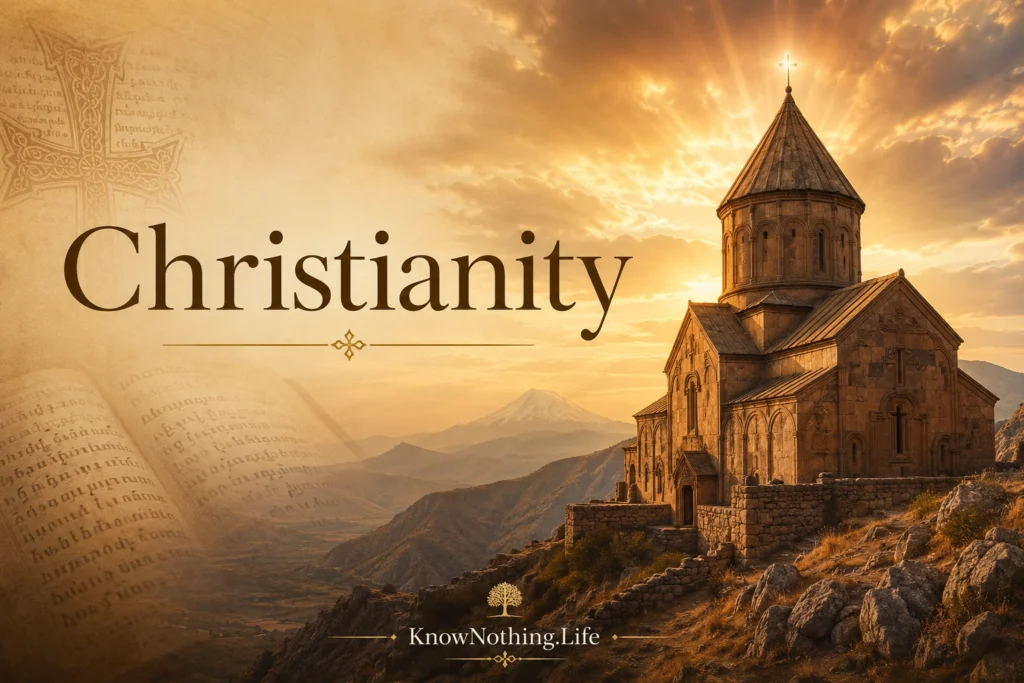
One of the most important milestones in Christian history is Armenia’s adoption of Christianity as its state religion. Armenia is widely recognized as the first nation to officially adopt Christianity, traditionally dated to 301 CE under King Tiridates III through the missionary work of Saint Gregory the Illuminator. This happened before Christianity became favored in the Roman Empire under Constantine and long before it became the official religion of Rome. Armenia’s conversion therefore stands as a defining moment in the history of Christianity’s move from persecuted minority faith to national and cultural identity.
The Armenian Apostolic Church became central to Armenian civilization. Christianity shaped Armenian art, architecture, liturgy, manuscript culture, music, theology, and national memory. The creation of the Armenian alphabet by Mesrop Mashtots in the early fifth century helped preserve scripture, worship, and Armenian identity through language. The Etchmiadzin Cathedral, traditionally associated with Gregory the Illuminator’s vision, became one of the oldest and most sacred centers of Armenian Christianity. For Armenians, Christianity was not merely imported belief. It became inseparable from the survival, suffering, creativity, and historical endurance of the Armenian people.
Sin, Grace, and Salvation
Christianity teaches that human beings are created in the image of God, yet wounded by sin. Sin is not only individual wrongdoing; it is alienation from God, distortion of desire, injustice, pride, violence, and broken relationship. Augustine of Hippo, in works such as Confessions and The City of God, explored the restless human heart and the problem of disordered love. For Augustine, sin is not merely rule-breaking but loving lesser things above the highest good.
Grace is Christianity’s answer to sin. Salvation is not achieved by human perfection but received through God’s mercy. Different Christian traditions explain salvation differently. Catholics emphasize grace working through faith, sacraments, love, and transformation. Protestants often emphasize justification by faith, especially following Martin Luther’s reading of Paul. Eastern Orthodox and Oriental Orthodox traditions, including the Armenian Apostolic Church, speak strongly of healing, participation in divine life, liturgy, and transformation. Despite differences, Christians agree that salvation is ultimately God’s work, not merely human achievement.
The Church and Sacramental Life
Christianity is not only a private belief system. It is communal. The church is understood as the gathered people of God, the body of Christ, and the community shaped by the Holy Spirit. From the beginning, Christians met for teaching, prayer, fellowship, the breaking of bread, and care for the poor. Worship formed Christian identity. The Eucharist, or Communion, became the central act of Christian remembrance and participation in Christ’s death and resurrection.
The sacraments are especially important in Catholic, Orthodox, Oriental Orthodox, Anglican, and some Protestant traditions. Baptism marks entry into Christian life, symbolizing cleansing, rebirth, and union with Christ. The Eucharist is understood in different ways, from Catholic teaching on the real presence to Protestant memorial and spiritual-presence interpretations. Orthodox and Armenian liturgical traditions emphasize worship as participation in sacred mystery, with chant, incense, icons, vestments, scripture, and ancient prayers forming the soul. Across traditions, Christian worship joins memory and hope: remembering Christ’s saving work and anticipating the kingdom of God.
Major Branches of Christianity
Christianity developed into several major branches. Roman Catholicism, centered historically on the authority of the pope and the sacramental life of the church, became the largest Christian tradition. Eastern Orthodoxy, rooted in the Greek-speaking and Eastern Christian world, emphasizes holy tradition, liturgy, icons, the church fathers, and theosis. Oriental Orthodoxy includes ancient churches such as the Armenian Apostolic Church, Coptic Orthodox Church, Syriac Orthodox Church, Ethiopian Orthodox Tewahedo Church, Eritrean Orthodox Church, and Malankara Orthodox Syrian Church. These churches have distinct histories and theological traditions and should not simply be treated as later offshoots of Rome or Byzantium.
The Protestant Reformation of the sixteenth century created another major division. Martin Luther, John Calvin, Huldrych Zwingli, and other reformers challenged Catholic authority, indulgences, and certain doctrines, emphasizing scripture, grace, faith, and reform of worship. Protestantism later diversified into Lutheran, Reformed, Anglican, Baptist, Methodist, Pentecostal, evangelical, and many other traditions. Christianity today is deeply global, with major communities in Africa, Latin America, the Middle East, Asia, Europe, and North America. It is no longer accurately described as merely Western.
Christian Ethics and the Life of Love
Christian ethics begins with love: love of God and love of neighbor. Jesus’ command to love enemies, forgive offenders, care for the poor, welcome strangers, and serve rather than dominate has shaped Christian moral imagination for two thousand years. The parable of the Good Samaritan, the Beatitudes, and Jesus’ identification with “the least of these” in Matthew 25 continue to challenge Christians toward compassion and justice.
Yet Christian history also contains contradiction. Christians have founded hospitals, schools, charities, abolitionist movements, human rights campaigns, orphanages, monasteries, and relief organizations. They have also participated in crusades, colonialism, antisemitism, coercion, slavery, persecution, and political violence. A serious account of Christianity must include both. The faith’s highest ideals have often inspired moral courage, while its institutions have sometimes betrayed their own teachings. This tension is part of Christianity’s historical reality: a religion of grace carried by imperfect human beings.
Christianity and Culture
Christianity has shaped art, music, philosophy, literature, law, architecture, education, and politics. Byzantine icons, Armenian illuminated manuscripts, medieval cathedrals, Gregorian chant, Bach’s sacred music, Dante’s Divine Comedy, Milton’s Paradise Lost, Dostoevsky’s novels, and countless paintings of the Madonna, the crucifixion, and the resurrection all emerged from Christian imagination. Thinkers such as Augustine, Thomas Aquinas, Anselm, Gregory of Narek, Martin Luther, John Calvin, Søren Kierkegaard, Karl Barth, C. S. Lewis, Dietrich Bonhoeffer, Dorothy Day, and Gustavo Gutiérrez shaped theology, ethics, politics, and modern thought.
Christianity also influenced ideas of human dignity, conscience, charity, natural law, education, and moral responsibility. At the same time, modern secular thought often developed in argument with Christianity. Enlightenment criticism, scientific discovery, historical biblical scholarship, feminism, liberation theology, and interfaith dialogue all forced Christianity to rethink itself. The tradition has survived partly because it continually returns to its sources while responding to new historical questions.
Final Thoughts
Christianity is a faith built around a person, a story, and a promise. The person is Jesus Christ. The story is creation, fall, covenant, incarnation, cross, resurrection, church, and new creation. The promise is that love, grace, and life are stronger than sin, despair, and death. Across centuries, Christians have expressed that promise through doctrine, liturgy, prayer, service, sacrifice, art, argument, and community.
Its history is vast, beautiful, troubled, and unfinished. Christianity has produced saints and sinners, reformers and rulers, mystics and missionaries, poets and theologians, hospitals and empires, acts of mercy and acts of violence. Armenia’s place as the first Christian nation shows how early and deeply Christianity became rooted in national identity, culture, language, and survival. To understand Christianity is not only to study beliefs, but to study how those beliefs have shaped entire peoples and civilizations. At its best, Christianity calls people beyond ego, fear, greed, and hatred toward love of God and neighbor. Its central symbol remains the cross: a sign of suffering transformed, violence answered by forgiveness, and death met with the hope of resurrection.