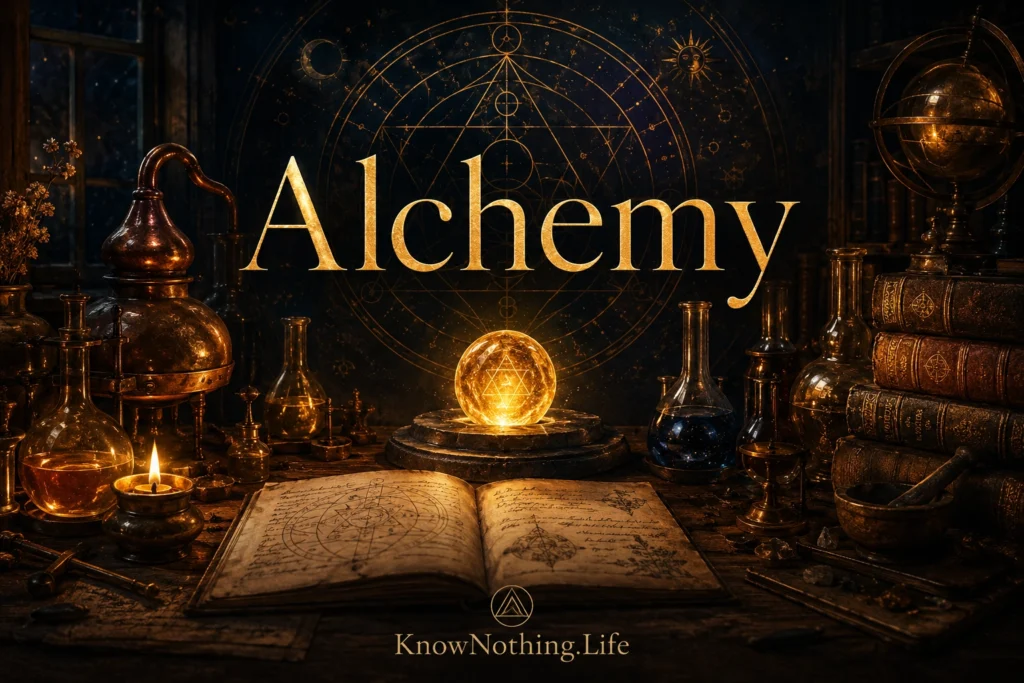
Alchemy is one of the most mysterious and misunderstood traditions in intellectual history. To modern readers, it is often remembered as the failed attempt to turn lead into gold, but that narrow image misses much of its meaning. Alchemy was a practical art, a spiritual discipline, a symbolic philosophy, a medical tradition, and an early contributor to chemistry. It joined laboratory work with metaphysical speculation, treating metals, minerals, plants, colors, fire, vessels, and transformation as signs of a deeper order in nature. The alchemist did not merely ask what matter is made of. The alchemist asked how matter changes, how life is purified, and whether nature itself is moving toward perfection.
At its heart, alchemy is about transformation. The transformation of base metals into noble metals was the outward image, but many alchemical writers also understood the work inwardly. Lead symbolized heaviness, corruption, ignorance, or the unrefined state. Gold symbolized perfection, incorruptibility, illumination, and spiritual completion. The laboratory and the soul mirrored one another. This is why alchemy survived for so long even after modern chemistry rejected its literal theories. It gave humanity a powerful symbolic language for becoming something higher than one’s original condition.
Ancient and Hellenistic Roots
Alchemy grew from many sources: Egyptian metallurgy, Greek philosophy, Hellenistic Hermeticism, Babylonian astrology, early medicine, and religious symbolism. Egypt was especially important because of its long traditions of metalworking, dyeing, embalming, glassmaking, temple ritual, and sacred craft. The very word “alchemy” is often linked through Arabic to older terms associated with Egypt and the “black land” of the Nile. In the Hellenistic city of Alexandria, Greek philosophical ideas mixed with Egyptian religious imagination, producing a world where matter, spirit, planets, gods, and hidden correspondences were often studied together.
Early alchemical texts were attributed to legendary or semi-legendary figures such as Hermes Trismegistus, Maria the Jewess, Zosimos of Panopolis, and Democritus. Hermes Trismegistus, central to Hermetic tradition, became a symbolic patron of alchemy because Hermeticism taught that the human being and the cosmos reflect one another. Zosimos, one of the most important early alchemical writers, described alchemical processes in both technical and visionary language. His works show that alchemy was never simply crude chemistry. From early on, it blended material operations with dreams, purification, sacrifice, and spiritual rebirth.
The Philosopher’s Stone
The most famous object in alchemy is the philosopher’s stone. It was believed to be a mysterious substance capable of transmuting base metals into gold and sometimes of producing the elixir of life, a medicine that could heal disease or prolong life. The stone was not always imagined as an ordinary stone. It could be described as a powder, tincture, medicine, secret fire, or perfected substance. Its identity was hidden behind riddles, symbols, and deliberately obscure language.
The philosopher’s stone represents the alchemical dream of perfect transformation. If nature slowly matures metals in the earth, perhaps the alchemist could accelerate that process in the laboratory. If matter contains hidden potential, perhaps it can be purified into its highest form. Spiritually, the stone became a symbol of completed wisdom: the union of opposites, the purified soul, the hidden divine principle discovered within ordinary matter. In that sense, the philosopher’s stone was both a chemical hope and a metaphysical ideal.
Transmutation and the Meaning of Metals
Alchemy was built on the belief that metals were not fixed substances in the modern sense. Many alchemists thought metals grew inside the earth and could mature over time. Lead, tin, iron, copper, mercury, silver, and gold were often arranged in hierarchies and associated with the planets. Gold, connected with the sun, represented perfection. Silver corresponded with the moon. Iron was linked with Mars, copper with Venus, tin with Jupiter, lead with Saturn, and mercury with the planet Mercury. These correspondences reflected the old idea that the heavens and earth were connected through hidden sympathies.
The desire to transmute metals may seem naïve today, but it came from a worldview in which nature was dynamic rather than inert. Alchemists saw change everywhere: seeds become plants, ore becomes metal, grapes become wine, bodies become ash, illness becomes health, and raw substances become medicines. Transmutation was the great principle of nature. The alchemist’s task was to understand and guide it. Even when the literal goal failed, the search produced techniques of distillation, sublimation, calcination, crystallization, and extraction that later contributed to experimental science.
Islamic Alchemy and the Preservation of Knowledge
Alchemy developed significantly in the Islamic world. Arabic-speaking scholars translated Greek texts, preserved ancient knowledge, and expanded alchemical theory and practice. Jabir ibn Hayyan, known in Latin as Geber, became one of the most famous names associated with Islamic alchemy, though the large body of writings attributed to him likely reflects a broader tradition. Jabirian alchemy developed theories of sulfur and mercury as principles underlying metals and explored purification, balance, and transformation.
Islamic alchemists also contributed to laboratory technique and chemical vocabulary. Distillation, acids, salts, alcohol-related terminology, and apparatus became part of the broader history of chemistry. Alchemy moved through Arabic texts into medieval Europe, where Latin translations helped spark new traditions of natural philosophy, medicine, and occult speculation. This transmission reminds us that alchemy was not a single European curiosity. It was a cross-cultural tradition shaped by Greek, Egyptian, Persian, Indian, Islamic, Jewish, and Christian influences.
Medieval and Renaissance Alchemy
In medieval Europe, alchemy became linked with medicine, metallurgy, theology, and esoteric philosophy. Figures such as Albertus Magnus, Roger Bacon, and later pseudo-Lullian and pseudo-Geberian writers helped give alchemy intellectual prestige. Some theologians were suspicious of it, especially when it seemed to promise unnatural power or fraudulent wealth. Yet others saw alchemy as a legitimate investigation into God’s creation. If nature was made by divine wisdom, then studying its hidden processes could be a form of reverence.
During the Renaissance, alchemy flourished alongside Hermeticism, astrology, Kabbalah, medicine, and magic. Heinrich Cornelius Agrippa included alchemical themes within a broader occult philosophy. Paracelsus, the sixteenth-century physician and reformer, transformed alchemy by applying it to medicine. He argued that the purpose of alchemy was not merely to make gold, but to prepare remedies, purify substances, and understand the hidden virtues of nature. Paracelsian alchemy helped shift attention toward chemical medicine, influencing later pharmacy and early modern science.
Symbols, Colors, and Stages of the Work
Alchemy developed a rich symbolic language. Texts and images speak of kings and queens, dragons, lions, ravens, suns and moons, weddings, deaths, baths, eggs, serpents, trees, fountains, and sealed vessels. These images often refer to laboratory processes, but they also carry psychological and spiritual meanings. Alchemical language was intentionally difficult because knowledge was considered powerful, sacred, and dangerous if misunderstood. Secrecy also protected practitioners from accusations of fraud, heresy, or political misuse.
Many alchemical traditions describe stages of the work through colors. The black stage, or nigredo, represents dissolution, decay, confusion, and death of the old form. The white stage, or albedo, represents purification, clarification, and washing. The yellow or citrinitas stage sometimes symbolizes awakening or dawning light. The red stage, or rubedo, represents completion, integration, and the achievement of the perfected state. These stages became especially important in symbolic interpretations of alchemy as a process of inner transformation.
Alchemy and Carl Jung
In the twentieth century, psychologist Carl Jung gave alchemy a new interpretation. In works such as Psychology and Alchemy, Mysterium Coniunctionis, and Alchemical Studies, Jung argued that alchemical imagery expressed unconscious psychological processes. He did not read alchemy only as bad chemistry. He saw it as a symbolic record of the human psyche trying to become whole. The alchemist projected inner transformation onto matter, seeing in the vessel and its substances the drama of the soul.
For Jung, the alchemical goal resembled individuation: the integration of conscious and unconscious, masculine and feminine, spirit and body, shadow and self. The union of opposites, often symbolized by the alchemical marriage of king and queen, represented psychic wholeness. Jung’s interpretation remains influential, though historians caution that it can over-psychologize a tradition that was also practical, religious, technical, and historical. Still, Jung helped explain why alchemy continues to fascinate modern people. Its symbols speak to the experience of breakdown, purification, and renewal.
Alchemy and the Birth of Chemistry
Alchemy was eventually displaced by modern chemistry, but it helped prepare the way. Early chemists inherited alchemical apparatus, laboratory methods, practical recipes, and fascination with material transformation. Robert Boyle’s The Sceptical Chymist challenged older theories of elements and helped move chemistry toward a more experimental and mechanical framework. Antoine Lavoisier later transformed chemistry through careful measurement, oxygen theory, and the rejection of phlogiston. By this point, the old alchemical dream of metallic transmutation had lost scientific authority.
Yet alchemy should not be dismissed as mere error. It belonged to a period before the modern separation of science, religion, medicine, psychology, and philosophy. Alchemists worked with real substances and real experiments, even when their theories were wrong. They also preserved a symbolic understanding of transformation that modern science does not replace. Chemistry explains reactions; alchemy asked what transformation means.
Common Misunderstandings
The most common misunderstanding is that alchemy was only about greed. Some alchemists certainly hoped to make gold and gain wealth, and fraud was a real problem. Courts and rulers sometimes sponsored alchemists for financial reasons. But many serious alchemists criticized greedy gold-making and insisted that true alchemy required discipline, humility, patience, and moral purification. The outer work was meaningless without inner refinement.
Another misunderstanding is that alchemy and chemistry are the same thing. Chemistry is a modern science based on measurement, experiment, atomic theory, and reproducible evidence. Alchemy is a premodern tradition combining practical experiment with spiritual, symbolic, and cosmological interpretation. It contributed to chemistry, but it cannot simply be reduced to it. Alchemy belongs equally to the history of science, religion, medicine, art, and psychology.
Final Thoughts
Alchemy is the art of transformation. Its furnaces, vessels, metals, stones, colors, and symbols formed one of the most imaginative systems ever developed for understanding change. Historically, it sought to purify matter, heal bodies, discover hidden substances, and perhaps transmute metals into gold. Spiritually and symbolically, it sought the perfection of the soul. From Hermes Trismegistus, Zosimos, Jabir ibn Hayyan, Paracelsus, and Agrippa to Robert Boyle and Carl Jung, alchemy has moved between laboratory, temple, clinic, library, and imagination.
Its literal theories have largely been replaced by modern science, but its deeper symbolism remains powerful. Human beings still understand life through alchemical language: pressure transforms, suffering burns away illusion, darkness precedes illumination, and the ordinary self may contain hidden gold. Alchemy endures because it expresses a hope older than chemistry: that what is base can become noble, what is fragmented can become whole, and what is hidden in matter may also be hidden in the human soul.