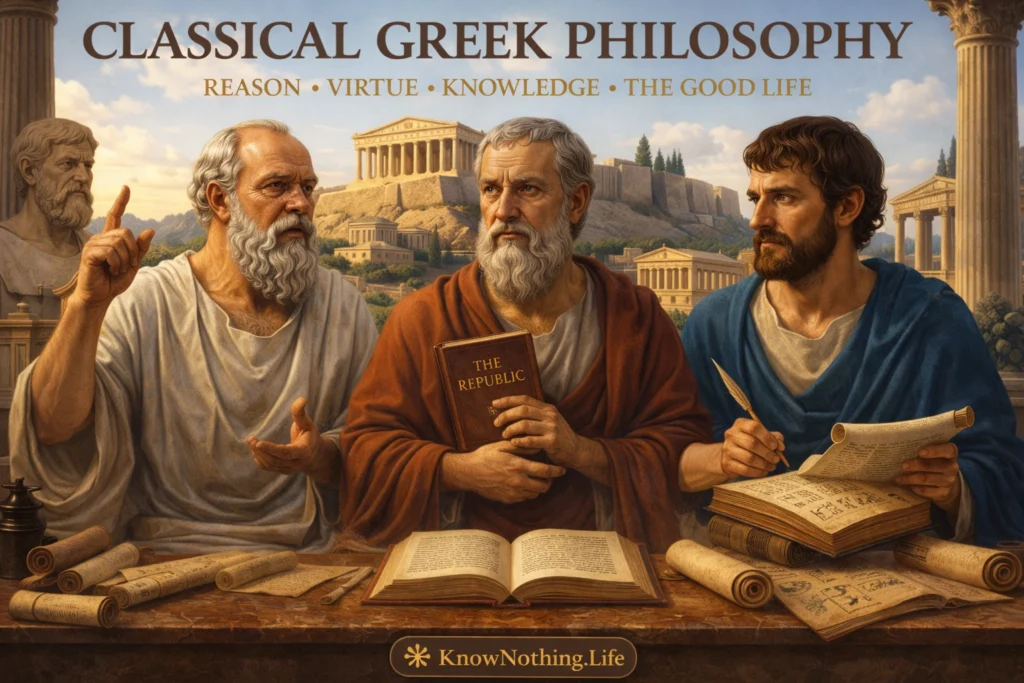
Classical Greek philosophy represents one of the most formative periods in the history of intellectual inquiry, establishing the foundations of Western thought through systematic reflection on ethics, politics, knowledge, and reality. Emerging in the 5th and 4th centuries BCE, this tradition marks a decisive shift from earlier natural philosophy toward questions concerning human life, moral responsibility, and the structure of society. At its center stand three towering figures—Socrates, Plato, and Aristotle—whose ideas continue to shape philosophical discourse.
What distinguishes classical Greek philosophy is its commitment to reasoned argument and dialogue. Rather than relying on myth or tradition, these thinkers sought to uncover truths through questioning, analysis, and debate. Their work not only addresses timeless questions about justice, knowledge, and the good life but also establishes the methods by which such questions can be explored. The legacy of this period lies in its synthesis of inquiry and practice, offering a vision of philosophy as both a theoretical and practical pursuit.
Socrates and the Ethical Turn
The figure of Socrates marks a turning point in Greek philosophy, redirecting attention from cosmological speculation to ethical inquiry. Unlike the Pre-Socratics, who focused on the nature of the physical world, Socrates is primarily concerned with how individuals ought to live. His method, preserved in the dialogues of Plato, involves questioning assumptions and exposing contradictions in commonly held beliefs. This process, known as the Socratic method, is designed to lead individuals toward clearer understanding.
Socrates’ philosophy is grounded in the belief that knowledge and virtue are intimately connected. He argues that wrongdoing arises from ignorance and that true knowledge leads to right action. His famous assertion, “The unexamined life is not worth living,” underscores the importance of self-reflection and critical inquiry. By encouraging individuals to question their beliefs and values, Socrates transforms philosophy into a practical endeavor aimed at moral improvement.
Despite his influence, Socrates’ life ends in controversy. Accused of corrupting the youth and impiety, he is sentenced to death by the Athenian state. His refusal to abandon his principles, even in the face of execution, becomes a powerful symbol of philosophical integrity. Through his life and death, Socrates establishes a model of the philosopher as a seeker of truth, committed to inquiry regardless of personal cost.
Plato and the Realm of Forms
Plato, a student of Socrates, develops a comprehensive philosophical system that addresses metaphysics, epistemology, and politics. In works such as The Republic, Plato explores the nature of justice, the structure of an ideal society, and the relationship between knowledge and reality. Central to his philosophy is the theory of Forms, which posits that the physical world is a shadow of a higher, unchanging reality composed of abstract entities.
According to Plato, true knowledge is not derived from sensory experience but from intellectual understanding of the Forms. This distinction between appearance and reality underlies his critique of conventional beliefs and his emphasis on philosophical education. The famous allegory of the cave illustrates this idea, depicting individuals as prisoners who mistake shadows for reality until they are guided toward the light of truth.
Plato’s political philosophy reflects his metaphysical commitments. He argues that a just society is one in which individuals fulfill roles suited to their abilities, guided by philosopher-kings who possess knowledge of the Forms. While this vision has been subject to criticism, it highlights Plato’s belief in the importance of wisdom and reason in governance. His work establishes enduring questions about the nature of justice, the role of education, and the relationship between knowledge and power.
Aristotle and the Empirical Approach
Aristotle, Plato’s student, offers a different approach that emphasizes empirical observation and practical reasoning. In contrast to Plato’s focus on abstract Forms, Aristotle argues that knowledge arises from studying the natural world. His works, including Nicomachean Ethics and Metaphysics, present a systematic framework for understanding reality, combining logic, science, and philosophy.
Aristotle’s ethical theory centers on the concept of virtue, defined as a mean between extremes. He argues that the goal of human life is eudaimonia, often translated as flourishing or well-being, which is achieved through the cultivation of virtuous habits. As he writes, “We are what we repeatedly do. Excellence, then, is not an act, but a habit.” This emphasis on practice and character distinguishes Aristotle’s approach from Plato’s more theoretical focus.
In addition to ethics, Aristotle makes significant contributions to logic, biology, and political theory. His classification of forms of government and his analysis of their strengths and weaknesses provide a practical framework for understanding political life. Aristotle’s work represents a culmination of classical Greek philosophy, integrating diverse areas of inquiry into a coherent and influential system.
Knowledge, Truth, and the Nature of Reality
A central concern of classical Greek philosophy is the nature of knowledge and truth. Socrates, Plato, and Aristotle each offer distinct approaches to these questions, reflecting broader debates about the relationship between reason and experience. Socrates emphasizes the importance of questioning and dialogue, suggesting that knowledge emerges through critical examination. Plato, by contrast, locates truth in the realm of Forms, accessible through intellectual insight rather than sensory perception.
Aristotle provides a more balanced approach, integrating reason and observation. He argues that knowledge begins with sensory experience but is refined through rational analysis. This synthesis allows for a more comprehensive understanding of reality, bridging the gap between abstract theory and empirical evidence. Aristotle’s approach anticipates later developments in scientific inquiry, emphasizing the importance of observation and classification.
These differing perspectives highlight the richness of classical Greek philosophy, demonstrating that the pursuit of knowledge involves multiple methods and approaches. The debates between these thinkers continue to influence philosophical discussions, shaping contemporary understandings of truth and inquiry.
Ethics, Politics, and the Good Life
Ethical and political questions are central to classical Greek philosophy, reflecting a concern with how individuals and societies can achieve a good and just life. Socrates’ emphasis on virtue and self-examination establishes a foundation for ethical inquiry, while Plato’s vision of the ideal state explores the relationship between individual and collective well-being.
Aristotle’s political philosophy builds on these ideas, examining different forms of government and their impact on human flourishing. He argues that the purpose of the state is to promote the good life for its citizens, emphasizing the importance of participation and civic responsibility. His analysis of democracy, oligarchy, and monarchy provides a framework for understanding political systems and their potential strengths and weaknesses.
The integration of ethics and politics in classical Greek philosophy reflects a holistic approach to human life. Rather than treating these domains as separate, these thinkers emphasize their interconnectedness, suggesting that personal virtue and social justice are mutually reinforcing. This perspective continues to inform contemporary debates about the role of individuals in society and the nature of political responsibility.
The Enduring Legacy of Classical Greek Philosophy
The influence of classical Greek philosophy extends far beyond its historical context, shaping the development of Western thought in profound ways. The methods of inquiry established by Socrates, the metaphysical frameworks developed by Plato, and the empirical approaches pioneered by Aristotle continue to inform philosophical, scientific, and political discourse.
The enduring significance of this tradition lies in its commitment to reason and its exploration of fundamental questions. By engaging with issues of knowledge, ethics, and governance, classical Greek philosophers provide a foundation for understanding the complexities of human life. Their work invites ongoing reflection, encouraging individuals to question assumptions and seek deeper understanding.
Ultimately, classical Greek philosophy represents more than a historical period; it is a living tradition that continues to inspire and challenge. Its emphasis on inquiry, dialogue, and the pursuit of truth remains central to the practice of philosophy, offering insights that are as relevant today as they were in ancient Athens.