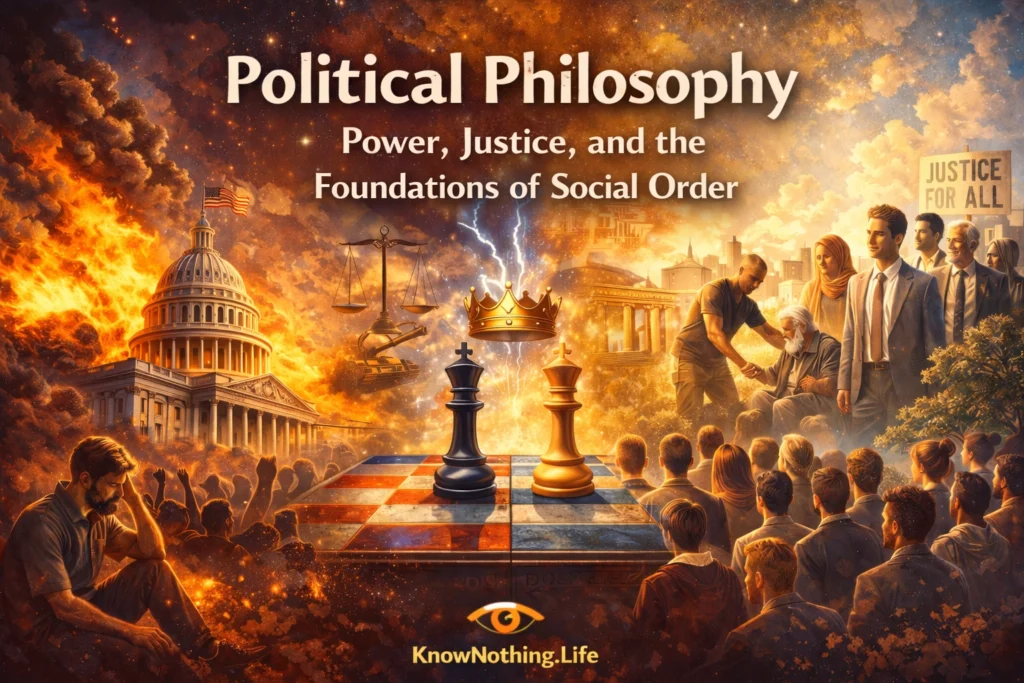
Political philosophy is the disciplined inquiry into the nature, legitimacy, and limits of power. It asks how societies should be organized, what justice demands, and why individuals ought to obey—or resist—authority. From the ancient city-states of Athens to modern liberal democracies, political philosophy has served as both a mirror and a critique of political life, shaping constitutions, revolutions, and the moral vocabulary through which citizens understand their rights and duties. It is not merely abstract speculation; it is a field whose ideas have repeatedly been translated into institutions, laws, and movements that define entire civilizations.
At its core, political philosophy grapples with enduring tensions: freedom versus order, equality versus hierarchy, individual rights versus collective goods. These tensions are not problems to be permanently solved but conditions to be navigated. Philosophers develop frameworks—often grounded in metaphysics, ethics, and human psychology—to interpret these conflicts and propose viable arrangements for living together. Whether in the social contract theories of the early modern period or contemporary debates about global justice, the field remains a living conversation about what it means to build a just political world.
Foundations in Ancient Thought
The roots of political philosophy are often traced to classical Greek thinkers, especially Plato and Aristotle, whose works continue to shape the discipline’s conceptual foundations. In The Republic, Plato constructs an ideal city governed by philosopher-kings, arguing that justice emerges when each part of society performs its proper role. His famous assertion that “Until philosophers rule as kings… cities will have no rest from evils” reflects a deep skepticism toward democratic governance and a belief in the authority of reason over opinion.
Aristotle, in contrast, offers a more empirical and pluralistic approach in Politics. He defines the human being as a “political animal,” suggesting that participation in civic life is intrinsic to human flourishing. Rather than seeking a single ideal regime, Aristotle analyzes different forms of government—monarchy, aristocracy, and polity—along with their corrupt counterparts. His emphasis on the middle class and the importance of balanced institutions anticipates later theories of constitutionalism and mixed government.
Beyond Greece, political philosophy also developed in parallel traditions. In ancient China, Confucius emphasized moral leadership and social harmony, while Han Feizi advocated strict laws and centralized authority. These contrasting perspectives illustrate that political philosophy has always been a global endeavor, shaped by diverse cultural and historical contexts rather than a single intellectual lineage.
Social Contract and the Birth of Modern Politics
The early modern period marks a decisive shift toward theories of political legitimacy grounded in individual consent. Thinkers such as Thomas Hobbes, John Locke, and Jean-Jacques Rousseau develop social contract theories that seek to explain why individuals would agree to form political societies. In Leviathan, Hobbes famously describes life in the state of nature as “solitary, poor, nasty, brutish, and short,” arguing that absolute sovereignty is necessary to escape perpetual conflict. For Hobbes, security is the primary justification of political authority.
Locke offers a more optimistic account in his Two Treatises of Government, grounding political authority in natural rights to life, liberty, and property. Governments exist to protect these rights, and when they fail, citizens retain the right to revolt. Locke’s ideas profoundly influenced the development of liberal democracy, particularly in the American Revolution, where his language of rights and consent became foundational to political legitimacy.
Rousseau, in The Social Contract, introduces the concept of the “general will,” arguing that true freedom consists in obedience to laws one has prescribed for oneself as part of a collective. His provocative claim that individuals may be “forced to be free” highlights the tension between individual autonomy and collective authority. Together, these thinkers redefine politics as a human creation grounded in agreement rather than divine mandate, setting the stage for modern democratic theory.
Justice, Equality, and the Modern State
In the twentieth century, political philosophy turns increasingly toward questions of distributive justice and the moral structure of institutions. John Rawls, in A Theory of Justice, proposes a vision of justice as fairness, grounded in the hypothetical “original position” behind a “veil of ignorance.” Rawls argues that rational individuals, unaware of their social status, would choose principles that guarantee equal basic liberties and benefit the least advantaged. His framework revitalizes normative political philosophy and becomes a central reference point for contemporary debates.
Critics such as Robert Nozick challenge Rawls’s emphasis on redistribution in Anarchy, State, and Utopia, defending a minimal state limited to protecting individual rights. Nozick’s libertarian perspective asserts that justice lies in the legitimacy of acquisition and transfer, not in patterned distributions of wealth. The tension between Rawls and Nozick reflects a broader ideological divide between egalitarian and libertarian conceptions of justice.
Other influential thinkers expand the conversation. Karl Marx critiques capitalism as a system of exploitation, arguing in Capital that economic structures shape political power and social relations. Meanwhile, Hannah Arendt explores the nature of authority and totalitarianism, warning in The Origins of Totalitarianism that modern political systems can erode individual freedom through bureaucratic domination. These diverse perspectives illustrate the richness and complexity of modern political thought.
Power, Authority, and Legitimacy
A central concern of political philosophy is the nature of power and its justification. What makes authority legitimate, and when is it right to resist it? Max Weber famously distinguishes between traditional, charismatic, and legal-rational forms of authority, emphasizing that legitimacy depends not only on force but on the belief in the rightfulness of rule. This insight shifts attention from formal institutions to the social and psychological foundations of political order.
Philosophers such as Michel Foucault challenge conventional understandings of power by arguing that it is diffuse, embedded in everyday practices and knowledge systems. In works like Discipline and Punish, Foucault shows how modern societies regulate behavior through surveillance and normalization rather than overt coercion. Power, in this view, is not merely possessed but exercised through networks of relationships that shape how individuals think and act.
The question of legitimacy also raises issues of resistance and civil disobedience. Thinkers such as Henry David Thoreau argue that individuals have a moral duty to oppose unjust laws, while later figures like Martin Luther King Jr. articulate a vision of nonviolent resistance grounded in justice and equality. These perspectives underscore that political philosophy is not only about justifying authority but also about defining the conditions under which it may be challenged.
Contemporary Debates and Global Perspectives
Today, political philosophy engages with an increasingly interconnected and complex world. Questions of global justice, environmental responsibility, and cultural diversity have expanded the scope of the field beyond the boundaries of the nation-state. Philosophers debate issues such as immigration, human rights, and climate change, seeking principles that can guide political action in a global context. The challenge is to reconcile universal moral claims with the realities of cultural and political pluralism.
Contemporary theorists also revisit earlier traditions in light of new concerns. Feminist political philosophy, for example, critiques the exclusion of women from canonical theories and emphasizes the role of power in shaping gender relations. Postcolonial thinkers examine how historical patterns of domination continue to influence global inequalities, calling for a rethinking of justice that accounts for colonial legacies. These approaches highlight the importance of including diverse voices and experiences in political theory.
At the same time, debates about democracy remain central. Scholars explore the strengths and weaknesses of representative institutions, the role of deliberation and public reason, and the impact of technology on political participation. The rise of digital communication and artificial intelligence introduces new questions about privacy, autonomy, and the nature of political agency. Political philosophy continues to evolve, responding to changing conditions while drawing on its rich intellectual heritage.
The Enduring Relevance of Political Philosophy
Political philosophy endures because the fundamental questions it addresses are inseparable from human life. Every society must decide how to distribute power, resolve conflicts, and define justice. While specific answers vary across time and place, the underlying concerns remain constant. As Aristotle observed, “Man is by nature a political animal,” and this insight captures the enduring relevance of the field: to live together is to engage in politics, whether consciously or not.
The discipline’s value lies not only in its answers but in its capacity to clarify problems and expand the range of possible solutions. By examining competing visions of justice, authority, and freedom, political philosophy equips individuals to think critically about their own societies and to imagine alternatives. It fosters a deeper understanding of the principles that govern collective life and encourages a reflective engagement with the structures that shape human experience.
In an era marked by rapid change and persistent conflict, political philosophy remains an essential tool for navigating uncertainty. It invites us to question assumptions, challenge injustices, and articulate visions of a better world. Whether through the idealism of Plato, the pragmatism of John Locke, or the critical insights of Michel Foucault, the tradition continues to offer resources for understanding and shaping the political realities we inhabit.