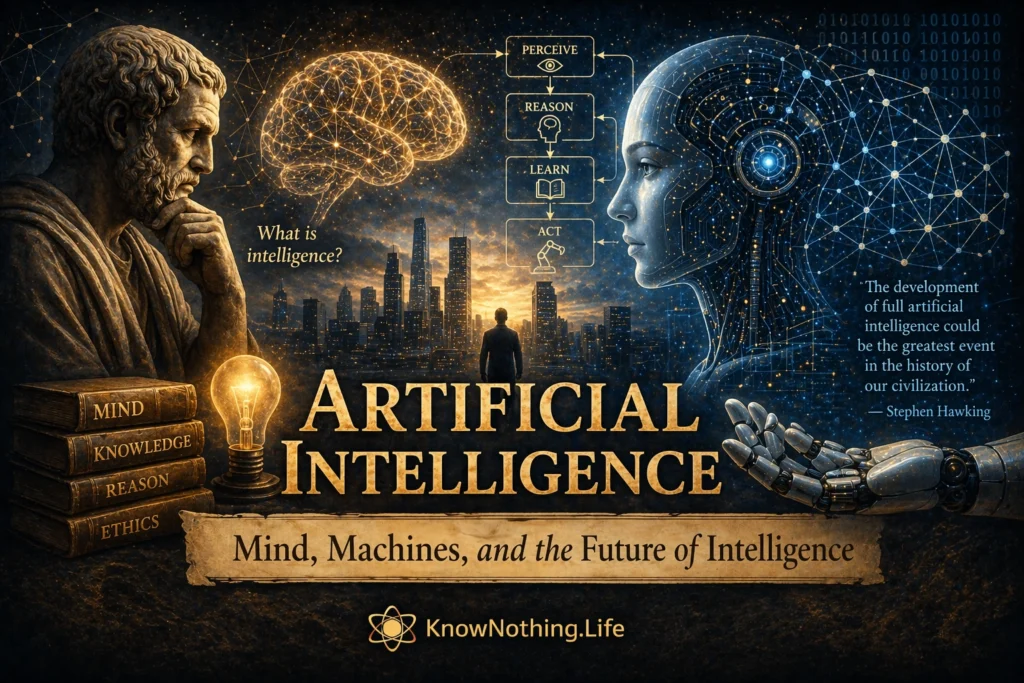
Artificial Intelligence (AI) has rapidly evolved from a theoretical concept into one of the most transformative forces shaping the modern world. At its core, AI refers to the creation of systems capable of performing tasks that typically require human intelligence—such as reasoning, learning, perception, and language use. Yet beyond its technical definition, AI raises profound philosophical questions about the nature of intelligence, the limits of computation, and the relationship between mind and machine.
The study of AI sits at the intersection of computer science, philosophy, and cognitive science. Early pioneers envisioned machines that could replicate human thought, while contemporary developments have produced systems capable of complex pattern recognition, decision-making, and even creative output. As AI continues to advance, it challenges traditional assumptions about what it means to think, understand, and be intelligent, prompting renewed inquiry into some of philosophy’s most enduring questions.
The Foundations of Artificial Intelligence
The conceptual foundations of AI can be traced to the idea that intelligence can be formalized and mechanized. Alan Turing played a pivotal role in this development, proposing that machines could, in principle, simulate any process of reasoning. His famous “Turing Test” suggested that if a machine’s responses are indistinguishable from those of a human, it could be considered intelligent.
This early vision led to the development of symbolic AI, which treated intelligence as the manipulation of symbols according to formal rules. Researchers sought to encode knowledge into logical systems, enabling machines to perform tasks such as theorem proving and problem-solving. While this approach achieved notable successes, it also encountered limitations, particularly in dealing with ambiguity, context, and real-world complexity.
In response, new approaches emerged, including machine learning and neural networks, which focus on learning from data rather than relying on explicit programming. These methods have driven recent advances in AI, allowing systems to recognize patterns, adapt to new information, and perform tasks that were once considered uniquely human.
Intelligence and Understanding
A central philosophical question in AI is whether machines can truly understand or merely simulate understanding. While AI systems can process language, recognize images, and generate responses, it remains unclear whether these capabilities constitute genuine comprehension or sophisticated imitation.
John Searle famously addressed this issue with his “Chinese Room” argument. He imagined a person inside a room manipulating Chinese symbols according to a set of rules, producing outputs that appear meaningful to external observers. Despite this, the person does not actually understand Chinese. Searle argued that similarly, a computer may process symbols without possessing real understanding or consciousness.
This argument challenges the idea that computation alone is sufficient for intelligence. It suggests that there may be aspects of human cognition—such as intentionality and subjective experience—that cannot be captured by purely formal systems. The debate continues, with some arguing that sufficiently advanced systems could achieve genuine understanding, while others maintain that there is a fundamental gap between simulation and reality.
AI and the Philosophy of Mind
Artificial intelligence is deeply connected to the philosophy of mind, particularly in discussions about consciousness and cognition. If the mind can be understood as a computational system, then it may be possible to replicate it in a machine. This view aligns with functionalism, which defines mental states in terms of their functional roles rather than their physical composition.
Philosophers such as Jerry Fodor have contributed to this perspective by proposing that the mind operates like a computer, manipulating symbols in a structured way. From this standpoint, the possibility of artificial minds seems plausible, as long as the appropriate functional organization can be achieved.
However, critics argue that this analogy overlooks the importance of embodiment and context. Human cognition is not confined to abstract symbol manipulation but is deeply rooted in sensory experience and interaction with the environment. This has led to alternative approaches that emphasize embodied and situated cognition, suggesting that true intelligence may require more than computational processes alone.
Ethics and Responsibility
As AI systems become more powerful and pervasive, ethical considerations have come to the forefront. Questions about responsibility, fairness, and the impact of AI on society are increasingly urgent. Who is accountable when an AI system makes a harmful decision? How can we ensure that algorithms do not perpetuate bias or inequality?
Ethicists and philosophers are grappling with these issues, drawing on traditional frameworks while adapting them to new technological contexts. The concept of moral agency is particularly relevant: can machines be held responsible for their actions, or does responsibility always lie with their creators and users? These questions challenge existing ethical theories and require careful consideration.
Privacy and surveillance are also major concerns. AI technologies enable the collection and analysis of vast amounts of data, raising questions about individual autonomy and the balance between security and freedom. Philosophers play a crucial role in examining these issues, helping to shape policies and practices that align with ethical principles.
AI, Creativity, and Human Identity
One of the most striking developments in AI is its ability to perform tasks traditionally associated with creativity, such as composing music, generating art, and writing text. This raises questions about the nature of creativity itself. Is creativity a uniquely human trait, or can it be replicated by machines?
Some argue that AI-generated works lack genuine creativity, as they are based on patterns learned from existing data rather than original insight. Others contend that creativity can be understood as the recombination of existing elements in novel ways, a process that machines are increasingly capable of performing. This debate challenges our understanding of artistic expression and the value we place on human creativity.
The rise of AI also prompts reflection on human identity. If machines can perform tasks that once defined human intelligence, what distinguishes us from them? This question has both philosophical and practical implications, influencing how we think about work, education, and the future of society.
The Future of Artificial Intelligence
Looking ahead, the development of AI raises both opportunities and uncertainties. Advances in machine learning, robotics, and natural language processing are likely to continue transforming industries and everyday life. At the same time, these developments bring new challenges, including the potential for job displacement, ethical dilemmas, and the need for effective regulation.
Philosophers are increasingly involved in shaping the discourse around AI, contributing to debates about its implications and guiding its development. By addressing fundamental questions about intelligence, consciousness, and ethics, they provide a framework for understanding the broader significance of AI.
The future of AI may also involve the integration of human and machine intelligence, through technologies such as brain-computer interfaces and augmented cognition. These possibilities blur the boundaries between human and artificial systems, raising new questions about identity, agency, and the nature of intelligence.
Conclusion
Artificial intelligence represents a profound shift in how we understand intelligence, technology, and the human condition. It challenges traditional distinctions between mind and machine, raising questions that extend far beyond technical considerations. From the foundational ideas of Alan Turing to contemporary debates about ethics and consciousness, AI continues to reshape both philosophy and society.
As we navigate this rapidly evolving landscape, the philosophy of AI provides essential tools for reflection and analysis. It helps us understand not only what machines can do, but what it means to think, create, and be human in an age of intelligent technology.