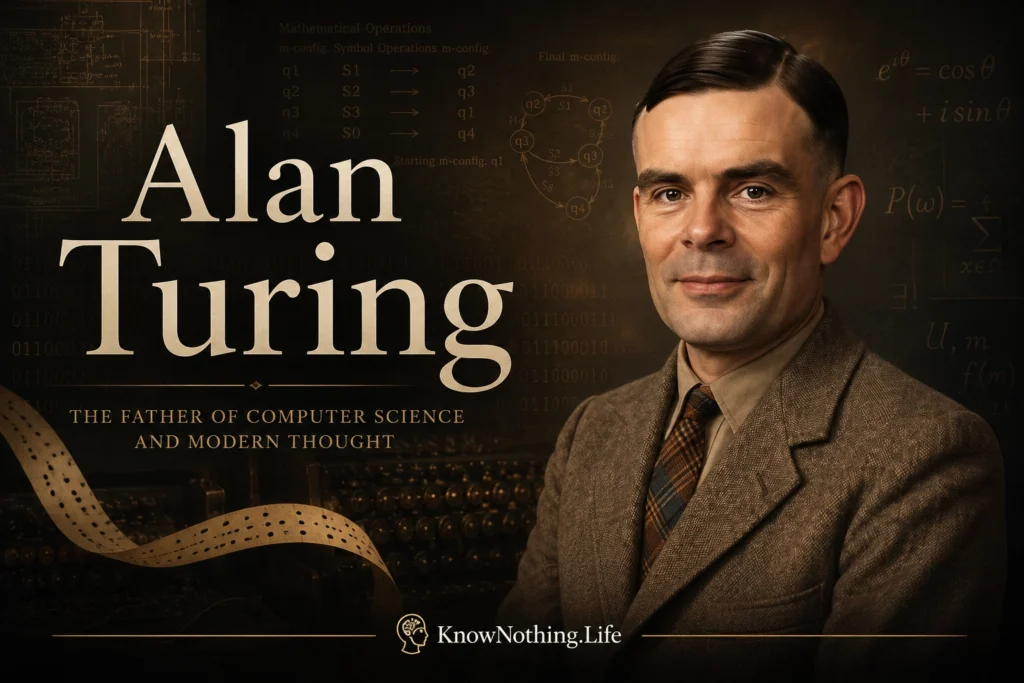
Alan Mathison Turing was born on June 23, 1912, in London, into a British family connected to imperial service and conventional education. From childhood, however, Turing’s mind moved in unconventional directions. He was fascinated by numbers, chemistry, machines, natural patterns, and the hidden order beneath ordinary experience. At Sherborne School, his scientific interests did not always fit the expectations of a classical English education, but his independence became one of the defining features of his life. Turing was never simply a disciplined calculator. He was an imaginative thinker who asked whether the processes of thought itself could be made exact.
A powerful emotional and intellectual event in his youth was his friendship with Christopher Morcom, a fellow student whose intelligence and companionship deeply affected him. Morcom’s death in 1930 left Turing shaken and intensified his interest in mind, matter, and whether consciousness could be explained scientifically. This combination of personal loss and mathematical curiosity helped shape the deepest questions of his career. Turing wanted to know what minds are, what machines can do, and where the limits of calculation lie.
Cambridge and the Problem of Computation
Turing entered King’s College, Cambridge, where he studied mathematics and found an intellectual home more suited to his originality. He graduated with distinction and was elected a Fellow of King’s in 1935. Around this time, mathematical logic was confronting one of its central problems: David Hilbert’s Entscheidungsproblem, or decision problem, which asked whether there could be a general mechanical method for deciding the truth of all mathematical statements in a formal system.
Turing’s answer came in his 1936 paper “On Computable Numbers, with an Application to the Entscheidungsproblem.” The paper introduced what later became known as the Turing machine: an abstract device that reads and writes symbols according to fixed rules. With astonishing clarity, Turing defined computation not by describing any existing physical machine, but by analyzing what a human computer does when following a procedure step by step. He showed that there are limits to what any such procedure can decide. In doing so, he helped create the theoretical foundation of computer science before modern computers existed.
The Universal Machine
One of Turing’s greatest ideas was the universal machine. Instead of imagining a separate machine for every possible calculation, he showed that one machine could imitate any other calculating machine if given the right instructions. This was a profound conceptual breakthrough. It meant that a single general-purpose device could be programmed to perform many different tasks. The modern computer, with software loaded into a general machine, descends directly from this insight.
The philosophical meaning was just as large. Turing had transformed “mechanical procedure” into a precise mathematical concept. He did not merely invent a clever model; he clarified the nature of algorithmic thinking. His work also showed that some problems are not merely unsolved, but unsolvable by any mechanical method. This boundary between the computable and the uncomputable remains central to mathematics, computer science, logic, and philosophy of mind.
Princeton and Mathematical Logic
After Cambridge, Turing went to Princeton University, where he studied under Alonzo Church and completed a Ph.D. in 1938. Church had independently developed the lambda calculus and reached related results about computability. Turing’s machine-based approach, however, gave the idea of effective procedure an especially intuitive and enduring form. At Princeton, Turing also worked on ordinal logics and explored how mathematical reasoning might extend beyond fixed formal systems.
This period deepened his technical power while keeping his imagination broad. Turing was never content with one result. He moved from computation to logic, from logic to machines, from machines to intelligence, and later from intelligence to biology. His mind crossed boundaries that academic departments often kept separate. That crossing became one of the reasons his work looks more contemporary with each passing decade.
Bletchley Park and the Enigma War
When the Second World War began, Turing joined the Government Code and Cypher School at Bletchley Park. There he became central to the British effort to break German encrypted communications, especially messages produced by the Enigma machine. Enigma was not a simple code but a complex electromechanical cipher system whose settings changed constantly. Breaking it required mathematical insight, practical engineering, disciplined teamwork, and relentless attention to operational detail.
Turing helped design the British bombe, an electromechanical machine that searched for Enigma settings using logical patterns in intercepted messages. Gordon Welchman’s diagonal board improved the bombe’s effectiveness, and large teams operated the machines as part of a vast secret intelligence system. Turing also worked on naval Enigma, one of the most urgent codebreaking problems because U-boats threatened Allied shipping in the Atlantic. His wartime work remained secret for years, but it was among the most consequential intellectual labor of the war.
Machines, Intelligence, and the Imitation Game
After the war, Turing turned toward the construction of real electronic computers. At the National Physical Laboratory, he wrote plans for the Automatic Computing Engine, one of the earliest detailed designs for a stored-program computer. Later, at the University of Manchester, he worked with early computing machinery and began thinking seriously about whether machines could display intelligence. His interests were never merely mechanical. He wanted to know what computation could reveal about thought.
In 1950, Turing published “Computing Machinery and Intelligence” in Mind, one of the most famous papers in modern philosophy. Instead of trying to define thinking directly, he proposed replacing the question “Can machines think?” with what he called the imitation game. If a machine could converse so convincingly that a human interrogator could not reliably distinguish it from a person, then the machine would deserve serious consideration as intelligent. Turing wrote that by the end of the century, ordinary language and educated opinion might change so much that people could speak of machines thinking “without expecting to be contradicted.”
The Turing Test and Its Meaning
The Turing Test, as it later came to be called, is often misunderstood as a simple trick of imitation. Turing’s deeper point was methodological. He wanted to move the debate about machine intelligence away from vague metaphysical objections and toward observable performance. Human beings already infer other minds from behavior, language, and interaction. Turing asked why machines should be excluded in advance if they could meet comparable standards.
The paper also shows Turing’s wit and caution. He did not claim that machines already possessed human consciousness, nor did he solve every question about mind. He opened a path. One of his memorable lines says, “We can only see a short distance ahead, but we can see plenty there that needs to be done.” That sentence captures the spirit of his later work: modest about prediction, bold about the work in front of us. Artificial intelligence, cognitive science, and philosophy of mind still live inside the space Turing opened.
Morphogenesis and Patterns in Nature
In the early 1950s, Turing made a surprising turn toward mathematical biology. His 1952 paper “The Chemical Basis of Morphogenesis” proposed a mathematical account of how patterns can arise in living organisms through interacting chemical processes. He was interested in how spots, stripes, spirals, and biological forms could emerge from relatively simple laws. This work is now recognized as pioneering in the study of pattern formation and developmental biology.
The shift from computers to living forms was not as abrupt as it looks. Turing’s whole career explored how complex order can arise from rule-governed processes. A calculation, a codebreaking machine, an intelligent response, and a biological pattern all invited the same deep question: how can something rich and surprising emerge from simple operations? Turing’s morphogenesis work shows that his legacy is not limited to computers. He was a theorist of organized complexity.
Persecution and Death
In 1952, Turing was prosecuted for homosexual conduct, then criminalized under British law. He was convicted of “gross indecency” and subjected to hormonal treatment as an alternative to imprisonment. The conviction also damaged his ability to continue certain classified work. The injustice was not incidental to his biography. It was a collision between one of the greatest minds of the century and a society whose laws punished his private life.
Turing died on June 7, 1954, at his home in Wilmslow, Cheshire, from cyanide poisoning. The death was ruled a suicide, though some later writers have questioned details of the case. What is not in doubt is that he died at only forty-one, after giving the world foundational ideas in computation, codebreaking, artificial intelligence, and mathematical biology. In 2013, he received a posthumous royal pardon, a symbolic recognition of the injustice done to him, though no pardon can undo the loss.
Legacy and Lasting Importance
Alan Turing’s legacy is immense because he helped define the modern world at its deepest technical and philosophical level. The Turing machine clarified computation. The universal machine anticipated the general-purpose computer. His wartime codebreaking helped turn encrypted signals into military intelligence. His 1950 paper shaped artificial intelligence. His work on morphogenesis opened a mathematical path into biological pattern formation. Few thinkers have touched so many fields so profoundly in such a short life.
Turing remains essential because he made the invisible logic of machines thinkable before machines transformed civilization. He asked where calculation ends, how intelligence might be recognized, and how order can emerge from rules. His life also stands as a moral warning: a society can depend on a person’s genius while refusing to protect his dignity. Alan Turing’s achievement belongs to mathematics, computing, philosophy, war history, biology, and human rights. His question still echoes through every computer and every debate about artificial intelligence: what can a machine do, and what does that tell us about ourselves?