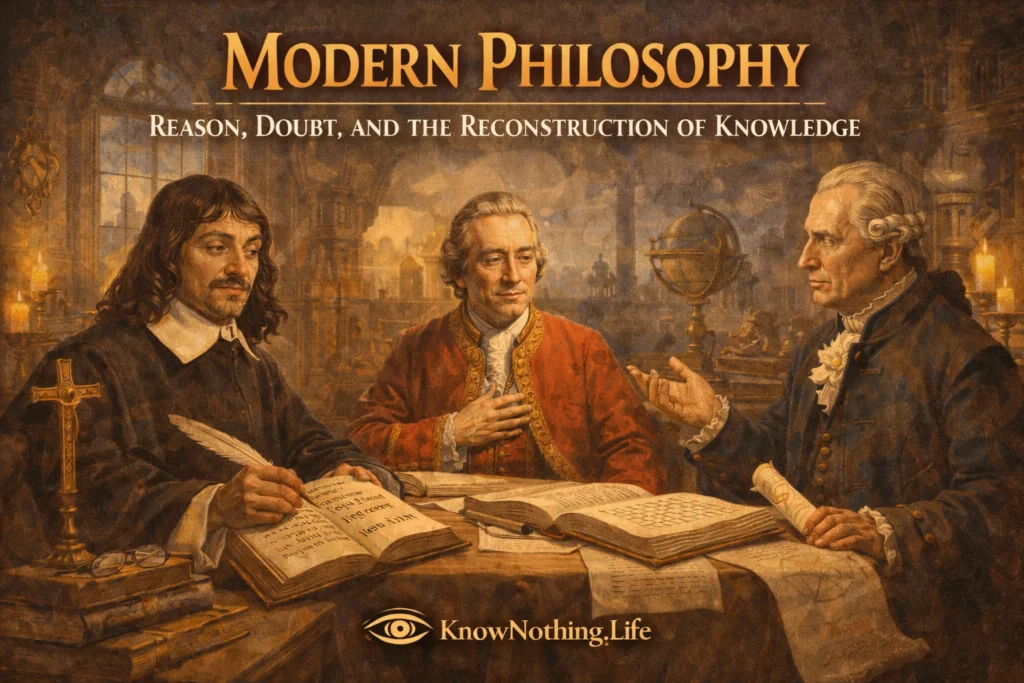
Modern philosophy marks a decisive turning point in the history of thought, emerging in the 17th century as philosophers sought new foundations for knowledge in a rapidly changing intellectual landscape. The scientific revolution, religious conflict, and the decline of medieval scholastic authority prompted thinkers to reconsider how truth could be known and justified. Rather than relying on tradition or inherited systems, modern philosophers emphasized individual reason, critical inquiry, and methodological skepticism.
At its core, modern philosophy is defined by a shift toward the subject—the thinking individual—as the starting point for understanding the world. Questions about knowledge, certainty, and the limits of human understanding take center stage, alongside enduring concerns about ethics, politics, and reality. This period produces some of the most influential figures in philosophical history, whose ideas continue to shape contemporary debates across disciplines.
Descartes and the Foundation of Rationalism
The beginning of modern philosophy is often associated with René Descartes, whose work Meditations on First Philosophy establishes a new method for philosophical inquiry. Descartes seeks certainty by systematically doubting all beliefs that can be questioned, including the evidence of the senses. Through this process, he arrives at the famous conclusion, “I think, therefore I am,” identifying the thinking self as the indubitable foundation of knowledge.
Descartes’ method reflects a commitment to rationalism, the view that reason is the primary source of knowledge. He argues that certain truths, such as mathematical principles and the existence of the self, can be known independently of experience. This emphasis on reason marks a departure from medieval reliance on authority and tradition, establishing a new paradigm for philosophical inquiry.
At the same time, Descartes grapples with the relationship between mind and body, proposing a dualistic framework in which the mind is a non-material substance distinct from the physical world. This mind-body problem becomes a central issue in modern philosophy, prompting further exploration by later thinkers and influencing debates in science and psychology.
Empiricism and the Role of Experience
In contrast to rationalism, empiricism emphasizes the role of sensory experience in the formation of knowledge. John Locke, in An Essay Concerning Human Understanding, argues that the mind begins as a blank slate, or tabula rasa, upon which experience writes. According to Locke, all knowledge is derived from observation and reflection, challenging the rationalist claim that certain ideas are innate.
Locke’s empiricism is further developed by George Berkeley, who questions the existence of material substance. In his work A Treatise Concerning the Principles of Human Knowledge, Berkeley argues that objects exist only as perceptions in the mind, encapsulated in the phrase “to be is to be perceived.” This radical view challenges assumptions about the nature of reality, emphasizing the role of perception in shaping experience.
David Hume pushes empiricism to its limits, questioning the basis of causation, identity, and even the self. In An Enquiry Concerning Human Understanding, Hume argues that our belief in cause and effect is based on habit rather than logical necessity. He famously observes that “reason is, and ought only to be the slave of the passions,” highlighting the limits of rationality and the influence of emotion in human life.
Kant and the Synthesis of Reason and Experience
The tension between rationalism and empiricism reaches a turning point in the philosophy of Immanuel Kant. In Critique of Pure Reason, Kant seeks to reconcile these opposing traditions by arguing that knowledge arises from the interaction between sensory experience and the structures of the mind. According to Kant, while experience provides the content of knowledge, the mind imposes forms and categories that shape how this content is understood.
Kant’s famous statement, “Thoughts without content are empty, intuitions without concepts are blind,” captures this synthesis. He argues that human knowledge is limited to phenomena—the world as it appears to us—while the underlying reality, or noumena, remains inaccessible. This distinction redefines the scope of philosophy, emphasizing the limits of human understanding.
In ethics, Kant develops a deontological framework based on the concept of duty and the categorical imperative. He argues that moral principles must be universal and grounded in reason, rather than contingent on consequences or desires. His work establishes a powerful foundation for modern moral philosophy, influencing debates about autonomy, rights, and responsibility.
Enlightenment Thought and Political Philosophy
Modern philosophy is closely tied to the Enlightenment, a period characterized by the promotion of reason, science, and individual liberty. Philosophers such as John Locke and Jean-Jacques Rousseau develop theories of political authority and social organization that challenge traditional hierarchies.
Locke’s theory of natural rights, articulated in Two Treatises of Government, argues that individuals possess inherent rights to life, liberty, and property. Government, in this view, derives its legitimacy from the consent of the governed and exists to protect these rights. This framework has a profound influence on modern democratic systems.
Rousseau, in The Social Contract, offers a different perspective, emphasizing the collective will of the people as the basis of political authority. He famously writes, “Man is born free, and everywhere he is in chains,” highlighting the tension between natural freedom and social constraints. These competing visions reflect broader debates about the nature of freedom, equality, and governance.
Nineteenth-Century Developments and Critiques
The nineteenth century sees significant transformations in modern philosophy, as thinkers respond to the challenges of industrialization, social change, and scientific progress. Georg Wilhelm Friedrich Hegel develops a dialectical approach to history, emphasizing the dynamic and evolving nature of ideas. His work influences a wide range of later thinkers, including Karl Marx.
Marx, in Capital, critiques the economic and social structures of capitalism, arguing that they produce inequality and exploitation. He famously states, “Philosophers have only interpreted the world… the point, however, is to change it,” emphasizing the practical implications of philosophical inquiry. His work represents a shift toward materialist and socially engaged philosophy.
At the same time, Friedrich Nietzsche challenges traditional moral and religious values, declaring “God is dead” and calling for a revaluation of values. Nietzsche’s emphasis on individuality, power, and creativity introduces existential themes that would later be developed in twentieth-century philosophy.
The Legacy of Modern Philosophy
Modern philosophy establishes many of the central frameworks that continue to shape contemporary thought. Its emphasis on reason, critical inquiry, and the limits of knowledge provides tools for understanding complex issues in science, politics, and ethics. The debates between rationalism and empiricism, the synthesis proposed by Kant, and the critiques of later thinkers all contribute to a rich and dynamic intellectual tradition.
The legacy of modern philosophy is also evident in its influence on institutions and cultural practices. Ideas about individual rights, democratic governance, and scientific method are deeply rooted in this period, shaping the modern world in profound ways. At the same time, the questions raised by modern philosophers—about knowledge, freedom, and the nature of reality—remain unresolved, inviting ongoing exploration.
Ultimately, modern philosophy represents a turning point in the history of thought, redefining how individuals approach the pursuit of knowledge and the organization of society. Its enduring significance lies in its commitment to questioning assumptions and seeking understanding through reasoned inquiry, a legacy that continues to inspire philosophical reflection today.