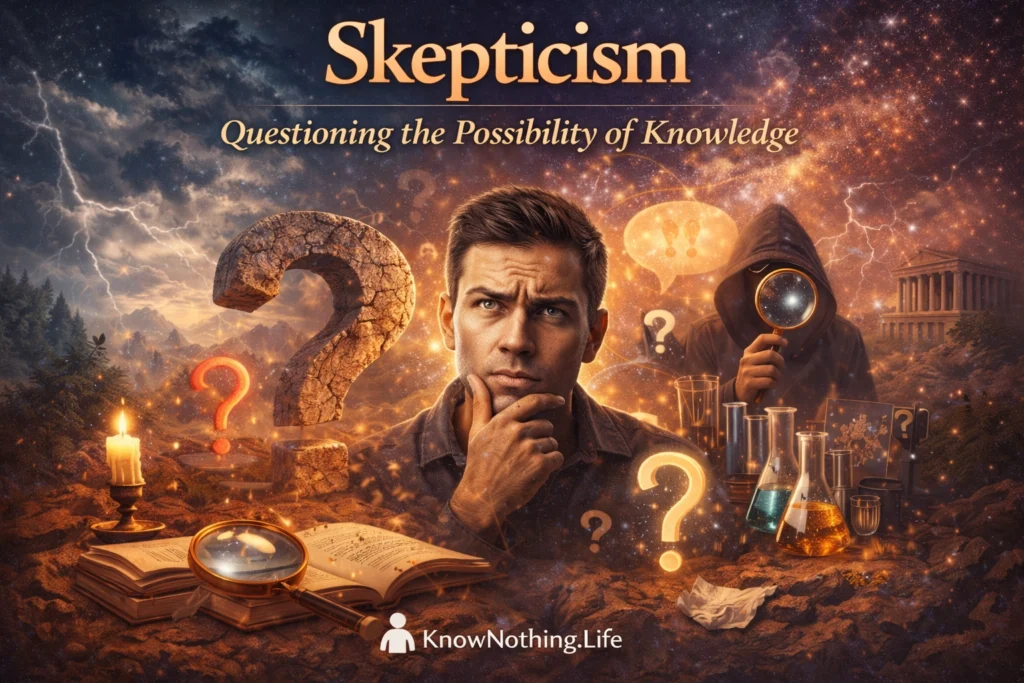
Skepticism is one of the most enduring and provocative traditions in philosophy, centered on the question of whether knowledge is possible at all. While many philosophical systems attempt to establish certainty, skepticism challenges these efforts by exposing the limits of human understanding. It asks whether our beliefs—about the external world, causation, the self, or even logic—can ever be justified with complete confidence.
Far from being a purely negative doctrine, skepticism plays a crucial role in philosophical inquiry. By questioning assumptions and demanding justification, it forces other theories to refine their claims and confront hidden weaknesses. Skepticism is not necessarily the denial of knowledge, but rather a method of critical examination that tests the strength of our beliefs.
The tradition of skepticism spans from ancient Greece to modern philosophy, with key figures including Pyrrho, Sextus Empiricus, René Descartes, and David Hume. Each offers a different form of skepticism, yet all share a common goal: to investigate the foundations of knowledge and determine whether certainty is truly attainable.
Ancient Skepticism and Pyrrhonism
The origins of skepticism can be traced to ancient Greece, particularly in the philosophy of Pyrrho. Pyrrho is associated with a form of skepticism that emphasizes epoché, or the suspension of judgment. According to this view, because we cannot know the true nature of things, we should refrain from making definitive claims about reality.
This approach was later systematized by Sextus Empiricus, whose works, such as Outlines of Pyrrhonism, provide a detailed account of skeptical arguments. Sextus argues that for any claim, an equally compelling counterargument can be presented, leading to a state of equilibrium that prevents certainty. The result is not despair, but tranquility, as the skeptic is freed from the anxiety of trying to attain absolute knowledge.
Ancient skepticism is thus both epistemological and practical. It challenges the possibility of knowledge while also offering a way of life grounded in intellectual humility. By suspending judgment, skeptics aim to achieve peace of mind, demonstrating that skepticism is not merely a theoretical position but a philosophical practice.
Cartesian Skepticism and Radical Doubt
In the modern era, skepticism took on a new form in the work of René Descartes. Unlike the ancient skeptics, Descartes did not embrace skepticism as a final position but used it as a method to establish certainty. In Meditations on First Philosophy, he introduces the method of radical doubt, systematically questioning all beliefs that could possibly be false.
Descartes famously considers the possibility that his senses are deceptive, that he may be dreaming, or even that an evil demon is manipulating his perceptions. These scenarios raise profound doubts about the reliability of sensory experience and the existence of the external world. By pushing skepticism to its limits, Descartes seeks to identify a belief that cannot be doubted.
This search leads him to the famous conclusion, “Cogito, ergo sum” (“I think, therefore I am”). Even if everything else is uncertain, the act of thinking itself confirms the existence of the thinker. Descartes uses this insight as a foundation for rebuilding knowledge, demonstrating how skepticism can serve as a tool for establishing certainty rather than undermining it entirely.
Humean Skepticism and Induction
David Hume offers one of the most influential forms of skepticism in modern philosophy, focusing on the problem of induction. In An Enquiry Concerning Human Understanding, Hume examines how we form beliefs about cause and effect, arguing that these beliefs are not grounded in reason but in habit.
According to Hume, we never directly perceive causation itself—only sequences of events. When we observe that one event consistently follows another, we infer a causal connection. However, this inference cannot be logically justified. There is no guarantee that the future will resemble the past, and thus no rational basis for expecting the same outcomes to occur.
Hume’s skepticism extends beyond causation to challenge the foundations of science and everyday reasoning. As he writes, “All reasonings concerning matters of fact seem to be founded on the relation of cause and effect.” Yet if this relation cannot be justified, then much of what we consider knowledge rests on uncertain grounds. Hume’s work reveals the limits of empirical knowledge and highlights the role of psychological factors in shaping belief.
Skepticism About the External World
One of the most persistent forms of skepticism concerns the existence of the external world. How can we be certain that the world we perceive is real, rather than an illusion or simulation? This question has been explored in various forms, from Descartes’ evil demon to modern thought experiments such as the “brain in a vat.”
These scenarios challenge the assumption that perception provides reliable access to reality. If our experiences could be produced by external manipulation, then our beliefs about the world might be fundamentally mistaken. This form of skepticism raises deep questions about the relationship between perception and reality, as well as the limits of human knowledge.
Philosophers have responded to this challenge in different ways. Some argue that skepticism sets an impossibly high standard for knowledge, requiring absolute certainty where practical reliability is sufficient. Others attempt to refute skepticism by demonstrating that certain beliefs—such as the existence of the external world—are more justified than the skeptical hypotheses that challenge them.
Responses to Skepticism
The challenge of skepticism has prompted a wide range of philosophical responses. One approach is foundationalism, which seeks to establish secure starting points for knowledge. René Descartes’ cogito is an example of this strategy, providing a belief that cannot be doubted.
Another response is contextualism, which suggests that the standards for knowledge vary depending on the context. In everyday situations, we may reasonably claim to know things, even if those claims would not meet the strict standards imposed by skepticism. This approach allows for practical knowledge while acknowledging the force of skeptical arguments.
Pragmatism offers a different perspective, emphasizing the usefulness of beliefs rather than their absolute certainty. From this viewpoint, knowledge is not about achieving perfect certainty but about forming beliefs that work effectively in guiding action. This shift reflects a more flexible understanding of knowledge, one that accommodates uncertainty without abandoning inquiry.
The Role of Skepticism in Philosophy
Despite its challenges, skepticism plays a vital role in the development of philosophical thought. By questioning assumptions and exposing weaknesses, it drives the search for more robust theories of knowledge. Skepticism forces philosophers to clarify their concepts, refine their arguments, and justify their claims more rigorously.
Skepticism also encourages intellectual humility. By recognizing the limits of human knowledge, it reminds us that certainty is often elusive and that our beliefs may be subject to revision. This perspective fosters a more critical and reflective approach to knowledge, one that values inquiry over dogmatism.
At the same time, skepticism highlights the tension between doubt and belief. While complete skepticism may be difficult to sustain in practice, its challenges cannot be easily dismissed. The ongoing engagement with skepticism reflects its enduring significance as both a philosophical problem and a methodological tool.
Conclusion
Skepticism stands as one of the most powerful and enduring challenges in epistemology. From the ancient skepticism of Pyrrho to the modern analyses of David Hume, it has continually questioned the possibility of knowledge and the reliability of human cognition.
Rather than undermining philosophy, skepticism has enriched it by forcing deeper reflection on the nature of belief, justification, and truth. It reveals that knowledge is not a simple or straightforward concept, but one that requires careful examination and constant reevaluation.
As Sextus Empiricus observed, “We do not deny what we feel, but we suspend judgment about what we think.” This balance between doubt and experience captures the essence of skepticism: a commitment to questioning that ultimately deepens our understanding of knowledge itself.