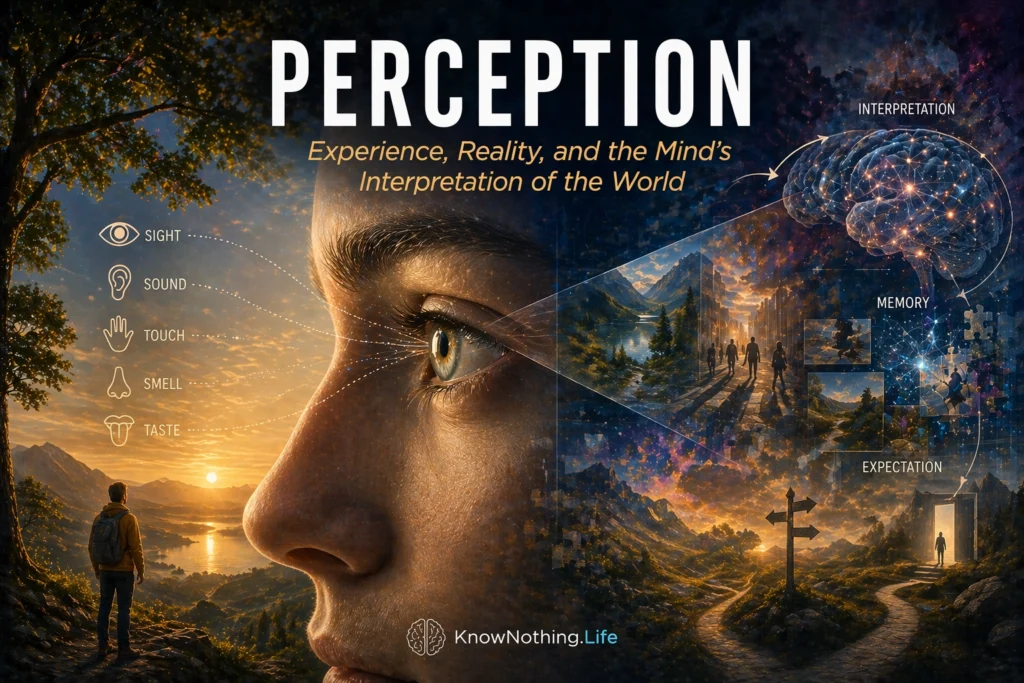
Perception is the primary means by which human beings encounter the world. Through sight, sound, touch, taste, and smell, individuals gain access to their environment, forming the basis of knowledge, action, and experience. Yet perception is not a simple or transparent process. It does not merely present the world as it is; it interprets, organizes, and sometimes distorts what is given. This raises a central philosophical question: do we perceive reality directly, or do we experience a constructed version shaped by the mind?
The philosophy of perception examines the nature of sensory experience and its relationship to the external world. It explores how perceptual processes work, what they reveal about reality, and how they can be trusted as sources of knowledge. By analyzing perception, philosophers address broader issues in epistemology and metaphysics, including the nature of truth, the limits of knowledge, and the relationship between mind and world. Understanding perception is thus essential for understanding how human beings make sense of their existence.
Historical Foundations of Perception
Philosophical inquiry into perception dates back to ancient Greece, where early thinkers sought to explain how the mind interacts with the world. Plato famously questioned the reliability of perception, suggesting that sensory experience can be deceptive. In his allegory of the cave, he described ordinary perception as a shadow of true reality, emphasizing the role of reason in achieving genuine knowledge. This skepticism toward the senses set the stage for ongoing debates about the trustworthiness of perception.
Aristotle offered a more balanced account, viewing perception as a natural process through which the mind receives information from the world. While acknowledging its limitations, Aristotle emphasized the role of the senses in acquiring knowledge, integrating perception into a broader framework of empirical inquiry. This perspective laid the groundwork for later philosophical traditions that value sensory experience as a source of understanding.
In the early modern period, philosophers revisited these questions with renewed intensity. René Descartes expressed doubt about the reliability of perception, arguing that sensory experiences can be misleading. In contrast, empiricists such as John Locke emphasized the importance of sensory input in forming ideas, suggesting that knowledge arises from experience. These differing views highlight the enduring tension between skepticism and empiricism in the philosophy of perception.
Direct and Indirect Realism
A central debate in the philosophy of perception concerns whether we perceive the world directly or through intermediary representations. Direct realism, also known as naïve realism, holds that perception provides immediate access to external objects. According to this view, when we see a tree, we are directly aware of the tree itself, not a mental representation of it. This perspective aligns with common sense, suggesting that perception connects us straightforwardly with reality.
Indirect realism, on the other hand, argues that perception is mediated by mental representations. According to this view, we do not perceive objects directly but rather experience internal representations caused by those objects. This approach accounts for phenomena such as illusions and hallucinations, where perception does not accurately reflect the external world. By emphasizing the role of mental processes, indirect realism highlights the complexity of perceptual experience.
Philosophers such as George Berkeley took this idea further, arguing that perception is fundamentally mental and that the existence of objects depends on being perceived. While this idealist perspective is controversial, it underscores the importance of examining the relationship between perception and reality. The debate between direct and indirect realism remains central to understanding how perception connects the mind to the world.
Perception and the Construction of Experience
Modern philosophy and science increasingly view perception as an active process of construction rather than passive reception. The mind does not simply record sensory data; it organizes and interprets it, creating a coherent experience of the world. This perspective is influenced by the work of Immanuel Kant, who argued that the mind imposes structure on sensory input through innate categories.
Contemporary cognitive science supports this view, showing that perception involves complex interactions between sensory information and prior knowledge. The brain uses expectations and context to interpret incoming data, often filling in gaps and resolving ambiguities. This process allows individuals to navigate the world efficiently but also introduces the possibility of error and distortion.
The constructive nature of perception raises important philosophical questions. If perception is shaped by the mind, to what extent does it reflect reality? Are we ever able to access the world as it truly is, or are we limited to our interpretations? These questions challenge the assumption that perception provides a transparent window onto reality, suggesting instead that it is a mediated and interpretive process.
Illusion, Error, and Skepticism
The existence of perceptual illusions and errors poses a significant challenge to the reliability of perception. Illusions demonstrate that sensory experience can be misleading, presenting objects in ways that do not correspond to reality. For example, a straight stick may appear bent in water, or a stationary object may seem to move under certain conditions. These phenomena raise doubts about the accuracy of perception.
Philosophical skepticism builds on these observations, questioning whether perception can provide genuine knowledge. If the senses can deceive, how can we be certain that our experiences reflect the external world? René Descartes famously explored this question, suggesting that it is possible to doubt all sensory experience. This radical skepticism challenges the foundations of knowledge, forcing philosophers to consider how certainty can be achieved.
Responses to skepticism often involve distinguishing between ordinary errors and systematic deception. While perception can be mistaken in specific cases, it may still be reliable overall. By examining the conditions under which perception succeeds or fails, philosophers seek to establish a more nuanced understanding of its reliability. This approach acknowledges the limitations of perception while preserving its role as a source of knowledge.
Perception, Consciousness, and Subjectivity
Perception is closely linked to consciousness, as it involves the subjective experience of sensory input. The way individuals perceive the world is influenced by their perspectives, emotions, and prior experiences, making perception inherently subjective. This subjectivity raises questions about the relationship between individual experience and objective reality.
Philosophers such as Thomas Nagel have emphasized the difficulty of understanding subjective experience from an external perspective. His famous question, “What is it like to be a bat?” highlights the challenge of accessing another being’s perceptual world. This problem underscores the limits of objective analysis in capturing the full richness of perception.
At the same time, perception is not entirely subjective. Shared sensory experiences allow for communication and agreement about the world, suggesting that there is a common structure underlying perception. The interplay between subjectivity and objectivity is a central theme in the philosophy of perception, reflecting the complexity of human experience.
Perception in Contemporary Thought
In modern philosophy and science, the study of perception has become increasingly interdisciplinary. Neuroscience, psychology, and artificial intelligence contribute to a deeper understanding of how perceptual processes operate. These fields provide empirical evidence about the brain’s role in processing sensory information, revealing the mechanisms underlying perception.
Advances in technology have also influenced philosophical discussions, particularly in relation to virtual reality and artificial perception. These developments challenge traditional assumptions about the relationship between perception and reality, raising questions about the nature of experience in artificial environments. As technology evolves, the boundaries between perception and simulation become increasingly blurred.
Despite these advances, many philosophical questions about perception remain unresolved. The relationship between mind and world, the nature of subjective experience, and the limits of knowledge continue to be topics of debate. This ongoing inquiry reflects the enduring importance of perception as a subject of philosophical exploration.
Conclusion
Perception is a complex and multifaceted process that lies at the foundation of human experience. It connects individuals to the world while also shaping how that world is understood. Philosophical inquiry reveals that perception is not a simple reflection of reality but an active and interpretive process, influenced by both sensory input and mental structure.
The study of perception highlights the tension between trust and skepticism, objectivity and subjectivity, reality and representation. By examining these tensions, philosophers seek to understand the nature of knowledge and the limits of human understanding. Perception, in this sense, is not only a topic of study but a gateway to broader philosophical questions.
Ultimately, the philosophy of perception invites a deeper reflection on how individuals experience the world. It challenges assumptions about what is seen and known, encouraging a more critical and nuanced understanding of reality. Through this exploration, perception emerges as both a source of insight and a subject of ongoing inquiry.