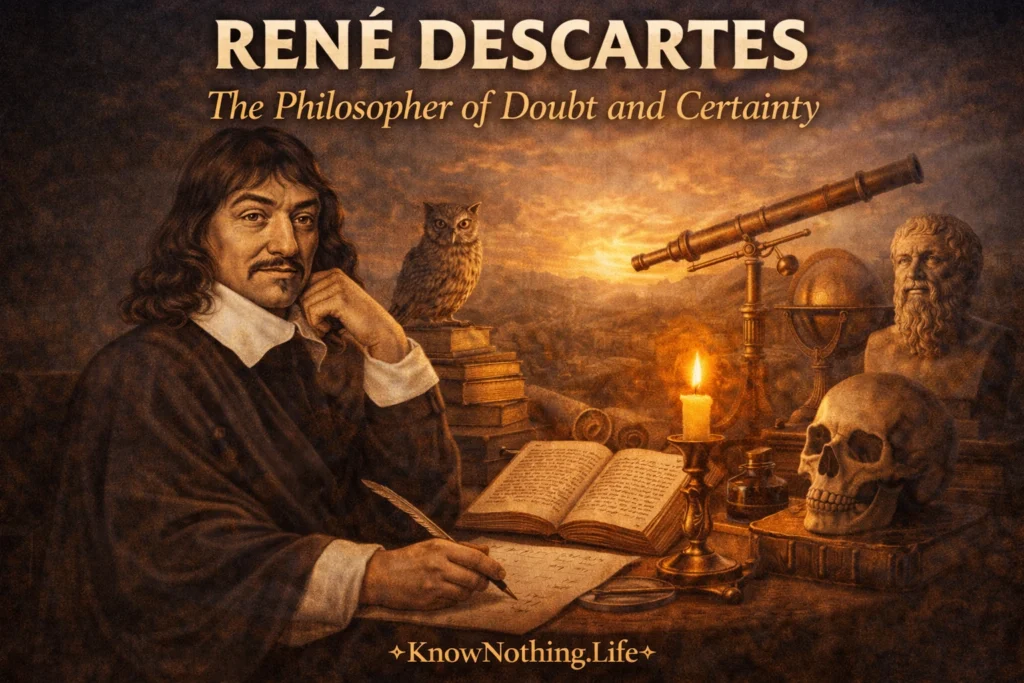
The intellectual revolution that reshaped Europe in the 17th century found one of its clearest voices in René Descartes. Often called the “father of modern philosophy,” Descartes sought to rebuild human knowledge from the ground up, rejecting inherited assumptions and demanding absolute certainty. His work represents a decisive break from medieval scholasticism, replacing reliance on authority with a method grounded in reason and systematic doubt.
Born in 1596 in La Haye en Touraine (now renamed Descartes in his honor), he lived during a period of rapid scientific transformation. The rise of figures like Galileo Galilei challenged traditional views of the cosmos, while new mathematical tools offered unprecedented precision. Within this environment, Descartes aimed to create a unified system of knowledge that could withstand skepticism and provide a secure foundation for science, philosophy, and human understanding.
Early Life and Intellectual Formation
Descartes was born into a minor noble family and received a rigorous education at the Jesuit college of La Flèche, one of the most prestigious institutions in Europe. There, he was exposed to classical philosophy, mathematics, and the emerging scientific ideas of the time. While he excelled academically, he grew dissatisfied with the uncertainty and contradictions he perceived in traditional learning. This early disillusionment would later motivate his search for indubitable truth.
After completing his education, Descartes spent several years traveling across Europe, serving in various military campaigns and immersing himself in different intellectual environments. These experiences broadened his perspective and reinforced his belief that knowledge should not depend on tradition or geography, but on universal principles accessible to reason. During this period, he began developing the ideas that would define his philosophical project.
A pivotal moment in his life reportedly occurred in 1619, when he experienced a series of vivid dreams that he interpreted as a revelation of his life’s mission: to establish a new method for acquiring knowledge. Whether taken literally or symbolically, this episode reflects the intensity of his commitment to intellectual clarity and certainty.
Method of Doubt and the Search for Certainty
At the heart of Descartes’ philosophy lies his method of doubt, a radical approach that begins by questioning everything that can possibly be doubted. Rather than accepting beliefs at face value, he systematically dismantled them, seeking a foundation that could not be shaken by skepticism. This process is most famously articulated in Meditations on First Philosophy.
Descartes doubted the reliability of the senses, noting that they can deceive us. He extended this doubt further, considering the possibility that even mathematical truths could be manipulated by a powerful deceiver. This extreme skepticism was not an end in itself, but a means of clearing away uncertainty to reveal something absolutely certain. In doing so, he arrived at one of the most famous conclusions in philosophy: “Cogito, ergo sum” (“I think, therefore I am”).
This statement represents a turning point in philosophical thought. Even if everything else is doubted, the very act of doubting confirms the existence of the thinker. From this single certainty, Descartes began reconstructing knowledge, arguing that clear and distinct ideas—those perceived with absolute clarity—could serve as the basis for truth. His method laid the groundwork for rationalism, emphasizing reason as the primary source of knowledge.
Major Works and Contributions
Descartes’ philosophical and scientific contributions are preserved in several key works, each addressing different aspects of his intellectual project. Among the most influential is Discourse on the Method, published in 1637. Written in French rather than Latin, it was intended for a broader audience and outlines his approach to reasoning, emphasizing simplicity, clarity, and systematic analysis.
In Meditations on First Philosophy, Descartes explores metaphysical questions, including the existence of God and the nature of the mind and body. He argues that the idea of a perfect being could not originate from an imperfect mind, leading him to conclude that God must exist. This conclusion plays a crucial role in his system, as it guarantees the reliability of clear and distinct perceptions.
Beyond philosophy, Descartes made groundbreaking contributions to mathematics. His development of analytic geometry, presented in La Géométrie, introduced the Cartesian coordinate system—a framework that allows geometric shapes to be expressed algebraically. This innovation bridged the gap between algebra and geometry, fundamentally transforming mathematics and enabling advances in physics and engineering.
Mind-Body Dualism
One of Descartes’ most influential—and controversial—ideas is his theory of mind-body dualism. According to this view, reality consists of two fundamentally different substances: the mind (res cogitans), which is non-physical and capable of thought, and the body (res extensa), which is physical and governed by mechanical laws.
This distinction allowed Descartes to reconcile scientific explanations of the physical world with the existence of consciousness and free will. By treating the body as a machine, he aligned with the emerging scientific perspective, while preserving the autonomy of the mind. However, this separation also raised difficult questions about how the two interact—a problem that continues to be debated in philosophy and neuroscience.
Descartes proposed that the interaction between mind and body occurs in the pineal gland, a small structure in the brain. While this specific claim has been rejected by modern science, the broader issue of how mental and physical processes relate remains central to contemporary discussions of consciousness.
Quotes and Key Ideas
Descartes’ writings contain some of the most enduring statements in philosophical history. Among his most notable quotes:
- “Cogito, ergo sum” (“I think, therefore I am.”)
- “It is not enough to have a good mind; the main thing is to use it well.”
- “Divide each difficulty into as many parts as is feasible and necessary to resolve it.”
- “Conquer yourself rather than the world.”
These quotes reflect the core principles of his philosophy: the primacy of thought, the importance of method, and the value of intellectual discipline. They emphasize that knowledge is not merely a matter of possessing information, but of applying reason effectively.
His key ideas—methodical doubt, the cogito, and dualism—continue to influence fields ranging from philosophy and psychology to computer science and artificial intelligence. They represent a shift toward introspection and analytical thinking that defines modern intellectual life.
Later Life and Death
In his later years, Descartes sought a quieter life dedicated to writing and reflection. He spent much of his time in the Dutch Republic, where intellectual freedom allowed him to pursue his work without interference. During this period, he published many of his major works and engaged in correspondence with other leading thinkers.
In 1649, he accepted an invitation from Queen Christina of Sweden to join her court in Stockholm. The move proved challenging, as the harsh climate and demanding schedule disrupted his routine. Within months, Descartes fell ill, likely with pneumonia, and died in 1650 at the age of 53.
Despite his relatively short life, his impact was immense. His ideas spread rapidly across Europe, influencing both supporters and critics. The debates he initiated helped shape the development of modern philosophy and science, ensuring that his legacy would endure.
Legacy and Influence
Descartes’ influence extends far beyond his own era, shaping the trajectory of modern thought in profound ways. As a central figure in rationalism, he inspired philosophers such as Baruch Spinoza and Gottfried Wilhelm Leibniz, who expanded and challenged his ideas. At the same time, empiricists like John Locke and David Hume responded critically, creating a dynamic dialogue that defined early modern philosophy.
In science, his emphasis on mathematical description and mechanical explanation contributed to the development of physics and engineering. The Cartesian coordinate system remains a fundamental tool in mathematics, used in everything from basic graphing to advanced physics simulations. His method of breaking problems into smaller parts continues to influence scientific and analytical thinking.
Perhaps most importantly, Descartes shifted the focus of philosophy inward, emphasizing the role of the subject in constructing knowledge. This move laid the groundwork for later developments in epistemology, psychology, and even existentialism. His insistence on certainty and clarity remains a guiding principle for intellectual inquiry.
Conclusion
René Descartes stands as a pivotal figure in the transition from medieval to modern thought. Through his method of doubt, he challenged assumptions that had gone unquestioned for centuries, seeking a foundation for knowledge that could withstand even the most radical skepticism. His discovery of the cogito provided that foundation, establishing the thinking self as the starting point for philosophy.
His contributions to mathematics, metaphysics, and science demonstrate a rare combination of analytical rigor and creative insight. While some of his ideas have been revised or rejected, the questions he raised continue to shape intellectual discourse. In a world often marked by uncertainty, Descartes’ pursuit of clarity and certainty offers a model for disciplined inquiry and critical thinking.
To engage with Descartes is to confront the fundamental challenge of philosophy: how to know anything with certainty. His answer—begin with doubt, and build from what cannot be denied—remains one of the most powerful approaches ever proposed.